Thank You For Your Service: Five LGBT Veterans Who Helped Change The World

Thank You For Your Service: Five LGBT Veterans Who Helped Change The World

Happy Memorial Day.

Today we honor and remember military personnel who served their country, particularly those who died in battle or as a result of wounds sustained in battle. (Not to be confused with Veterans Day, which honors all soldiers who have served our country.)

Scroll down to read about five famous LGBT army veterans from decades past, and add more to the list in the comments section below…

von-steuben-by-ralph-earl

Baron Frederick von Steuben

Though Prussian by birth, Frederick von Steuben trained George Washington’s Colonial Army and was invaluable in helping them defeat the better equipped and trained British troops. The Baron arrived in the Colonies in September 1777, with his young aide de camp, Louis de Pontière, and their prized Italian greyhound, Azor. Steuben developed a model company of 120 men, who in turn trained others. As part of his technique, the Baron would don full military dress and upbraid the troops in French and German. (He eventually recruited a captain to curse at them in English.) The Baron was often described as “eccentric”and “flamboyant,” which was essentialy Colonial-era lingo for “gay.” Despite this–or more likely, because of this–he still managed to become one of the great heroes of the Revolutionary War.


Dooley

Thomas A. Dooley

While serving as a physician in the U.S. Navy in the 1950s, Dooley, a celebrated doctor and humanitarian, was investigated by the Navy and forced to resign his commission. Despite being fired, he remained in Southeast Asia, tending to the forgotten victims of war and building hospitals through the Medical International Cooperation Organization. After he died of cancer at just 34, Dooley’s legacy was later enshrined by President John F. Kennedy, who cited the doctor’s example when he launched the Peace Corps. Dooley was also posthumously awarded a Congressional Gold Medal.

Fannie-Mae-Clackum-600x469

(Female members of the Women Airforce Service Pilots, a.k.a WASPs)

Cpls Fannie Mae Clackum and Grace Garner

Though hardly the first people forced out of the military for being gay, Fannie Mae Clackum and Grace Garner, U.S. Air Force reservists in the late 1940s and early 1950s, were the first to successfully challenge their discharge. When the two women were suspected of being lesbians, the Office of Special Investigations essentially entrapped the pair, giving the Air Force cause to issue dishonorable discharges to both in 1952. But they refused to accept the discharges and demanded their case be brought to a courtmartial. Eight years later, the pair won their suit: the courts vacated the discharge and awarded them back pay.

Matlovich_time_cover-360x474

Sgt. Leonard Matlovich

Vietnam vet Sgt. Leonard Matlovich was the first gay man to disclose his sexual orientation in the military while serving in the U.S. Air Force. His photograph, along with the headline “I Am a Homosexual,” appeared on the cover of the September 8, 1975 edition of Time. In addition to being one of the first openly gay American soldiers, Matlovich was also the first to appear on the cover of an American news magazine.

Graham Gremore

feedproxy.google.com/~r/queerty2/~3/61gcJAf9iYI/thank-you-for-your-service-five-lgbt-veterans-who-helped-change-the-world-20150525

'Game Of Thrones' Just Had One Of Its Most Impressive Episodes

'Game Of Thrones' Just Had One Of Its Most Impressive Episodes
A good “Game of Thrones” episode can be a lot of things. It can be one that triggers a powerful, emotional reaction for a beloved character, one that stuns its audience with a shocking death, or even an episode that spends the entire hour depicting an epic battle.

Spoiler alert for Season 5 Episode 7 “The Gift”

tv show gifs
Image via HBO/HuffPost

But Sunday night’s “Game of Thrones” was one of the most well-written, well-sculpted episodes of the entire series. Episode 7 of Season 5, “The Gift,” was fantastic for weaving together so many plots with various tones. The episode honored the passing of a cherished character (RIP Aemon Targaryen), showcased the courage of others, served up some of the best dialogue between rivals (all the awards for Olenna Tyrell), incited long-awaited romance, and best of all, served up delicious justice. That alone is a lot for merely half a season of “GoT,” but “The Gift” managed to cohesively pack it all in with smooth directing and poignant writing that still didn’t fall short on the nudity and violence. Here were the highlights:

Cersei got what was coming to her
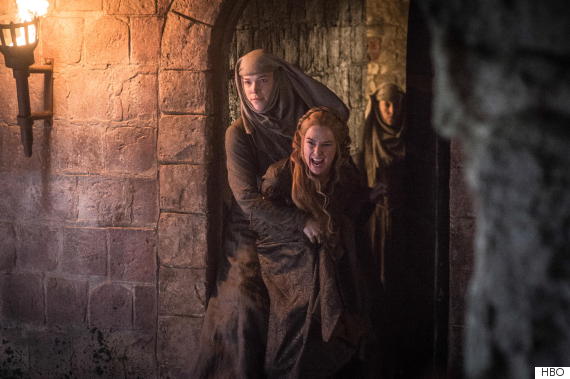
Finally the queen of manipulating and backstabbing was served up a hot steaming plate of justice when the High Sparrow locked her up for her previous incestuous relations with Cousin Lancel. Watching the satisfied smirk slowly fade from her lips almost made her evil acts from the past five seasons worth it. Now we can expect that major Cersei scene to happen any week now.

cersei

Sansa stood up to Ramsay
After last week’s highly controversial episode where Sansa is brutally raped by Ramsay, we saw the Stark girl weeping in bed covered in bruises. She told Theon that Ramsay has continued to assault her each night and that she’s trying to escape Winterfell. Theon, aka Reek tattled on Sansa, but she held her own when she called her new husband a bastard to his face. She may be continually abused, but Sansa is still strong and fighting as best she can.

Tyrion and Daenerys finally meet!
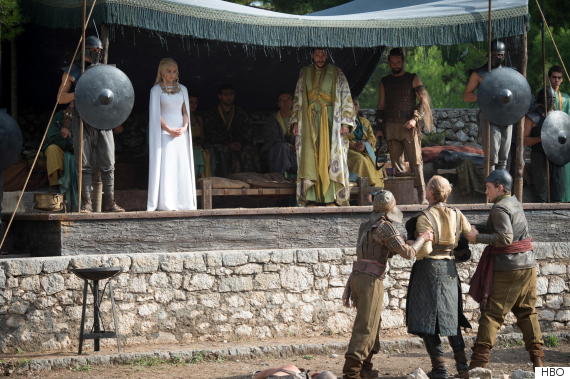
Two of the (arguably) most significant characters in the series finally met when Jorah and the Lannister arrived to the fighting pits. The look on Dany’s face when Tyrion announced himself (as “the gift”) was something truly magnificent. Now go take over the world and make it a better place, guys.

jorah

Sam was the real hero
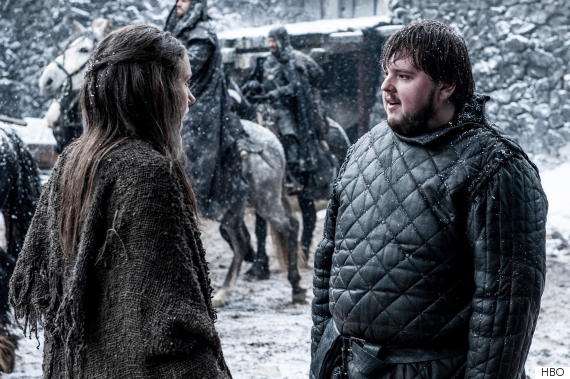
Samwell Tarley has proven his courage number times, first by killing a White Walker and then during the Battle of Castle Black. But in “The Gift” he fought two of his Night’s Watch brothers to save Gilly from being raped. His reward? The two finally kissed and had sex! We shall dub them Gillwell. And Ghost the direwolf also made a heroic appearance, reminding us why the House Stark sigil is the baddest of them all.

sam gilly

Melisandre wants another sacrifice
The Red Woman’s latest scheme to help Stannis achieve victory is one the Lord of Dragonstone isn’t thrilled to hear. Melisandre wants to sacrifice his daughter Shireen in order to win Winterfell from the Boltons. He kicks her out of his tent for mentioning it, and after a recent episode where Stannis bonded with his daughter, it would be surprising for him to give in.

The Baratheon kids got really upset
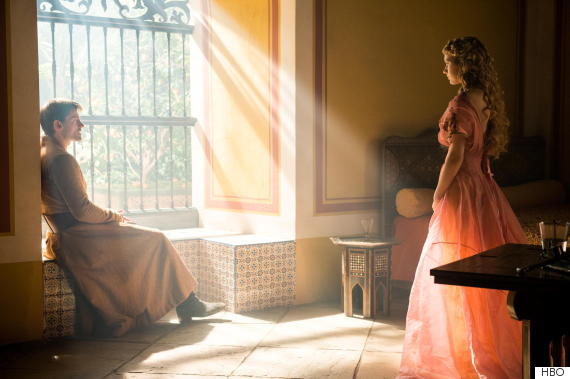
Both Tommen and Myrcella Baratheon lashed out at their parents on Sunday, (except the latter doesn’t know Jaime is her father). Tommen yelled at Cersei and cried over Margaery’s imprisonment, while Myrcella refused to return to King’s Landing since she’s determined to marry Tyrstane Martell.

myrcella jaime

Bronn got seduced and saved
Last week, we predicted Bronn’s possible death after he was cut by one of the Sand Snakes’ spears, which was likely dipped in poison. As it turns out, the blade was deadly and began to slowly kill the fighter as he lay in his cell watching Tyene Sand seduce him with her bare chest. Tyene eventually gave Bronn the antidote for the poison — but only after he admitted she was the most beautiful woman in the world.

“Game of Thrones” airs on Sundays at 9:00 p.m. ET on HBO.

— This feed and its contents are the property of The Huffington Post, and use is subject to our terms. It may be used for personal consumption, but may not be distributed on a website.

www.huffingtonpost.com/2015/05/24/game-of-thrones-the-gift-recap_n_7433484.html?utm_hp_ref=gay-voices&ir=Gay+Voices

The Seismic Shift in Irish Values, and One Reason It Happened

The Seismic Shift in Irish Values, and One Reason It Happened
The landslide victory for marriage equality in Ireland caught some conservatives off guard. What happened to the staunchly conservative, almost fanatical Catholicism of the Irish people?

Paul Valleley, a professor of public ethics at the University of Chester, offered some important suggestions. He lists two major reasons. One is that “the Catholic Church has lost its grip on the Irish,” something he attributes to “self-destruction” by the church as a result of priestly child abuse and physical and psychological cruelty by nuns and priests at various institutions of the church, such as the infamous Magdalene laundries.

It is the second reason that I want to focus upon, however. Valleley writes:

Ireland had joined the EU, giving it access to markets much larger than previously when its trade had been predominantly with Britain. That, combined with an influx of foreign investment, transformed Ireland from one of the poorest countries in Europe to one of the wealthiest. Its economy grew so powerfully in the 1990s that Ireland became known as the Celtic tiger.

With that affluence, and an increased engagement with Europe, came a shift in social attitudes. Emigration, so long a potent norm in Irish society, fell away. Brighter and more enlightened Irish talent no longer looked abroad but remained at home and fostered change. The Economist named Ireland the best place to live in the world. “Rising material wealth seems to have expanded minds as well as wallets,” as one Irish commentator put it. Secularism became linked in the public imagination with the benefits of urban modernity and religion was relegated to an association with the poverty of the rural past.

Ireland, according to Seán Ó’Riain’s The Rise and Fall of Ireland’s Celtic Tiger, was in crisis, with “massive government debt accompanied by severe unemployment, immigration and weak labour force participation among women.” But a series of liberalizing market reforms led to “rapid economic growth and, even more significantly, exceptionally high employment growth in the second half of the decade. The numbers employed in Ireland almost doubled between 1988 and 2008, increasing by one million jobs.”

Historically, the more market-oriented the economy, the more the well-being of LGBT people increases. Politicized markets require political power, something sexual minorities rarely have, but depoliticized economies only need an entrepreneur willing to cater to a minority. Soviet-style, top-down economies would never allocate paper for books on gay issues, let alone for a thriving gay media. That required a bottom-up, depoliticized or less-politicized economy, where entrepreneurs only had to buy the paper and find a profit-seeking printer. Even in the McCarthy-dominated 1950s, the United States had publications for gay men and lesbians. In Europe these publications existed since the late 1800s, something not possible in Comstockian America at the time, mainly because postal regulations were used to close down any publication that Comstock deemed obscene, such as information on birth control.

It was the Financial Times that noted the role of material wealth on social liberalism. They wrote, “Ireland’s apparent willingness to embrace gay marriage is therefore as much a product of the Celtic Tiger years as it is a reflection of the decline of the Church’s influence.” With rising prosperity, Irish voters started embracing socially liberal reforms, matching the economically liberal reforms of a few years earlier: deregulation and more individual choice. Women demanded and won liberalization of contraception laws and legalization of divorce.

Sociologist Tom Inglis said of Ireland, “[W]e have all signed up for cultural liberal individualism and a laissez faire approach to civil rights.”

Similar seismic shifts in cultural values occurred in other nations following periods of economic boom. The relative prosperity of the 1950s in America gave way to the social turbulence of the ’60s, which saw the culmination of not only the civil rights movement but the movements for women’s liberation and, of course, gay liberation.

In 1943 Abraham Maslow proposed his famous hierarchy of human needs. He argued that people fulfill lower-order needs first and work their way up the pyramid. The lower three rungs are basic needs, such as food, water, and sleep; safety needs, such as employment and security; and social needs, such as family, friends, and love. The higher-order needs are esteem (respect, confidence, and self-esteem) and self-actualization, which is the individual finding personal fulfillment, self-growth and their understanding of the meaning of their life.

These last categories underline the gay rights revolution. Gay rights were not about access to markets; a closeted gay could still access markets even in a prejudicial culture. It was hard, however, to be closeted yet still have self-esteem and self-growth. Once lower-order needs were out of the way, people clamored for those choices in life that make them individuals — different from others. Economic prosperity creates that demand by filling the lower-order needs. While economic reform is necessary for economic prosperity, it is social reform that is necessary for individuals to live as free individuals.

Many have damned liberal economic reforms because they encourage individualism, the theory being that individualism promotes an uncaring, socially isolated, atomistic culture. Yet studies find that “the tolerance level of the average American has been climbing steadily since the early 1970s.” The reason that tolerance has increased is precisely because people became more individualistic in how they perceive themselves and others:

The increase in tolerance co-occurred with increases in individualistic beliefs such as rejecting traditional social rules around gender, race, religion, sexuality, and drug use. At the group level, tolerance was higher in years with more individualistic language in books and a higher need for uniqueness. These analyses cannot infer causation, but these results are consistent with our hypothesis that increasingly individualistic attitudes may be one cause of increasing tolerance for outgroups.

Rising economic prosperity encourages individualism. With the rise of individualism, it becomes harder and harder to damn those “not like us.” There is no “us” anymore, just many individuals, each with different values and priorities. Intolerance is largely fear of individualism; once you prosper economically, the individualistic genie is out of the bottle, and social change inevitably follows. Depoliticized markets ought to terrify conservatives, for in them social change is born.

— This feed and its contents are the property of The Huffington Post, and use is subject to our terms. It may be used for personal consumption, but may not be distributed on a website.

www.huffingtonpost.com/james-peron/the-seismic-shift-in-iris_b_7430026.html?utm_hp_ref=gay-voices&ir=Gay+Voices

Texas Legislature Poised to Pass Bill that Undermines Privacy for People Living With HIV

Texas Legislature Poised to Pass Bill that Undermines Privacy for People Living With HIV

The Texas State House is considering SB 799, a bill that would allow any HIV test results to be used in any criminal proceedings against a person with HIV in Texas. 
HRC.org

www.hrc.org/blog/entry/texas-legislature-poised-to-pass-bill-that-undermine-privacy-for-people-liv?utm_source=rss&utm_medium=rss-feed

Gay Catholic: 'I Still Want to Have a Family. It’s Just Going to Look Different' – VIDEO

Gay Catholic: 'I Still Want to Have a Family. It’s Just Going to Look Different' – VIDEO

Carlo

When Carlo, a gay Catholic from Sydney, Australia, told his aunt he was gay, she began sobbing uncontrollably. 

When she finally calmed down, she explained that she needed to grieve the loss of the image she built up for him of having a wife and children. 

“I said to her, ‘I get that, but I want to make sure you understand: I still want that,'” Carlo recalls. “‘I still want to have a family, but it’s just going to look different. It’s going to be with a man as opposed to a woman.'” 

Carlo tells his coming out story as part of Nathan Manske’s “I’m From Driftwood” project. He says he didn’t come out until 25, largely because of his Catholic upbringing, including his image of the perfect family as a father, mother and children. 

Finally, he began telling his friends he was gay, but he knew he hadn’t really come out until he told his parents. He did it as they were driving to church for a Catholic mass. 

“I said to them, ‘Mom, dad, I’m attracted to men,” he recalls. “There was a bit of silence for a moment, but Dad was the first person to chime up and say ‘Carlo, as long as you’re happy, we’re happy,'” Carlo says. “And mom soon thereafter said: ‘You can’t change who you are. This is you, and we want you to be you.’ So I was actually surprised that they didn’t have any more questions.” 

Carlo later explained to his parents that he didn’t plan to follow the church’s teaching that you can be gay as long as you’re celibate, which was slightly harder for them to understand. A few weeks later, he was making cake decorations with his aunt. 

“My auntie jokingly said, ‘Maybe you could make some of these pink rose cake decorations for your girlfriend,'” Carlo recalls. “I said, ‘Well, that will never happen, because I’m actually gay.'” 

Once his aunt stopped crying, she said she was grateful that he told her because it would allow them to have a deeper relationship. 

“What I’ve learned is that I can be gay and I can be Catholic and the two can actually build on each other, and strengthen both parts of my identity,” Carlo says.  

Watch Carlo tell his coming out story, AFTER THE JUMP … 


John Wright

www.towleroad.com/2015/05/gay-catholic-i-still-want-to-have-a-family-its-just-going-to-look-different-video.html

Fox News Host Chris Wallace Grills Mike Huckabee on If He'd Ignore SCOTUS on Desegregation Too: VIDEO

Fox News Host Chris Wallace Grills Mike Huckabee on If He'd Ignore SCOTUS on Desegregation Too: VIDEO

Huckabee

During his 2016 presidential campaign announcement earlier this month, you may recall Mike Huckabee taking a thinly veiled shot at the Supreme Court’s upcoming ruling on same-sex marriage, saying:

“Many of our politicians have surrendered to the false god of judicial supremacy which would allow black robed and unelected judges the power to make law as well as enforce it.”

On Fox News Sunday earlier today, host Chris Wallace decided to give the evangelical favorite a refresher on Marbury v. Madison as well as history lesson on a fellow, former Arkansas governor who thought he didn’t have to follow the Supreme Court either.

Can’t blame the Huckster for not knowing these things though, he was probably busy reading his Bible in class as a kid instead of the textbook.

Watch Wallace ask whether Huckabee would have followed a Supreme Court order on desegregation, AFTER THE JUMP


Kyler Geoffroy

www.towleroad.com/2015/05/fox-news-host-chris-wallace-grills-mike-huckabee-on-if-hed-ignore-scotus-on-desegregation-too-video.html