

Monthly Archives: April 2015
Antigay N.D. Politician Outed Through Grindr
Antigay N.D. Politician Outed Through Grindr
Republican state representative Randy Boehning has voted against LGBT-inclusive legislation three times.
Neal Broverman
SCOTUS and Marriage Equality — The Sky Is Not Falling
SCOTUS and Marriage Equality — The Sky Is Not Falling
The Supreme Court of the United States heard two and a half hours of arguments on marriage equality on Tuesday. Now we must wait patiently until June when SCOTUS will announce their decision. Optimism and polls on marriage equality are higher than ever, perhaps because citizens in 36 states and Washington, D.C., already have marriage equality, and the sky did not fall.
Metropolitan Community Churches (MCC) are proud to say marriage equality has been part of our DNA for almost 50 years. One of the first things our founder, Rev. Elder Troy Perry, did after forming Metropolitan Community Church in 1968 was to begin performing marriage ceremonies.
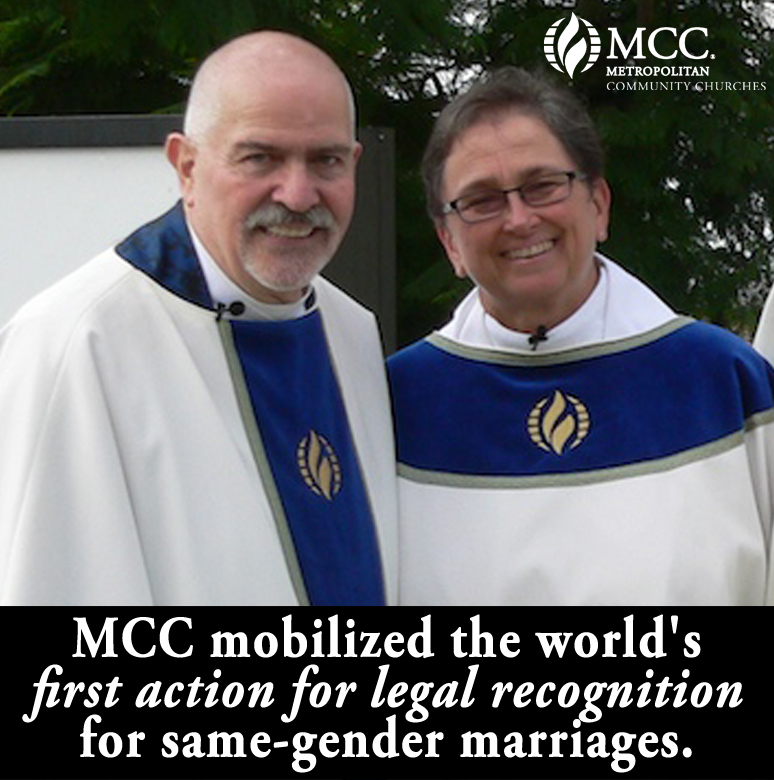
(MCC Founder, Rev. Elder Troy Perry, and Moderator, Rev. Dr. Nancy Wilson, working for marriage equality for almost 50 years.)
Over my decades of ministry, I have married hundreds of same-gender couples, and MCC has performed tens of thousands of marriages.
Early in my ministry, two elderly women, Connie and Eva, came to me to marry. They met in 1932 in Marlene Dietrich’s lesbian-friendly nightclub in Berlin. Eva was German; Connie was African-American. They were separated by World War II but reunited when Eva came to live with Connie in the United States. For decades, they lived as “Mrs. Winne and her maid Connie” until they found MCC and realized they could finally be authentically who they were: lifelong lovers, married in every way but in the eyes of the law. Everything changed when they knelt together at the altar to profess the love they had shared for 40 years. They were finally able to be open.
In 1975, Rev. Freda Smith, an MCC pastor, performed the wedding of Anthony Corbett Sullivan and Richard Frank Adams. The marriage laws in Colorado did not specify gender, so a county clerk saw no reason not to give them a license. MCC performed the first legal same-gender marriage in the country!
In June of 1970, The Advocate published “Perry Plans Marriage Test.” Reporter John Zeh described Rev. Perry’s plan to challenge California’s opposite-gender-only marriage laws. And he did! Represented by LA attorney Al Gordon, Rev. Perry brought the suit on behalf of Neva Heckman and Judith Bellew, a couple whose wedding he officiated in 1969. MCC mobilized the world’s first action for legal recognition for same-gender marriages. The lawsuit was dismissed, but the struggle had begun.
In 1971, Life magazine devoted two pages to Metropolitan Community Churches in an article called “Homosexuals in Revolution: A Church for Homosexuals.” Rev. Perry was pictured performing a wedding ceremony for Andre Charland and Richard Castle. The caption noted that marriages were being performed, but they were not legal — an indirect recognition of the inequality we faced.
All along, we knew that dismissing our marriages was unjust and probably illegal. For decades, MCC members around the world joined Rev. Perry in Valentine’s Day actions. We would go to the local officials, as same-sex couples, dramatically ask for a marriage license, and just as dramatically be turned down.
When Valentine’s Day rolls around next February, it is likely that all couples who choose to marry will be able to do so in the United States and in a growing number of other countries.
We know that being true to ourselves and our families is having an impact. When an MCC minister, Rev. Roberto Gonzalez, performed the first public same sex wedding at an ILGA conference in Rio in 1994, no one dreamed that Brazil, Uraguay, Argentina, Mexico City, Colombia, and Venezuela would today recognize legal marriages or civil unions.
When Rev. Dr. Brent Hawkes of Canada researched Canadian law and performed Canada’s first legal marriage in 2001 — and it held up in court in 2003 — we knew the orbit of planet justice had shifted on its axis.
History is being made. We have told our stories, claimed our stories, and treasured our stories. As Evan Wolfson stated in a recent Face the Nation interview, even if SCOTUS rules against marriage equality, we will continue to work for equality state-by-state.
— This feed and its contents are the property of The Huffington Post, and use is subject to our terms. It may be used for personal consumption, but may not be distributed on a website.
Queen Latifah Stands For Marriage Equality, Is Angry About Homophobia In The Black Community
Queen Latifah Stands For Marriage Equality, Is Angry About Homophobia In The Black Community
 People’s ideas in general are antiquated when it comes to who you love. We haven’t moved as quickly as we probably should. And the reality is that there’s always been gay people in the black community, so it’s not foreign to us. And not just as a black community but just a society as a whole…Who you choose to marry is really up to you and it’s not something you should be judged on. I don’t find being gay or lesbian to be a character flaw. Couples should be protected under the laws of this country period. It actually angers me. It’s not unusual so let’s be adults and let’s move forward.”
— Queen Latifah, who plays the late lady-loving blues legend Bessie Smith in HBO’s Bessie, in an interview with Uptown magazine
Jeremy Kinser
Marriage at the Supreme Court 2.0 Analysis: Recognizing Valid Out-of-State Marriages
Marriage at the Supreme Court 2.0 Analysis: Recognizing Valid Out-of-State Marriages
THIS ANALYSIS IS CONTINUED FROM PART 3. FOLLOW ALONG ON THE AUDIO CLIP FOR QUESTION 2.
As we have discussed, the single consolidated case of Obergefell v. Hodges raised two legal questions. The first question, which we have been discussing, is whether the Fourteenth Amendment prohibits States from banning gays from marrying. The second question, inspired by several plaintiff couples who married in one state but live in states that do not allow gays to marry, asks whether the Fourteenth Amendment allows a states to refuse to recognize valid marriages performed out of state.
A few preliminary notes before we get to the argument:
-
If plaintiffs win on Question 1 — if the Fourteenth Amendment prohibits marriage discrimination — Question 2 is irrelevant. Plaintiffs would be able to go home and get married.
-
It is possible that the Court could agree with one party on one question and disagree with that party on another question. For example, the Court could say states have to recognize valid out of state marriages, but they need not be forced to perform them on their own. That’s a tough middle road because it would ultimately result in a nationwide right to marry, but cause significant hardship.
The argument lasted a little under an hour. Doug Hallward-Driemeier (above, right), an accomplished Supreme Court practitioner, argued for marriage equality. Mr. Hallward-Driemeier, like his colleague Mary Bonauto, did a fine job under difficult circumstances. Ms. Bonauto had a hotter bench. Compared to both, Mr. Joseph Whelan (right), Solicitor General of Tennessee, was an absolutely failure. He started his argument at about minute 24. He didn’t know the law, made obvious mistakes on basic material, and had the justices asking questions as if Mr. Whelan were back in first year of law school. The first 10 minutes of his argument amounted to the justices challenging him on basic questions of law. Justice Breyer, often playing the role of the referee today, took a professorial approach: “what case says that”, for example, When this happens, you know your day is going poorly.
A few notable things happened (and didn’t happen):
-
Justice Kennedy did not ask a single question on Question 2. This could be a tip of that hat to where Justice Kennedy is leaning. Question 2 is irrelevant if the Court decides that States cannot ban gays from marrying. That Justice Kennedy didn’t have any questions — that he wasn’t concerned about any legal issue — may suggest that he doesn’t need to address Question 2.
And it wasn’t just Justice Kennedy. There was decidedly fewer questions, and fewer hostile questions, from the bench during Question 2. This suggests that several members of the Court are indeed ready and willing to decide on Question 1.
-
At Minute 25, Justice Scalia wanted to know why the Full Faith and Credit Clause, which requires states to recognize the rulings and decisions of other states, does not control Question 2. It took Mr. Whelan some time, after a detour into several incorrect statements of law, to finally aver that Supreme Court precedents have distinguished between court orders and things like marriage licenses. Orders and judgments get full faith and credit; traditionally, marriage licenses do not. Notably, it doesn’t have to be that way. The Supreme Court could say that the clause could apply to marriage licenses.
The rest of the argument seemed like an anti-climax. Mr. Hallward-Driemeier did a fine job going back to his talking points and framing the debate according to the narrative of his clients. Mr. Whelan failed miserably from question to question.
Stay tuned to Towleroad for analysis once we take a few steps back.
And if you missed the earlier parts of this analysis, you can find them here: Part 1, Part 2, Part 3…
***
Follow me on Twitter.
Ari Ezra Waldman is Associate Professor of Law and the Director of the Institute for Information Law and Policy at New York Law School. He holds a Ph.D. from Columbia University, a J.D. from Harvard Law School, and a B.A. from Harvard College. Ari writes regular posts on law and various LGBT issues.
Ari Ezra Waldman
Law Professor at the University of Illinois College of Law Robin Fretwell Wilson discusses the debate over gay marraige

Andrew Demeter, Vlogger, Interviews Westboro Baptist's Shirley Phelps
Andrew Demeter, Vlogger, Interviews Westboro Baptist's Shirley Phelps
What would you say to the Westboro Baptist Church if you had the chance to speak to one of its leaders?
YouTube vlogger Andrew Demeter, 17, recently had the opportunity to sit down with the Shirley Phelps and talk one-on-one about her beliefs surrounding the lesbian, gay, bisexual and transgender (LGBT) community. Shirley Phelps is the daughter of the late Fred Phelps, the Westboro Baptist Church founder who passed away in March 2014.
Maintaining a calm demeanor throughout the entire interview, Demeter doesn’t shy away from an open dialogue about questions we all have about Westboro, even telling Phelps at one point, “Well Shirley, if you’re going to Heaven, I am more than happy to go to Hell.”
The Huffington Post chatted with Demeter about his interview with Phelps this week.
The Huffington Post: Why did you decide to interview Shirley?
Andrew Demeter: In the past few months, I’ve brainstormed a list of some 25 newsmakers and other influencers who I want to interview at some point in the near future. Having already interviewed diverse characters like Fran Drescher, John McAfee and Nancy Pelosi, among others, Shirley was simply next on the list. My goal for the interview was simple: to attempt to understand the “rationale” of a hate-monger. This, however, soon proved futile as I was seeking out logic and reason where it wasn’t meant to be found. Another motivation for interviewing Shirley was to uncover from where her hatred [stemmed].
How did you get Shirley to agree to the interview?
Surprisingly, Shirley agreed to the interview with relative haste. I had contacted her via Twitter weeks beforehand to no avail, but after following up we scheduled a convenient date and time. I began surfing the web for additional research, binge-watching documentaries and other interviews, and immersing myself (from afar) into the Westboro Baptist Church’s culture.
What do you want viewers to take away from your interview?
The underlying message of this interview is the paradox that religion may incur violence. It is abysmal to justify hateful actions with mere words once inscribed on ancient tablets and parchment paper.
At the end of the interview, Demeter tells Phelps that he “respects her on a human level” and would have given her a hug if they weren’t conducting the interview through Skype.
Head here to see more from Demeter, including interviews with Fran Drescher, John McAfee, and Nancy Pelosi.
Parts of this interview have been modified and/or condensed.
— This feed and its contents are the property of The Huffington Post, and use is subject to our terms. It may be used for personal consumption, but may not be distributed on a website.
LISTEN: The Oral Arguments of 'Obergefell v. Hodges'
LISTEN: The Oral Arguments of 'Obergefell v. Hodges'
Here are the debates that may decide the future of nationwide marriage equality.
Advocate.com Editors
www.advocate.com/politics/2015/04/28/listen-oral-arguments-obergefell-v-hodges
LISTEN: Audio from Obergefell Oral Arguments Available Here
LISTEN: Audio from Obergefell Oral Arguments Available Here

Listen to oral arguments in Obergefell v Hodges, the historic case that could bring marriage equality nationwide.
HRC.org
Jeffrey Dahmer’s Killer Reveals Why He Felt The Gay Cannibal Needed To Die
Jeffrey Dahmer’s Killer Reveals Why He Felt The Gay Cannibal Needed To Die

Scarver (left) and Dahmer (right)
Notorious gay serial killer/cannibal/necrophiliac Jeffrey Dahmer made a name for himself in the early 1990s when he was convicted of raping, murdering, and eating seventeen men and boys between 1978 and 1991. He was sentenced to fifteen terms of life imprisonment in February 1992. In November 1994, he was beaten to death by another inmate. Now, his killer is speaking out about that fateful day.
On the morning of November 28, 1994, Christopher Scarver bludgeoned Dahmer to death with a 20-inch metal bar in the shower. He tells the NY Post that he did it because Dahmer used to sculpt severed body parts out of prison food, drizzle them with ketchup, and taunt other inmates with them.
“He would put them in places where people would be,” Scarver says. “He crossed the line with some people — prisoners, prison staff. Some people who are in prison are repentant, but he was not one of them.”
Related: Serial Killer Who Targeted Gay Men For “Spreading Evil” Finally Caught
Scarver was locked up for killing his former boss during a robbery in 1990, in which he walked away with just $15 cash. Though he never personally interacted with Dahmer, he says he had heard about what the 34-year-old cannibal had done and was “fiercely disgusted” by it.
On November 28, he and Dahmer, as well as a third man by the name of Jesse Anderson, were sent to clean the prison bathrooms by correction officers. They were unshackled and left them unattended. After getting their cleaning supplies together, the three men split up. Scarver followed Dahmer toward the staff locker room. On his way there, he grabbed a metal bar from the weight room.
“I asked him if he did those things ’cause I was fiercely disgusted,” Scarver recalls. “He was shocked. … He started looking for the door pretty quick. I blocked him.”
Scarver proceeded to clobber Dahmer in the head until, he says, “he ended up dead.” Afterwards, he killed Anderson as well.
Scarver believes the guards are partly responsible for the killing, saying they intentionally left the men alone together in hopes that he would murder Dahmer.
“They had something to do with what took place,” he says.
Related: Is There A Modern Day Jack The Ripper Terrorizing Manchester’s Gay Village?
Upon learning of her son’s death, Dahmer’s mother, Joyce Flint, angrily told the media: “Now is everybody happy? Now that he’s bludgeoned to death, is that good enough for everyone?”
Scarver was sentenced to two further life sentences for the killings. He claims that he spent 16 years in solitary confinement for killing Dahmer. Today he spends his time writing poetry, which he self-publishes on Amazon.
h/t: NY Post
Graham Gremore
