Gay Jamaicans Victims Of Violence, Human Rights Watch's 'Not Safe At Home' Report Finds

Gay Jamaicans Victims Of Violence, Human Rights Watch's 'Not Safe At Home' Report Finds
KINGSTON, Jamaica (AP) — Gay, lesbian, bisexual and transgender people are the targets of unchecked violence and discrimination in Jamaica, frequently refused housing or employment in the Caribbean country typically described as the region’s most hostile to LGBT citizens, a leading human rights group says in a report released Tuesday.

In its 86-page report titled “Not Safe at Home,” Human Rights Watch noted that LGBT citizens in Jamaica are often driven from their communities by neighbors and sometimes even family. Some health professionals stigmatize them by casting judgment on their sexuality when they seek care. Police protection against bias and physical attacks is generally poor. LGBT people in Jamaica “face intolerable levels of violence and cannot rely on the police,” Graeme Reid, the organization’s LGBT rights director, said in a release. “The authorities from the prime minister on down need to call a halt to the violence and discrimination, prosecute anyone responsible, and get homophobic laws off the books.”

The New York-based rights group called on the Jamaican government to strike down the anti-sodomy law that criminalizes anal sex and another that prohibits “acts of gross indecency” between men. While prosecution is rare under Jamaica’s 1864 law making sexual intimacy between men a crime, the advocacy organization says it gives “social sanction to prejudice and helps to create a context in which hostility and violence is directed against LGBT people.”

The Human Rights Watch report was the result of five weeks of research conducted last year in Jamaica. It said it interviewed various people, including 71 LGBT citizens — 44 of whom reported being victims of “some form of violence based on their sexual orientation or gender identity.” Many LGBT people on the island “live in constant fear,” the rights group said.

Gay activists on the island have long called for the anti-sodomy law to be repealed and said they are still discussing the rights group’s assertions and recommendations. Jamaica’s information minister did not respond to an email seeking comment.

Dane Lewis, executive director of the advocacy group Jamaica Forum for Lesbians, All-Sexuals & Gays, has said the Caribbean island of 2.7 million people is seeing an increase in “pockets of tolerance,” but homophobia remains culturally ingrained.

Human Rights Watch did note that there has been a “groundswell of change in Jamaica in the way it is responding to human rights abuses against LGBT people.” It praised Prime Minister Portia Simpson Miller and other government leaders for constructive statements about LGBT rights.

But many people in the largely Christian country consider homosexuality to be sinful, and believe the gay rights lobby is a perversion from abroad. Even among those who tolerate homosexuality, some people think it should not be advertised and believe activists have exaggerated reports of violence.

A recent poll commissioned by the Jamaica Gleaner newspaper suggested that 91 percent of Jamaicans are opposed to repealing the anti-sodomy law. The survey of 1,208 Jamaicans had a margin of error of 3 percent.

Last year, a transgender teen named Dwayne Jones was killed by a mob at a crowded street dance outside Montego Bay and the slaying remains unsolved.

In late August, a young Jamaican gay rights activist who brought an unprecedented legal challenge to the Caribbean island’s anti-sodomy law withdrew his claim after growing fearful about possible violent reprisals. When the legal challenge was initiated last year, several pastors led crowded revival meetings in Jamaica’s two biggest cities to counter what they called a growing mainstream acceptance of homosexuality.

Jamaica is among numerous English-speaking Caribbean nations with anti-sodomy laws. Public health officials say the laws criminalizing gay sex have fueled the region’s HIV epidemic by making it hard to effectively reach men who have sex with men, a population that generally faces elevated levels of HIV infection.

____

David McFadden on Twitter: twitter.com/dmcfadd

www.huffingtonpost.com/2014/10/22/jamaica-lgbt-violence_n_6027016.html?utm_hp_ref=gay-voices&ir=Gay+Voices

‘Sup Bro: Eight Things Gay Men Need Straight Dudes To Know

‘Sup Bro: Eight Things Gay Men Need Straight Dudes To Know

The chasm that has divided homo and hetero men seems to be closing fast. Straight dudes are opening up about the subject of anal play, and gay/straight bromances — not to mention cross-sexuality cuddling — are becoming increasingly popular. Still, there’s work to be done.

One can never have too many friends. We’re totally happy to open up our social circles and welcome males of the opposite sexuality into our folds, provided we’re all on the same page.

Here are eight things we’d like our straight brethren to know before we take our relationships to the next level:

8. No, we don’t all want to sleep with you.

Do you want to bed every woman you lay eyes on? Probably not. The same goes for us. Just because you happen to have a penis doesn’t mean we’re the least bit interested in getting naked with you. While there are certainly some gay guys who see it as a challenge to seduce “straight” men, the vast majority of us prefer hooking up with our own kind, especially since straight men don’t always seem to understand the definition of hygiene. After all, why would we want to sleep with someone who doesn’t want to sleep with us?

Paranoia-resized

7. And, no, we’re not checking out your ass.

So stop acting all suspicious. Your insecurity is very unbecoming. Honestly, we were just trying to read the designer label on your jeans.

1350264854_5a5b9749c1

6. OK, maybe we’re checking out your ass.

But, really, who cares? So long as it’s all look and no touch, what’s the big deal? You check out women’s asses all the time. Hell, you may have even checked out a few men’s asses in the past. (For comparison purposes only, of course!) The bottom line: We’re taking a brief moment to admire your donque. Be flattered. Then see #8 again.

Screen shot 2014-10-16 at 3.21.39 PM

5. Please don’t call us “bro.”

You may call us “man.” You can even call us “dude.” But please, for the love of Jesus, refrain from saying “‘Sup, bro” then offering us a fist bump. It’s just awkward.

football

4. Some of us enjoy watching sports.

As someone whose boyfriend is obsessed with football, I’m often dragged to sports bars whenever there’s a big game. Nine times out of 10, the moment we first step in through the door, we’re met with sideways glances from other bar patrons who seem confused as to what the hell a gay couple is doing there. We’re there for the same reason you are: To drink cheap beer and watch the game.

Madonna-vogue-all-in-one-images

3. It’s OK if you like “gay” things.

We see you tapping your foot under the table to that Madonna song we selected on the jukebox. It’s OK if you want to get up and groove to the music. We won’t judge you. We know Madonna’s tunes are totally infectious. We discovered her, after all. And we’re more than happy to share our queen with you.

2. Nobody will think you’re gay if you talk to us.

And if they do, who cares?

cheers_to_beers_1

1. Sure! We’d love to grab a beer some time.

On a strictly plutonic basis, of course.

Related stories:

10 Totally Obnoxious Things You Have To Be Gay To Fully Understand

Why Straight Girls Who Hang Out In Gay Bars Can Be A Big Problem

Don’t Be That Gay: The 10 Most Obnoxious Types Of Homosexual Men


Graham Gremore is a columnist and contributor for Queerty and Life of the Law. Follow him onFacebook and Twitter.

Graham Gremore

feedproxy.google.com/~r/queerty2/~3/CiZ2VBBGx_U/10-things-straight-men-could-learn-from-gay-men-20141022

Things Are Improving For LGBT Students, But They're Still Really Bad

Things Are Improving For LGBT Students, But They're Still Really Bad
Schools are getting better at fostering a friendly environment for LGBT students, but they still have a long way to go.

A survey released Wednesday by the Gay, Lesbian & Straight Education Network, which advocates school safety for students, regardless of sexual orientation or gender expression, showed notable improvement for LGBT students during the 2012-2013 school year from 2010-2011.

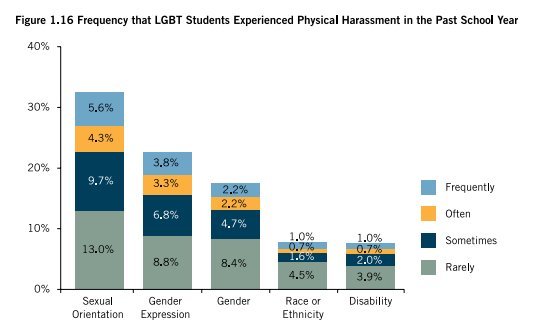
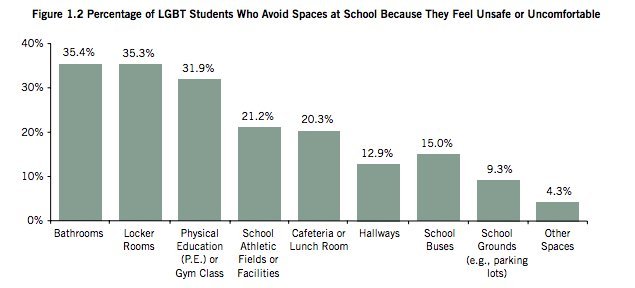
But huge numbers of LGBT students reported problems at school. Of the nearly 8,000 students ages 13 to 21 who were surveyed, more than 55 percent reported feeling unsafe at school due to their sexual orientation, down from 64 percent in 2011. Thirty-six percent faced physical harassment, including pushing or shoving, a drop of 2 percentage points from the earlier survey. And more than 16 percent said they were physically assaulted, sometimes with a weapon, a decline of 2 percentage points. Many students said they avoided places at school that made them feel unsafe.

“You see tremendous progress since 2011,” Eliza Byard, executive director of Gay, Lesbian & Straight Education Network, told The Huffington Post. “That being said, it still means far too many students are experiencing anti-LGBT violence and discrimination.”

harassment

avoid

The survey found that certain school policies contribute to discrimination. More than half of students who were surveyed reported hearing teachers or school staff make homophobic remarks against LGBT students. Further, school staff often fail to protect LGBT students, the survey showed. The number of students who said school staff members intervened to stop bullying was unchanged from 2011.

Byard said the new report provides greater detail than earlier surveys on how schools discriminate against LGBT students. For example, nearly 18 percent of students reported being prevented by from “discussing or writing about LGBT topics in school assignments.” Nearly 16 percent were prohibited from wearing clothing or items supporting LGBT issues. For the first time, the survey asked students whether they had heard negative remarks about transgender people.

“We don’t know if that’s on the way up or way down,” Byard said. “The increased visibility in trans students and issues makes it a place where we have to pay attention.”

Byard said she worries that school structures and policies are not keeping pace with changes in student behavior.

“In our current political climate, that makes me really worried,” Byard said.

www.huffingtonpost.com/2014/10/22/glsen-2013-survey_n_6024742.html?utm_hp_ref=gay-voices&ir=Gay+Voices