
Category Archives: NEWS

A Photographer Lost A Client For Supporting Marriage Equality. His Response Shows Why #LoveWins

A Photographer Lost A Client For Supporting Marriage Equality. His Response Shows Why #LoveWins
A photographer in Florida says he lost a client after he showed his support online for marriage equality. His response to the situation has won him legions of fans.

Following the U.S. Supreme Court’s landmark decision to legalize gay marriage nationwide last week, Clinton Brentwood Lee of Brentwood Photography took to Facebook to show his support for the decision, changing his profile picture and cover photo.

Lee says a client later contacted him to say that they would no longer be “using [his] services” for their upcoming wedding.

“My fiancé and I support traditional marriage between a man and a woman and don’t want to our money going to places that supports otherwise [sic],” the client allegedly wrote.

The photographer shared a screenshot of the exchange on Facebook Saturday, with the caption: “Lost a client for supporting gay marriage. But that’s ok! We love everyone, even this now former client who may not have liked our reply. Lol.”

This was Lee’s full response to the client:

Wow, I’m not really sure what to say here. I would say this disappoints me, but I actually find this to be a good thing because our company now would now not like to work with you as well.

It’s not that because you have a different view from us, but it’s because, since you don’t like an support gay marriage, no one else should be able to have it. That’s like me not liking broccoli, and demanding that everyone else in the world should not have broccoli either! If you’re not in favor of gay marriage that’s fine, don’t marry a woman.

Personally, I was taught not to judge others and to love everyone else. So I will try not to judge you here and say anything more as to my opinion of you.

At Brentwood Photography we see love in all forms. Now as far as your retainer goes, I hope you’ll read the first article in the contract you signed stating that this retainer is nonrefundable.

But don’t you worry, I’m not going to keep it!

Because of this conversation, I have decided to donate your $1500 to GLAAD [the Gay & Lesbian Alliance Against Defamation], a group created to help and support gay rights.

So let me be the first to say [redacted], thank you very much for your donation and support for this great cause!

I couldn’t have done it without your money.

Sincerely and with Love,
Brentwood Photography

The Facebook post has since been liked more than 58,000 times, with scores of netizens praising the photographer for choosing principle over profit.

Lee told Buzzfeed that he’s also received his fair share of hate mail.

“I think it’s truly beautiful the amount of positive messages and words of encouragement I have received, it is been about 90 percent positive and 10 percent gut wrenching sad personal attacks,” he said. “The hate that comes out of these people’s mouths make me want to cry, but the 90 percent give me the strength to stay strong and not doubt what I did.”

The photographer added that he’s been called a “crook” for not returning the money to the client. He stressed, however, that they signed a contract clearly stating that the deposit was non-refundable.

“The retainer is paid for and there to protect us,” he told Buzzfeed, adding that the client responded to his message with the words: “Companies like yours are the reason our country is falling apart… Good luck with the queers, ASSHOLE!”

Ultimately, Lee says he’s “happy I took a stand.”

There’s just one thing he wishes he could change.

“The only thing I wish I had changed … is where it says I support ‘Gay Marriage,’” he wrote on Instagram Sunday. “While I 100 percent do, I wish I had just said that I support marriage opportunity for all. We shouldn’t have to call it ‘gay marriage’ like it is something different. It’s just marriage. Like it is between a man or a woman or a black person and a white person. Every person on this planet deserves their own happy ever after, even if it is different from your view of it.”

— This feed and its contents are the property of The Huffington Post, and use is subject to our terms. It may be used for personal consumption, but may not be distributed on a website.

feeds.huffingtonpost.com/c/35496/f/677065/s/47a94a96/sc/7/l/0L0Shuffingtonpost0N0C20A150C0A60C290Cphotographer0Egay0Emarriage0Ebrentwood0Ephotography0In0I76850A580Bhtml0Dutm0Ihp0Iref0Fgay0Evoices0Gir0FGay0KVoices/story01.htm

After 54 Years Together, Jack Evans And George Harris Become First Same-Sex Couple To Marry In Dallas

After 54 Years Together, Jack Evans And George Harris Become First Same-Sex Couple To Marry In Dallas
They waited over half a century to say “I do.”

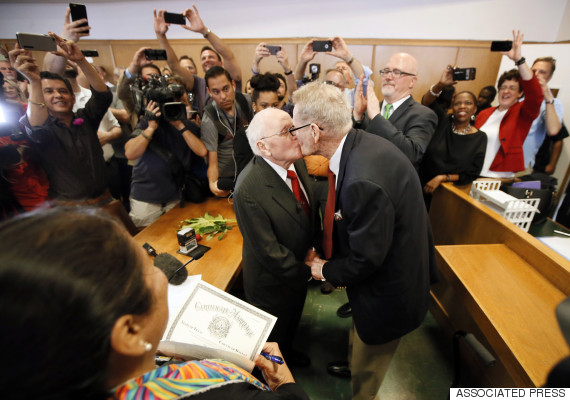
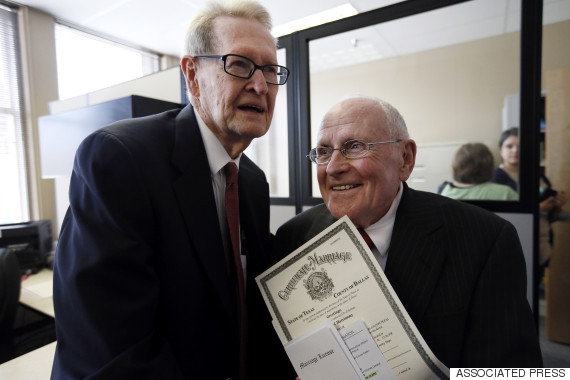
On Friday, Jack Evans, 85, and George Harris, 82, became the first same-sex couple to wed in Dallas County, Texas.

jack evans george harris
Judge Dennise Garcia, left front, watches as George Harris, center left, 82, and Jack Evans, center right, 85, kiss after being married on Friday, June 26, 2015, in Dallas.

According to NBC 5 News, the octogenarians were the first of 170 same-sex couples to be married in Dallas County on Friday. Their nuptials came just hours after the U.S. Supreme Court’s landmark decision to legalize gay marriage nationwide.

Evans and Harris have been together for more than 54 years.

“You would have been blown away by the crowd there, there must have been 450 people there, people waiting to get married, reporters. It was amazing. Just amazing,” Evans told People magazine about the unforgettable moment. “Ten years ago [marriage equality] was not within the realm of possibility.”

jack evans marriage
Evans (left) and Harris show their marriage license after being the first couple to receive it from the Dallas County Clerk on June 26, 2015.

Evans and Harris have reportedly spent decades fighting for gay rights and marriage equality, founding both the North Texas GLBT Chamber of Commerce and The Dallas Way, a project aimed at preserving and documenting the history of the gay, lesbian, bisexual and transgender community in the city.

“Our real focus has been our legacy for the community, that our whole lives have been trying to improve, to encourage the young people to make a difference,” Harris told D Magazine last year. “They think they can walk down Cedar Springs holding hands, and it’s just automatically come to that, but there was a lot of struggle to get there.”

Prior to the Supreme Court’s ruling last week, Texas had been one of 13 states where gay marriage was banned. However, the battle is still not over. On Sunday, the state’s attorney general Ken Paxton (R) announced that county clerks in Texas will still be able to refuse marriage licenses to same-sex couples based on religious objections.

— This feed and its contents are the property of The Huffington Post, and use is subject to our terms. It may be used for personal consumption, but may not be distributed on a website.
feeds.huffingtonpost.com/c/35496/f/677065/s/47a76174/sc/7/l/0L0Shuffingtonpost0N0C20A150C0A60C290Cfirst0Esame0Esex0Ecouple0Edallas0Ejack0Eevans0Egeorge0Eharris0In0I76844640Bhtml0Dutm0Ihp0Iref0Fgay0Evoices0Gir0FGay0KVoices/story01.htm

Uncomplicating Same-Sex Marriage Law

Uncomplicating Same-Sex Marriage Law
With its decision in Obergefell v. Hodges, the U.S. Supreme Court uncomplicated same-sex marriage law. The Court’s clear-cut rule that same-sex couples have a constitutional right to marry replaces the previous piecemeal approach generated by over a decade of new federal court decisions and state laws. Some states had banned same-sex marriage, some states permitted it legislatively, and some states permitted it by state court decision. Some federal courts upheld the state bans, others struck them down. The U.S. Supreme Court has now definitely settled the debate by allowing same-sex marriage across the county.

The U.S. Supreme Court found constitutional protection for same-sex marriage in the Fourteenth Amendment of the U.S. Constitution. The Court had previously interpreted this Amendment to encompass various constitutional rights not explicitly enumerated, including, for example, parental rights, the right to marital privacy involving the use of contraceptives, and the right to marry. In Obergefell, the Court confirmed that the right to marry applied to same-sex couples for the same reasons it applied to opposite-sex couples, such as the benefits of supporting marriage in society.

The speed of the development of same sex-marriage is practically unparalleled in the family law. Just in 1986, the U.S. Supreme Court handed down Bowers v. Hardwick, which upheld a Georgia law that criminalized certain homosexual acts. In 1996, the federal Defense of Marriage Act (DOMA) was enacted to restrict marriage to opposite-sex couples under federal law. Contrast this to 2003, when the U.S. Supreme Court overruled its own Bowers decision and 2012, when the Court struck down part of DOMA. Same-sex marriage is now guaranteed across the country, 12 years after Massachusetts became the first state to permit same-sex marriage.

— This feed and its contents are the property of The Huffington Post, and use is subject to our terms. It may be used for personal consumption, but may not be distributed on a website.

feeds.huffingtonpost.com/c/35496/f/677065/s/47a6f323/sc/7/l/0L0Shuffingtonpost0N0Cmargaret0Eryznar0Cuncomplicating0Esame0Esex0Em0Ib0I76842980Bhtml0Dutm0Ihp0Iref0Fgay0Evoices0Gir0FGay0KVoices/story01.htm

Bill Nye Explains The Mysteries of Time Travel: VIDEO

Bill Nye Explains The Mysteries of Time Travel: VIDEO

Bill Nye

In a new video for Big Think, Bill Nye tackles some big questions from a student at Columbia University.

The student asks what you would see if you were to travel at the speed of light, saying her professor told her you would see the past and future at the same time. Nye responds by discussing both the logistics (and impossibility) of time travel. He says that while it’s “big fun” to ask the question — a favorite in physics classes — his main point is that (despite the fun of speculation) it’s impossible for anything with mass to travel at light-speed.

The student also asks whether human beings could send garbage into outer space. Nye responds with an emphatic “no,” citing money as the limiting factor. He encourages young people to get used to the idea that Earth is a closed system, that people “cannot leave the Earth,” and they must “reduce, reuse, and recycle” to combat the problem of the waste we create.

Check out the video here:

The post Bill Nye Explains The Mysteries of Time Travel: VIDEO appeared first on Towleroad.


Jake Folsom

Bill Nye Explains The Mysteries of Time Travel: VIDEO

Elizabeth Berkley Celebrates Marriage Equality At ‘Showgirls’ Screening, Cements Status As Gay Icon

Elizabeth Berkley Celebrates Marriage Equality At ‘Showgirls’ Screening, Cements Status As Gay Icon

Showgirls-elizabeth-berkley-4979802-720-468Fans of Showgirls who were in attendance at its Cinespia screening at the Hollywood Forever Cemetery this weekend got a surprise treat from none other than Elizabeth Berkley herself. The Saturday night event kicked off with the actress providing an introduction to the film that is now celebrating its 20th anniversary.

The woman who brought Nomi Malone to life on the big screen sent the audience into a frenzy as she discussed the movie that was once ridiculed, but has since become one of MGM’s top selling video/dvd releases. Berkley who described the evening as “a full circle moment” expressed her gratitude to the die-hard fans who “made this the cult film that it is.”

Instagram Photo

Instagram Photo

Instagram Photo

Berkley also made reference to SCOTUS’s historic marriage equality ruling stating, “I truly can’t think of a better night to have come to the first screening of Showgirls in twenty years, a night after a day that we got to witness in this lifetime.” She is obviously keenly aware of the movie’s huge appeal to the LGBT audience.

Instagram Photo

Elizabeth ended the introduction with some signature Nomi Malone hand-ography. Take that, Cristal Connors!

Instagram Photo

Showgirls opened in 1995 to reviews calling it “impossibly vulgar, tawdry and coarse,” and declaring, “the absence of both drama and eroticism turns Showgirls into a bare-butted bore.” However, it was Berkley who unjustly bore the brunt of the criticism. It’s nice to see that she has developed an appreciation for the film’s now-cult classic status and is embracing Showgirls rather than disassociating herself from it.

Related: Hollywood Shocker! Faye Dunaway Reportedly Writing Book About Mommie Dearest

The actress and New York Times best-selling author of Ask Elizabeth posted the following on her Instagram account after Saturday’s event:

Instagram Photo

Instagram Photo

With her display of gratitude and love, Elizabeth Berkley can now add icon to her list of accomplishments.

Jeremy Kinser

feedproxy.google.com/~r/queerty2/~3/s3kv9-Fs3zA/elizabeth-berkley-celebrates-marriage-equality-at-showgirls-screening-cements-status-as-gay-icon-20150628

Houston Mayor Annise Parker: Marriage Equality Too Late For Many LGBT Seniors

Houston Mayor Annise Parker: Marriage Equality Too Late For Many LGBT Seniors

Parker.Annise

In a powerful column published Friday, out lesbian Houston Mayor Annise Parker wrote that for many LGBT seniors, the U.S. Supreme Court’s ruling in favor of same-sex marriage comes too late.

Screen shot 2015-06-28 at 2.04.22 PMParker, writing with Ann J. Robison (right), executive director of Houston’s Montrose Center, notes that many LGBT people who grew up in the 1950s and 1960s — the “Invisible Generation”— are still suffering under the weight of a lifetime of discrimination. LGBT seniors are two times more likely to age alone and four times less likely to have assistance from their families, according to Parker and Robison.

From the column in The Houston Chronicle:

For many LGBT Texans who cared for and nurtured their life partner in the final years of their life, marriage equality will be too late. They never had the benefit of access to their partner’s Social Security benefits or employer-sponsored pension. They faced the stunning realization that not only did they lose the love of their life; they will eventually lose the home they shared that life in, too, because of financial inequality and equal access. Many LGBT seniors have already been displaced from their homes, unable to maintain their previous standard of living on one income alone or with advanced care needs that no longer allow them to live independently.

Parker and Robison add that those who enter senior housing or assisted living often remain closeted out of fear, and that few such facilities properly train their staff on LGBT issues. As a result, those who do come out often face discrimination and even abuse from staff and residents. According to the National Resource Center on LGBT Aging, 43 percent of LGBT seniors in long-term care reported mistreatment and only one in four felt it was safe coming out.

From the Chronicle:

With approximately 10,000 Americans reaching retirement age every single day, it is critical that we take steps to ensure that all seniors – who were among the first generations to defy cultural norms of discrimination and inequality – can enjoy their retirement years in the communities that they helped to define and make better places to live. We owe this especially to our LGBT seniors, those that have already suffered a lifetime of marginalization and discrimination. As we are on the brink of achieving many gains, we recognize the sacrifices made by our LGBT seniors. There remains much more work to be done on their behalf as we continue the work towards full equality.

Houston is currently working to build an $18 million housing facility for low-income LGBT seniors. However, the project is facing resistance from nearby residents — some of which is fueled by homophobia.

Watch a report on the project from KHOU-TV below.

The post Houston Mayor Annise Parker: Marriage Equality Too Late For Many LGBT Seniors appeared first on Towleroad.


John Wright

Houston Mayor Annise Parker: Marriage Equality Too Late For Many LGBT Seniors

The Past and Future of (Same-Sex) Marriage

The Past and Future of (Same-Sex) Marriage
With its ruling in Obergefell v. Hodges, the U.S. Supreme Court took a step that seemed unimaginable two decades ago, when I started researching same-sex marriage. Many politicians, pundits and commentators have rightly hailed the Court’s decision as both just and historic. Legal experts can parse the finer points of the majority opinion and the four separate dissents, but let’s take this momentous occasion as an opportunity to reflect on where we have been on this issue, and what the future may hold.

First, a look backward. Although the dissents in Obergefell claimed that Americans should be given more time to sort out this issue through the democratic process, the history of the struggle over same-sex marriage is actually rather long. The first court ruling on the issue dates back to 1971, when the Minnesota Supreme Court found in Baker v. Nelson that neither the state nor the federal constitution guaranteed a right to same-sex marriage. But the issue really broke into public consciousness in the mid-1990s, when another state supreme court — this time in Hawaii — ruled its state constitution did in fact require the state to issue marriage licenses to same-sex couples.

That ruling prompted Congress to pass the Defense of Marriage Act (DOMA) in 1996, and many state legislatures (including Hawaii’s) passed their own “baby DOMAs” to ensure they would not have to recognize same-sex marriages. Then in 2004 Massachusetts became the first U.S. state to issue marriage licenses to same-sex couples, and for the next decade opponents and advocates of marriage equality fought ferocious and emotional battles in state after state.

Speaking in the Rose Garden shortly after the Obergefell decision came down, President Obama lauded the ruling and asserted that the result was a consequence of “countless small acts of courage” by people who came out to others and stood up for themselves. Obama framed the marriage victory as “a vindication of the belief that ordinary people can do extraordinary things,” and those words resonated for me as I thought about the plaintiffs in the earliest marriage cases — in Minnesota, Hawaii and elsewhere — who pursued dignity and equal treatment on their own, without the support of a coordinated, strategic effort by the national LGBT rights movement.

Indeed, it was only after the initial favorable ruling in Hawaii that the national gay rights groups were willing to devote significant attention and resources to the marriage issue, a detail that is easy to forget after years of high-profile, professionalized activism on marriage equality. Even those in the LGBT community who think other issues should have had priority over marriage, or who reject the institution outright, must be heartened by this evidence that major social change that starts at the grassroots is still achievable in our age of deep political cynicism and polarization.

The little-noted irony of the marriage equality victory is that it arrives at a moment when more heterosexual Americans are turning away from marriage. This “retreat from marriage,” as family scholars call it, manifests in lower marriage rates, a higher age at first marriage, more children born to unmarried parents, and a high divorce rate. The causes of the retreat from marriage are complex, but it’s clear the phenomenon is not spread evenly over the American population; it is disproportionately people on the lower rungs of the socioeconomic ladder who are delaying or foregoing marriage, or dissolving their existing marriages.

The economic conditions produced by de-industrialization and globalization are a significant factor: Stagnant wages and employment insecurity place less-educated Americans in a precarious position, and many now view marriage as a kind of middle-class luxury good that is out of reach or irrelevant to their daily struggles to survive.

Recognizing this larger reality of American marriage does not negate the value of expanding marriage rights to include same-sex couples, but as we celebrate marriage equality we must also acknowledge that the broader retreat from marriage is both a cause and a consequence of widening economic inequalities in our country. The optimism and enthusiasm of same-sex couples choosing marriage may be refreshing, but it will probably do little to reverse these broader trends.

Where are we headed? In the short term, the nationalization of same-sex marriage recognition will further increase the cultural visibility of sexual minorities and “alternative” family forms. Legal battles over same-sex marriage will shift to the terrain of religious liberty, where opponents of marriage equality will seek to use religious freedom arguments as grounds for ongoing discrimination against same-sex couples. Even if those legal fights are resolved fairly quickly, it will not be time for the LGBT rights movement to declare victory and close up shop.

The majority of U.S. states still lack anti-discrimination laws covering sexual orientation and gender identity, and efforts to pass a federal employment non-discrimination law have failed repeatedly in Congress. Hate crimes and bullying continue to pose difficult and sometimes life-threatening challenges for sexual minorities and gender variant people. And while Caitlyn Jenner’s coming out has generated mostly positive reactions, transgender rights issues are only starting to get the attention they require.

Finally, I hope that LGBT folk of all political persuasions will view the marriage victory as an invaluable opportunity to dedicate our resources and creativity to more coalition-building with other groups fighting for social justice. In public statements on the steps of the Supreme Court right after the ruling was announced, both lead plaintiff James Obergefell and plaintiffs’ attorney Mary Bonauto made a point to acknowledge the deep pain of the Charleston massacre and the reality that discrimination and hate persist in many forms in contemporary America. I thank them for using their moment in the public spotlight to link LGBT rights struggles to other important issues confronting our nation. Their sentiments represent the most inspiring and expansive elements of the LGBT rights crusade: a recognition of the importance of dignity and equality for all people, of how struggles for social justice are interlinked, and of the power of coalitions to create strength greater than the sum of their parts.

— This feed and its contents are the property of The Huffington Post, and use is subject to our terms. It may be used for personal consumption, but may not be distributed on a website.

feeds.huffingtonpost.com/c/35496/f/677065/s/47a62b31/sc/7/l/0L0Shuffingtonpost0N0Ckathleen0Ee0Ehull0Cthe0Epast0Eand0Efuture0Eof0Esame0Esex0Emarriage0Ib0I76814780Bhtml0Dutm0Ihp0Iref0Fgay0Evoices0Gir0FGay0KVoices/story01.htm