
Marriage Equality Among David Cameron's Proudest Achievements
Bucking some of his own party’s loudest critics, the U.K.’s Conservative Party prime minister is unflinching and unapologetic about his support for LGBT equality.
Thom Senzee
Please enter your date of birth to proceed.
Marriage Equality Among David Cameron's Proudest Achievements
Bucking some of his own party’s loudest critics, the U.K.’s Conservative Party prime minister is unflinching and unapologetic about his support for LGBT equality.
Thom Senzee
Bill Cosby Heckled During Final Show of Canadian Tour, Crowd Chants 'We Believe the Women' – VIDEO
At the third and final performance of his Canadian Friday night, Bill Cosby was disrupted by a group of some 20-30 protesters who used whistles and chanted “we believe the women” in reference to the numerous allegations of sexual abuse leveled against Cosby by various women in recent months.
USA Today reports:
The hecklers made their stand shortly after Cosby acknowledged the controversy that has followed him throughout his three-city Canadian . Then they marched out.
The 77-year-old comedian requested his audience let the incident pass without reacting.
“Whatever happens here tonight, if there’s some sort of outburst, we just have to remain calm and things will be taken care of. It oughtn’t last that long,” he said.
Shortly afterwards, another member of the audience can be hear yelling “arrogant piece of s–t!”
Watch, AFTER THE JUMP…
Kyler Geoffroy
Marvel at the Top 10 Hottest Tech Trends of CES 2015 – VIDEO
This week marked the return of the Consumer Electronics Show, the world’s biggest electronics and technology trade show. Spanning some two million square feet of exhibit space across Los Angeles, CES 2015 brought together thousands of exhibitors and dozens of giants in the tech, automotive, phone, computer, 3D printing, home entertainment, and virtual reality industries.
With so much innovation and just plain fun on display, it can be hard to narrow things down to a top 10 list. But we’ll give it a shot with our Top 10 Tech Trends at CES 2015.
Check out the list (in no particular order), AFTER THE JUMP…
The bizarre cars of the future
This year’s CES was another banner year for vehicles, with many cars standing out for their eye catching exteriors while others made waves for the innovative ways they address the “driverless” future in store for the entire industry.
One car that managed to do both was the Merecedes-Benz F015 “Luxury in Motion”. Dubbed by Mercedes-Benz head Dieter Zetsche as the “car of the future,” this slick, driverless concept car “does not only look different from the outside, it also offers completely new opportunities to spend and enjoy the time commuting from home to the office and back.” I’ve included a video below of the car’s unveiling, since it will do the car more justice than any descriptions I might offer.
Other car companies at CES revved their innovation engines in different ways. BMW unveiled its new iDrive system that supports gesture control while Audi showed off its new Virtual Cockpit that will enable drivers to change the dash with a variety of map and entertainment options. Toyota touted its Mirai hydrogen-powered car. Elsewhere, Ford announced a series of new services, including one that uses shared data from cars to help drivers find open parking spots across the city as well as a carshare program that might one day eliminate your need to buy a car all-together.
By far the most bizarre car concept on display was the Elio, a three-wheeler that supposedly gets 84 miles to the gallon and costs under $7,000. Check out The Verge‘s test drive of the quirky little car here.
And for those interested, Mashable also has a photo collection of some of the more weird/wonderful vehicles spotted on the CES showroom, including a see-through car.
New ways your smartphone can be your go-to camera
The line between smartphone and full-fledged camera became a little more blurry at CES this year. Asus announced the gorgeous looking Zenfone Zoom smartphone (pictured above) with a 3x optical zoom lens that is only 12 mm thin. For the selfie fans out there, Lenovo unveiled the $29 Vibe Xtension Selfie Flash meant to fix the bad lighting problem that plagues front facing cameras on smartphones. And to tackle a different kind of lighting problem, Knog has created the pocket-sized [expose] smart LED flash accessory to enable you to snap photos with your iPhone in low light or in the dark. Now you can take the perfect selfie or action shot wherever you go, in whatever lighting with the phone right there in your pocket.
Sling TV wants to help you cut the cord with your cable company
In a CES filled with unique cars and cool gadgets, who knew one of the best things of the week would be something less tangible. Offering live television like ESPN, TBS and Cartoon Network on any connected device, Sling TV is the perfect option for those who are tired of having to deal with the cable company subscriptions. Best of all, it’s only $20 a month.
The standalone streaming TV service was also named “Best of the Best” by CES media sponsor Engadget.
Virtual reality takes the next step forward (literally)
It’s always fun to see what’s new in the world of virtual reality, especially with Oculus Rift (even if CEO Brendan Iribe’s 2013 claim that the technology was “months, not years” away proved untrue). There’s plenty to get excited about while we wait for the inevitable consumer version of a virtual reality headset – whether that comes from Oculus or some other VR company.
Using the latest Crescent Bay prototype with 360 degree head ing, positional surround sound, and a small floor pad that s movement, Oculus was able to add a new level of immersion in the VR experience at CES this year. Lucky attendees got to experience walking through scenic forests, towering on top of skyscrapers, and even being chased by charging T-rex. Sadly no footage of the actual demo was released.
Other big VR stories from CES included the stylish Avegant Glyph (pictured above), HP’s Zvr Virtual Reality Display that uses passive 3-D screen technology to turn your desktop into an interactive 3-D environment, Razer’s Open Source VR platform to help streamline VR across all kinds of hardware, and Sixense STEM motion controller that lets you fulfil your childhood (or adulthood) dream of becoming a Jedi. Check it out below:
3D printers go beyond plastic
3D printing took a more backseat role at CES this year, but some notable developments still popped up. The biggest announcement came from MakerBot – which showed off various prototypes made of maplewood, limestone, bronze, and iron (blended with plastic) to make more realistic (and sturdy) products. Another stand out was the XYZPrinting 3D food printer, which turns chocolate, dough and other ingredients into unbaked sweets and even pizza. Growing up with an Easy Bake Oven, my inner eight-year-old is overjoyed at the culinary potential.
Drones that avoid obstacles and follow your every move
For the first few years, it was relatively easy to ignore the concept of drones. After all, most news reports of these unmanned aerial vehicles often took place half a world away. But as the drone industry becomes more mainstream, it’s easy to see these flyers one day becoming as synonymous with our everyday lives as smartphones.
At CES this year, you couldn’t turn your head without spotting a dazzled crowd gathered around one of the various remote-controlled flyers. Many drones such as the Airdog, Ghost, and Hexo+ advertised their new “follow me” feature that uses GPS to and video you while you are out exploring the wilderness or engaging in extreme sports.
Intel and some other high-end drone companies, meanwhile, touted flyers with sense-and-avoid technology – the ability to use sonar, lidar (laser detection), and cameras to delicately move around objects and obstacles without crashing.
But as PC Magazine points out below, there are still significant regulatory and safety concerns that the industry must address before you can expect to have your pizza delivered to your door by drone.
The Internet of Things takes over more “things”
(ndtv)
The Internet of Things, the concept of a world where everything from your garage door to your Keurig is connected to the internet and communicating with other devices was a dominant presence at CES this year – with many at the exhibit saying “Internet of Everything” was a more apt name for the concept now.
Google’s Nest showed attendees the promising future of smarthomes – washers and dryers that automatically run on a quieter mode when you’re home, a phone service that automatically forwards calls to your cell when you leave the house, a car charging station that lets you know when energy is in high demand so you avoid higher electricity bills.
Apple, while not officially at CES, had its home automation framework HomeKit all over the exhibit floor as Forbes points out:
There were quite a (few) “smart outlets” that basically allow you to control an outlet through your Apple product from iHOME, Incipio, GridConnect and iDevices. There was a Bluetooth-connected lock made by Schlage called the Schlage Sense that allows you to lock and unlock your door using Siri. Elgato announced a line of sensors for your home that collect data on air quality, humidity, air pressure, temperature as well as energy and water consumption using Bluetooth wireless technology. Chamberlain announced a new Wifi-based garage door opener that works with HomeKit. And, finally, old school home automation company Insteon came out with a hub that lets Insteon’s huge list of home devices connect to iOS through the HomeKit framework.
Check out some IoT highlights in the video below:
The wide world of wearables
The wearable craze saw a huge jump at CES this year with some remarkable (and practical) gadgets on display, as well some oddities thrown in for good measure.
In a move that promises to further shrink the size of wearables, Intel CEO Brian Krzanich unveiled a button-sized computer designed for smart clothes and other wearables. As Engadget points out, smartclothes were a big focus this year:
2015 was the year that we saw TempTraq announce its Bluetooth patch that pushes a person’s temperature straight to a smartphone. While intended to save you from disturbing a sleeping baby, it’s suitable for people of any age, and if it gets FDA approval then we could begin to see this in hospitals. Another similar product is VivaLnk’s NFC-based thermometer, which requires you to just tap your smartphone onto the skin sensor to instantly check their vitals. Given that this latter product could come to the market for as little as $15 for a pack of three means that it’s not impossible to think that parents could be using this within the next 12 months.
Both of these technologies are simple compared to AmpStrip, an adhesive patch that’s designed to stick onto your chest and push your vital signs to your smartphone. It’s been cooked-up as an activity er for people who don’t want to wear something on their wrist. That’s almost as exciting as XelfleX, a smart shirt from British R&D firm Cambridge Consultants that uses fiber optic cabling to be able to every part of your body’s movement in real time. Other available smart shirts just enable you to leave the heart-rate monitoring strap at home, but imagine if this becomes a real product — people can fire their personal trainer and use their app to shed those extra pounds.
In the smartglasses department, one of the coolest new items was Jins subtly designed Meme glasses. These Ray Bans-esque smartglasses can monitor your fitness, your eye movement for games and phone navigation, and determine when you are tired or losing focus – all without the “glasshole” vibe that so often plagues owners of Google Glass.
On the more unusual side of wearables came Belty, the world’s first “smart belt”. Belty self-adjusts as you sit according to the changing needs of your waistline – and could actually be useful for Thanksgiving and Christmas dinner.
Misfit Wearables in partnership with Swarovski launched a luxury version of the Misfit Shine activity er, called Swarovski Shine at CES. Sets range from $169.99 to $249.99.
And while there was disappointingly no Apple Watch to be found at CES, there were still plenty of other cool smartwatches on display. Check out Pocket-lint’s list of the best smartwatches and wearables at CES 2015.
TV goes beyond 4K
Using pixel-splitting technology, tv makers have unlocked the next level in picture clarity, dubbed “virtual 8K”.
Mashable reports how Sharp does it:
On the spec sheet, Sharp’s set is a 4K TV. Indeed, the company calls it the Sharp Aquos Beyond 4K Ultra HDTV and it careful not to use the term “8K” in describing what its 80-inch set can do.
But there’s some pixel magic going on: The TV is one of Sharp’s Quattron models, meaning every pixel has four subpixels instead of the usual three, adding yellow to the red, green and blue trio. The set has a total of 66 million subpixels — 42 million more than a normal 4K TV, and all of those subpixels can be individually controlled.
Elsewhere, Samsung’s 8K glasses-free 3D tv blew IGN’s minds:
The future sounds incredible
Audiophiles had a lot to droll over at CES this year.
The Bragi Dash wireless earbuds look and sound incredible – with a touch sensitive surface that lets you control your smartphone and music. It also includes a fitness er.
Want a speaker that’s as appealing to the eyes as it is to the ears? Try the Air2 – a speaker that uses magnets to hover in the air above its base.
Sony’s newly announced lantern-like Symphonic Light speaker-lamp enables you to liven up the rooms in your home with both music and light. This CES also marked the high-def return of Sony’s walkman (albeit now with a $1,119 price tag).
For more audio goodness, check out Business Insider’s list of the best headphones at CES.
Bonus: A robot that can beat you at beer pong. Game over man.
Kyler Geoffroy
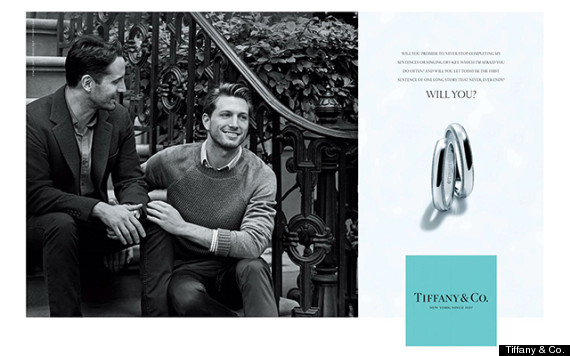
Tiffany Ad Features Gay Couple for First Time
They aren’t models, either. They’re a real couple.
Diane Anderson-Minshall
www.advocate.com/politics/marriage-equality/2015/01/10/tiffany-ad-features-gay-couple-first-time
Hot Damn! Will The Wigs Come Off In Next Week’s Episode Of “Branson Famous”?
Okay, okay, we have a confession to make: We’re absolutely, positively obsessed with the show Branson Famous. The country-themed “reality television musical” has us grinning like a possum eating a sweet potato. We can’t get enough of all the big hair and sequined dresses, family dramas and burning jealousies, and, of course, the impromptu singing confessionals.
In Episode 1 we were introduced to the Mabe family, who run a variety show called Baldknobbers Jamboree in the ist town of Branson, Missouri. Naturally, there was quite a bit of family drama, mainly between Patty, the brassy family matriarch, and her son Brandon’s stubborn-as-a-mule girlfriend, Megan, who Patty reckons “came in like a sweet rain, then she tore through my family like a hurricane.”
Then Episode 2 introduced blonde bombshell Heater Gentry, a sultry, self-proclaimed “Country Britney Spears” from Mississippi who is determined to prove she’s got what it takes to make it in the country music scene, much to Megan’s disdain.
What will Episode 3 have in store? We can’t wait to find out.
Don’t miss the latest episode of Branson Famous on TruTV on January 12 at 10/9C.
Like Branson Famous on Facebook
Watch clips and more on YouTube
Branson Famous Interactive Trailer
Graham Gremore
Republican Attorneys General In Louisiana, Texas Vow To Continue Defending 'Institution' Of Marriage In Face Of Obvious Defeat
Republican attorneys general in Louisiana and Texas say they plan to keep fighting even if the 5th U.S. Circuit Court of Appeals stirkes down bans on same-sex marriage in the two states.
As we’ve reported, such an outcome appears likely based on oral arguments, assuming the 5th Circuit decides to rule rather than waiting for the Supreme Court to settle the issue.
Louisiana Attorney General James D. “Buddy” Caldwell (above left) issued a statement late Friday:
Through the democratic process, Louisiana citizens have previously voted to establish this definition of marriage and to add it to the state’s constitution.
Louisiana’s Attorney General prevailed at the trial court level and was the first attorney general in the nation to win on this issue. Today’s appearance was in support of the trial court’s favorable decision.
Attorney General Caldwell said, “I was joined at counsel table today by constitutional law experts Kyle Duncan and Mike Johnson, both of whom I retained to assist my office with this important task of defending our constitution, which is the expression of the will of our Louisiana citizens.
“As I’ve said previously, as Louisiana’s attorney general, I will do everything in my power to uphold the will of our citizens and the right of states to manage their own affairs.”
“In 2005, Texans overwhelmingly supported a constitutional amendment defining marriage as the union of one man and one woman,” Paxton said. “I am committed to defending the Texas Constitution, the will of our citizens and this sacred institution.”
Mississippi’s attorney general and governor have been less outspoken about defending the state’s marriage ban, saying only that they believe it’s their duty to defend state laws, and I was unable to find statements from them about oral arguments. Their apparent silence may reflect the growing trend of resignation to marriage equality even among conservative Republicans, who recognize it’s a losing cause and no longer politically advantageous.
For example, neither Texas Gov. Rick Perry nor Gov.-elect Abbott, both Republicans who’ve vigorously defended the state’s marriage ban in court and elsewhere, had anything to say about Friday’s hearing. Moreoever, there didn’t appear to be any organized anti-gay presence outside the courthouse in New Orleans — the site of a historic hearing on same-sex marriage in the heart of the Deep South. Instead, the opposition was represented in the media by a smattering of well-paid anti-LGBT operatives, such as Texas Values President Jonathan Saenz (right).
But it appeared Saenz, whose wife famously left him for a woman, was determined to compensate for the poor turnout with some over-the-top rhetoric. From Talk Radio 1190 AM in Dallas:
Advocates call it a matter of equality, but Saenz disagrees.
“Redefining marriage equals private businesses being forced to fund and participate in an issue that’s not even settled by the Supreme Court,” he says.
“Redefining marriage equals men entering little girls’ bathrooms, and redefining marriage equals pastors being persecuted,” Saenz says referencing the battle over transgender restroom rights in Houston.
Saenz says the Sixth Circuit already upheld gay marriage bans.
“Marriage between one man and one woman has such a long tradition that it’s measured by millennia, not centuries or decades,” he says.
More from Saenz in OneNewsNow:
“The tradition, until recently, had been adopted by all governments and major religions of the world,” notes Jonathan Saenz of Texas Values. “That’s how settled the issue of marriage has been in our country and in our world. And in Texas we dealt with this issue before and settled it at the polls the way it should, when voters voted 76 percent in 2005.
Saenz contends, “It’s really a shame that all of that legitimate work could be undone by the stroke of a pen of a few federal court judges, but I think that a lot of people and a lot of legal experts believe and agree that the federal Fifth Circuit Court of Appeals will rule in favor of state marriage laws. That will be for Texas, that will be for Louisiana and Mississippi, and that will be a significant turning point in the debate and the discussion on this issue.”
Saenz adds that homosexuals claim equality as the overpowering argument, but in states where same-gender “marriage” is legal, it is used as a battering ram against Christians and Christian-owned businesses. He suggests that is hardly equality.
John Wright
Starkville, Miss. Repeals State's First Anti-Discrimination Ordinance
While two city council members voted to continue supporting LGBT employees and their partners, they were overruled by five others in a closed-door session. Now, can the mayor veto it?
Diane Anderson-Minshall
Tiffany Ad Features Gay Couple, Rings In New Year In A Big Way
Tiffany & Co. is engaging new customers.
The venerable jeweler features a gay couple for the first time in an ad, according to Time.
The photogenic men, who are a real couple in New York City, are pictured on a stoop for Tiffany’s “Will You” , next to a picture of two rings.
“Will you promise to never stop completing my sentences or singing off-key, which I’m afraid you do often?” the copy reads. “And will you let today be the first sentence of one long story that never, ever ends?”
Tiffany rep Linda Buckley told ELLE in a statement that love stories come “in a variety of forms.” “The Tiffany engagement ring is the first sentence of the story that a couple will write together as they create a life that is deeply intimate and exceptional.”
While it is still noteworthy that an iconic company like Tiffany is using same-sex imagery to advertise, the strategy has become increasingly common as gay marriage gains popularity. Advertisers such as Cheerios, Honey Maid and Ray-Ban have already paved the way.
www.huffingtonpost.com/2015/01/10/tiffany-gay-ad_n_6447830.html?utm_hp_ref=gay-voices&ir=Gay+Voices
5th Circuit Likely to Strike Down Gay Marriage Bans: An Analysis of the Hearing
There are several great summaries out there about what happened yesterday at the Fifth Circuit, which heard marriage equality appeals from Texas, Louisiana, and Mississippi. Among others, I recommend the summaries from Chris Johnson at the Washington Blade and Chris Geidner at Buzzfeed. I would like to go one step deeper. I have listened to the audio from the oral argument (as you can too, here). As with other oral arguments, I find the most insightful indication of how a judge is leaning is not the number of questions asked or to which lawyer he asks more, but the language and tone of those questions. I found that especially true with Judge Higginbotham (pictured, right) on Friday.
When analyzing oral arguments, I always caution that any connection between a judge’s questions and his or her ultimate decision is purely speculative. There are court-watchers who do studies about these things. But my reports on marriage equality hearings at the Fourth, Sixth, Seventh, Ninth, and Tenth Circuits, not to mention at the Supreme Court, suggest that we can draw conclusions. On all the metrics, it looks like marriage equality will win the day at the Fifth Circuit.
First, I will discuss those metrics. Then I will discuss where we go from here.
CONTINUED, AFTER THE JUMP…
Questions Asked To Lawyers. This metric is based on the notion that appellate court judges tend to ask more questions to the side of the argument they are inclined to oppose. That makes some sense: you ask questions because you are skeptical. As a related point, the side peppered with more questions presumably has the tougher case to make, which makes it more likely to lose. Sometimes, a judge will lob a helping hand at a beleaguered attorney, but you can bracket those and come up with a simple analysis.
Judge Higginbotham did not ask a single question to Camilla Taylor, the Lambda Legal attorney representing the plaintiffs in the Louisiana case. However, during a single 20 minute span during Louisiana’s argument in favor of its ban, Judge Higginbotham went toe to two with Louisiana’s attorney, Kyle Duncan (right), sentence for sentence. The attorney only barely spoke for more minutes than Judge Higginbotham during that time. Robbie Kaplan, the Paul Weiss attorney who represented Edie Windsor, also faced no questioning for the first part of her argument.
Ms. Kaplan deserves special recognition for her argument at the hearing. An accomplished attorney long before she came to represent Edie Windsor, Ms. Kaplan offered concise, smart, and well-reasoned responses to the judge’s questions. And, in response to Judge Smith, she wone the day: his crealy arguments could not withstand her onslaught.
Judges Arguing With Each Other. This metric gets closer to evaluating a judge’s views because it’s not about the number of questions or statements, but to whom they are directed and the substance of that back-and-forth. This might be helpful in evaluating which way swing judges are leaning, if they talk at all.
Judge Higginbotham spoke a lot, and when he was arguing with anyone other than the lawyers from the states (see above), he was arguing with Judge Smith.
Judge Smith (right) spent his question time on two things: Baker v. Nelson, the 1971 case that ended in a simple, one-line denial from the Supreme Court that said that challenges to state refusals to recognize gay marriage bring up no federal issues, and the level of scrutiny for the bans. We’ve heard the Baker argument before: it was not only rejected, but laughed out of court by Judge Posner and others. The only appellate judge to accept its continued validity despite so many changes in the interim was Judge Sutton on the Sixth Circuit.
We’ve also seen the level of scrutiny debate many times. Judge Smith wants rational basis review, the lowest form of court review of a law, but like his view of Baker, he manages to get this one wrong, too. Rational basis review requires a court to uphold a legislative act if there is any legitimate connection between the law and the problem it is supposed to solve. To Judge Smith, that means that if a court declares a law unconstitutional under the rational basis standard, it is really saying that the people who passed a marriage ban were being utterly “irrational.”
That’s a logical misstep, and both Judge Higginbotham and Judge Graves (pictured, right), an Obama appointee who has a great voice for radio (per the audio of argument). Declaring a law unconstitutional does not mean the people who passed it were raving lunatics; it just means that there is really no connection between this law and the underlying objective and whatever the public’s reason for passing the law, it is not countenanced by the Constitution.
Judge Smith is a non-starter for marriage equality. He showed himself hostile to equality and, with all due respect, reason. He bore the brunt of Judge Higginbotham’s judge-to-judge sparring, which may be an indication of where Judge Higginbotham is headed.
Tone and Language. This is a squishier metric because it doesn’t count numbers, it looks at the language a judge uses. Remember Judge Niemeyer of the Fourth Circuit, the rabidly antigay judge who talked a lot about “homosexual marriage” and called same-sex relationships “new” and “different”? That language spoke volumes about his substantive views. Judges, on the other hand, that use the word “gay” instead of “homosexual,” who refer to “marriage” rather than “gay marriage” or “homosexual marriage,” and who talk about “loving” couples rather than biologically-created children are also tipping their hats on their views. Notably, this metric doesn’t always work: Judge Posner wrote a powerful pro-equality decision that was utterly dismissive of antigay arguments; perhaps because of his age, he uses the phrase “homosexual marriage” at times.
At the Fifth Circuit, you had a smattering of different language uses, but Judge Higginbotham and Judge Graves, the Obama appointee, used language that was considerably more modern and accepting of the equality of gay relationships. That is especially notable given that Judge Higginbotham is pushing 80 years old.
***
Where do we go from here? The case submitted and argued, the judges will consider the briefs and oral argument and write a decision. I expect, like many who have analyzed the argument, that the decision will be 2-1 in favor of marriage equality. That would affirm the lower court rulings in Texas and Mississippi and reverse the district court in Louisiana. I checked the publicly available statistics on the Fifth Circuit and the court is not as slow in delivering its opinions as the Ninth, but its rate varies wildly. Still, I would expect a decision in no less than 2 months.
But this might all be a sideshow to the real battle at the Supreme Court. As I discussed yesterday, the justices considered the numerous marriage equality cases out of the Sixth Circuit, but did not issue any orders. That could mean that they are waiting until Monday to issue grants and denials or that they have more to talk about. Either way, the delay is no big deal.
Notably, one of the cases up for review by the Supreme Court is the Louisiana case, which both parties appealed directly to the Supreme Court because they wanted to bypass the Fifth and get it all over with. I doubt the Court will take it: the Court rarely takes cases that go outside the normal course and skip the appellate court.
A couple of possibilities here: The Supreme Court could take the Louisiana case, in which case, the Fifth Circuit would not have it to address and may delay in issuing any decision. The Supreme Court could delay and wait to hear what the Fifth Circuit has to say, but that’s unlikely given that it denied certiorari in the Fourth, Seventh, and Tenth Circuits because there was no reason to intervene; the Sixth Circuit cases give the justices a reason to intervene. Or, the Supreme Court could take a case out of the Sixth Circuit and let the Fifth issue a Louisiana opinion independently.
Stay tuned!
***
Follow me on Twitter and on Facebook.
Ari Ezra Waldman is a professor of law and the Director of the Institute for Information Law and Policy at New York Law School and is concurrently getting his PhD at Columbia University in New York City. He is a 2002 graduate of Harvard College and a 2005 graduate of Harvard Law School. Ari writes weekly posts on law and various LGBT issues.
Ari Ezra Waldman
Saks Claims It Has the Right to Discriminate Against Transgender Employees
Is it legal to discriminate against an employee for being transgender? The Justice Department, the Equal Employment Opportunity Commission, and some courts say no. But in a motion filed in federal court, Saks & Co. (HBC:CN) says yes.
You must be 18 years old or older to chat
