Category Archives: MISC

Leonardo da Vinci Saw in Animals the ‘Image of the World’

Leonardo da Vinci Saw in Animals the ‘Image of the World’

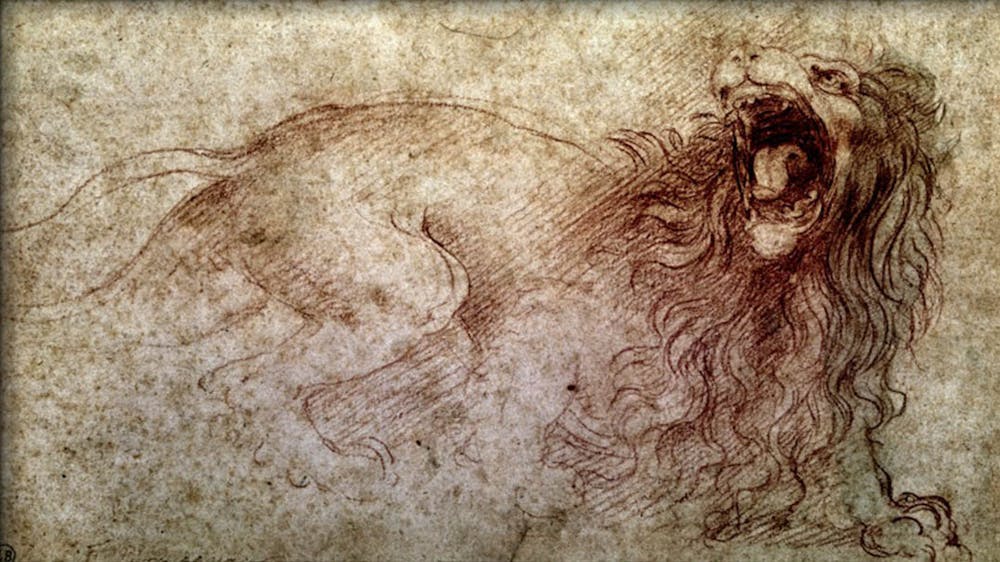
From cats to dragonflies, Leonardo sketched scores of animals. Leonardo da Vinci/Royal Collection Trust

About six months ago I stopped eating meat. I was teaching a graduate course at UCLA that investigated how Italian Renaissance writers conveyed their concepts about the human through writing about the nonhuman – plants, animals, objects, angels, demons, gods and God. As weeks passed, I found myself becoming more and more attuned to the nonhuman entities all around me, more aware of their vibrant lives. Cutting flowers for a short-lived bouquet seemed wrong; chewing on animal flesh became flat out impossible.

Leonardo da Vinci was one of the authors we were studying in the course. Out of the thousands of pages comprising his 25 documented codices, known collectively as his “Notebooks,” we read passages describing the natural world and its inhabitants, and some of his philosophical maxims, fables and riddles. In a striking passage that introduces his “Treatise on Water,” he wrote:

“By the ancients man has been called the world in miniature; and certainly this name is well bestowed, because, inasmuch as man is composed of earth, water, air, and fire, his body resembles that of the earth; and as man has in him bones — the supports and framework of his flesh —, the world has its rocks — the supports of the earth; as man has in him a pool of blood in which the lungs rise and fall in breathing, so the body of the earth has its ocean tide which likewise rises and falls … ”

Unlike many thinkers of his time who anthropomorphized the Earth, Leonardo terramorphized man. But it was not just man that Leonardo saw as a Platonic microcosmic-world-in-miniature. Animals, he wrote, are “the image of the world.” They reflect the Earth, just as we do.

Leonardo’s animals hold their own against human beings.
Leonardo da Vinci

Humans not superior to animal world

Leonardo never challenged the Christian belief that human beings were made in the image of God, nor the classical notion that man’s proportions and symmetries (albeit a white, middle-aged, able-bodied, European man) were beautiful and worthy of imitation in architecture and art. But he also never claimed other living beings were less beautiful, soulless, or lacked intelligence.

When comparing animals and humans – which he did often – animals often came out looking better. In one of his notes, Leonardo wrote, “Man has much power of discourse, which for the most part is vain and false; animals have but little, but it is useful and true, and a small truth is better than a great lie.” He often pointed out how much more powerful animals’ senses were, how much faster, stronger, more efficient and capable they were of performing remarkable feats, such as flight.

And animals were not nearly as “bestial” to one another as humans could be. “King of the animals – as thou hast described him – I should rather say king of the beasts,” he wrote. Leonardo lamented how human stomachs have become “a sepulcher for all animals” and how “our life is made by the death of others.”

Leonardo the vegetarian?

This passage, along with other writing about humans as killing machines and their esophagi as animal cemeteries, as well as a few comments by his contemporaries, have led many to believe that Leonardo was a vegetarian.

There is a 1515/6 letter by the Italian explorer Andrea Corsali to Giuliano de’ Medici that – in discussing how the Gujarati of India won’t eat anything with blood or allow hurt to come to any animate thing – says they are “like our Leonardo da Vinci.” Corsali, however, did not know Leonardo well, and the sentence is ambiguous; it could just mean that Leonardo never hurt animals or wanted to see them hurt.

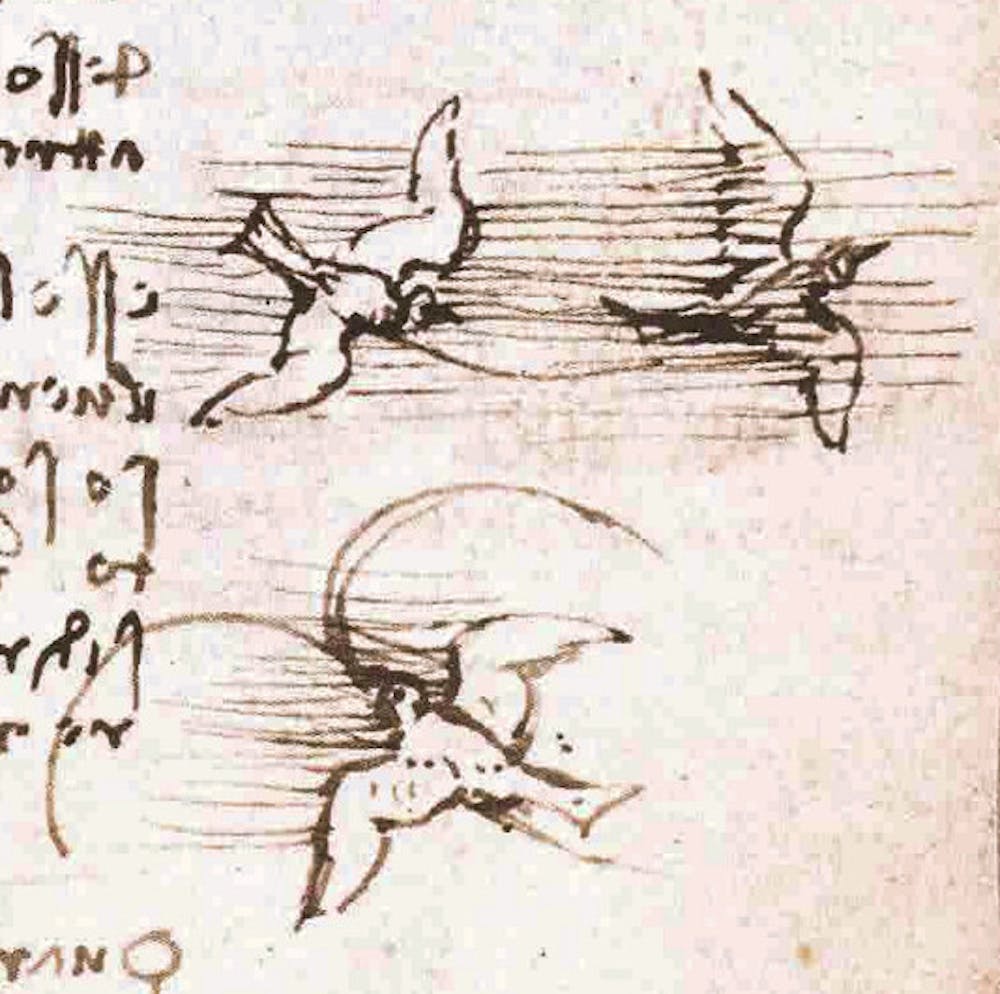
Leonardo was captivated by birds’ power of flight.
Leonardo da Vinci/Wikimedia Commons

Artist and biographer Giorgio Vasari (1511-1574) noted that Leonardo was famed for buying caged birds and setting them free and Leonardo did, in fact, advocate for eating Nature’s abundant senplici (“simples”), a term which seems to imply plant-based recipes. He pondered why Nature had created a world in which animals ate each other, but concluded it was because life is compelled to reproduce and endure, and consequently, Nature needed a way to keep numbers down.

Nowhere in his writing, however, did he speak of not eating meat. His grocery lists have meat on them, although it is possible he was purchasing it for members of his household: students, servants, guests, animals.

Whether he ate a totally meat-free diet or not is unclear, but his love for animals is unquestionable. He lived with animals on a farm as a child and they were ever-present in his studio – likely cats and dogs, insects, birds and reptiles (some alive, some deceased). Leonardo studied them, depicted them, wrote about them and built machines – even war machines – inspired by them.

Leonardo’s ‘Allegory of a Dog and an Eagle.’
Leonardo da Vinci/Royal Collection Trust

Literary animals

Leonardo’s literary writing – fables, riddles, aphorisms – is filled with animals. While they often serve as Aesopic moral stand-ins for humans, Leonardo also used them differently than other classical, medieval and Renaissance fabulists, contrasting them to humans, celebrating their strengths and wisdom and critiquing how humans treat them.

In his “Prophecy” riddles — which read like predictions of a horrendous apocalyptic future — one encounters legions of cruelty and pain. “I see children of thine given up to slavery to others … paid with the severest suffering, and spend[ing] their whole life benefiting those who ill treat them.” As a riddle, this is not what it seems. He’s writing not of humans, but rather, of donkeys, and how humans repay their services with unkindness and even violence. That said, in an empathic move, Leonardo was also linking humans to donkeys, and pointing to the ever-present fact that humans subject other humans to terrible fates.

In another riddle he noted the twistedness of horned animals being slaughtered by horn-handled knives, and the ostensible cannibalism of masters of estates “eating their own laborers” – oxen.

And in a particularly chilling prophecy, he described animals so full of evil that they were destroying all life on land and sea: He cries, “O Earth! Why dost thou not open and engulf [these animals] in the fissure of thy vast abyss and caverns, and no longer display in the sight of heaven such a cruel and horrible monster!” The monster, of course, is man.

Although many people assume Leonardo’s Vitruvian Man is an indication of an adherence to the commonly, but not universally, held Renaissance notion that man was the most perfect of beings and “the measure of all things,” his literary and artistic production seem to show that he saw animals as the true “image of the world.” While he included human beings in the group he called “animals,” it was not as preeminent entities, but as one of the world’s infinite, beautiful varieties.

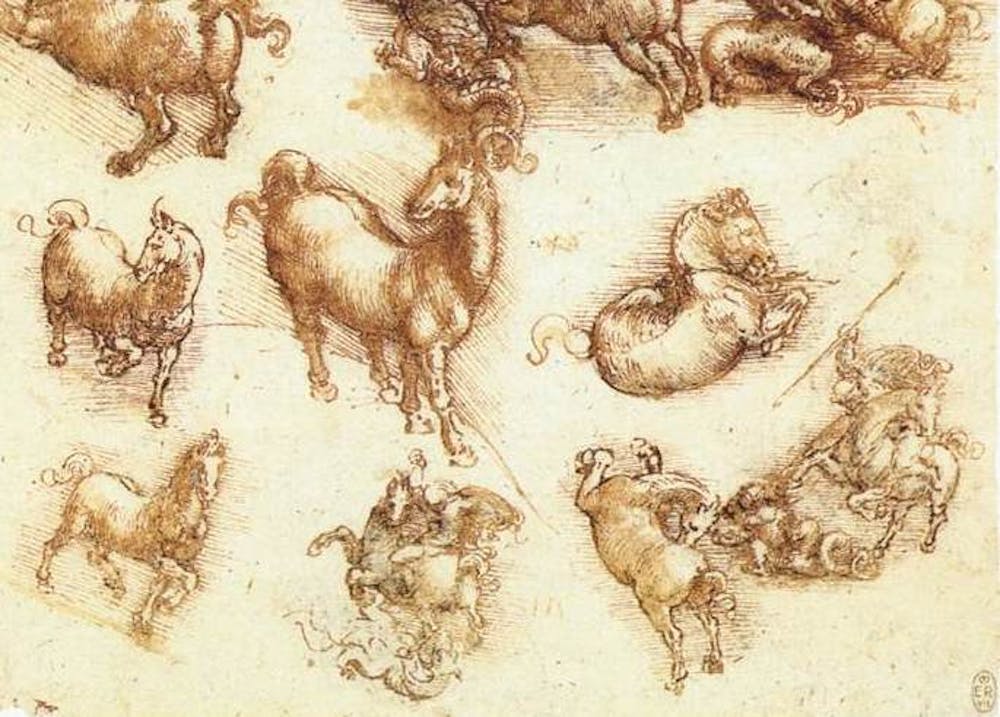
Horses were among the animals Leonardo most frequently sketched.
Leoardo da Vinci

Animals on their own terms

Animals proliferate in Leonardo’s visual art. In his sketches we see horses run, trot, rear up on back legs, fall. Birds, bats and insects extend their wings. Cats stretch, wrestle and lounge. Lions roar. Bears, dogs, crabs, rhinoceroses quietly stand or walk. Beetles and ants bend their appendages.

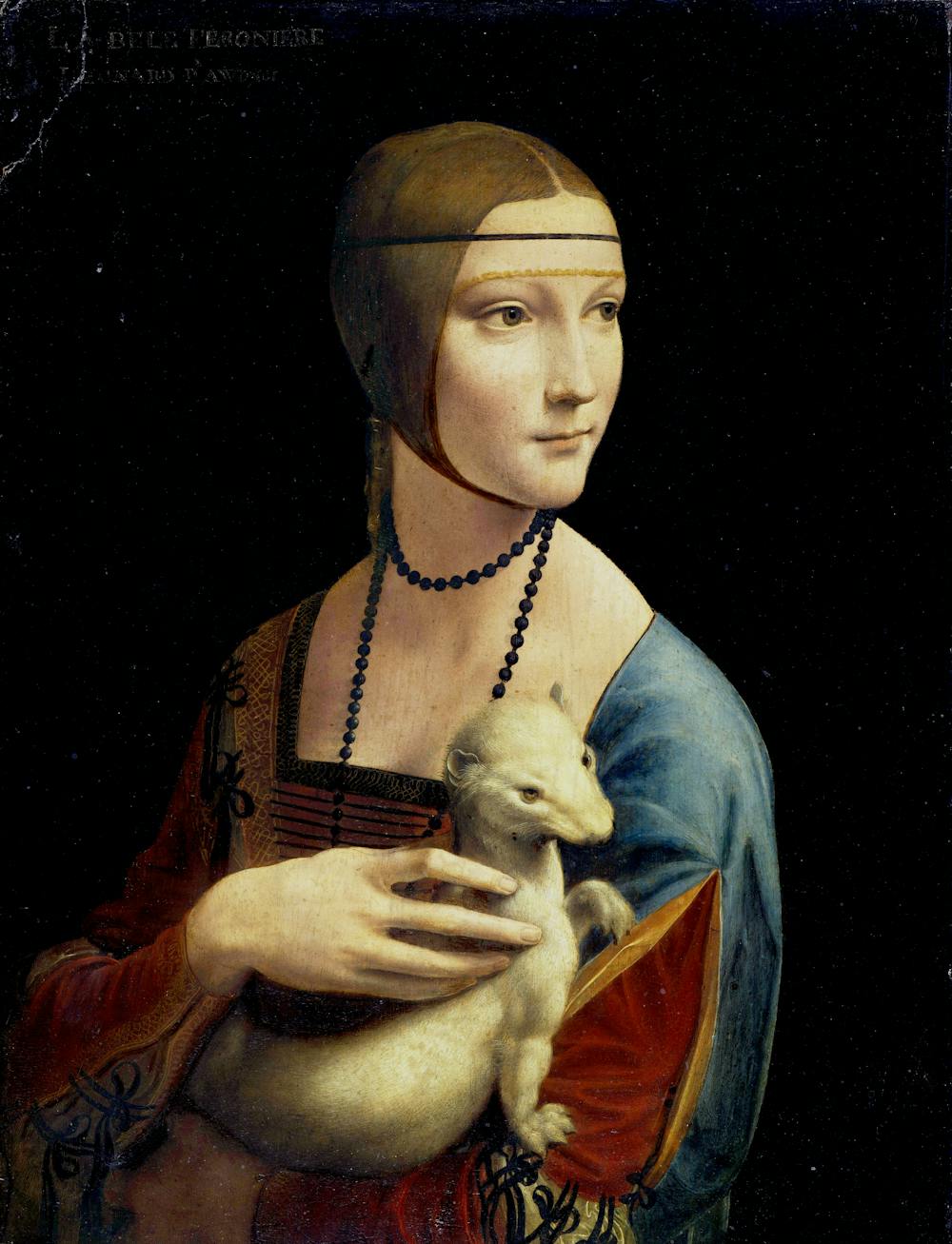
‘The Lady with an Ermine (Portrait of Cecilia Gallerani)’
Leonardo da Vinci/Wikimedia Commons

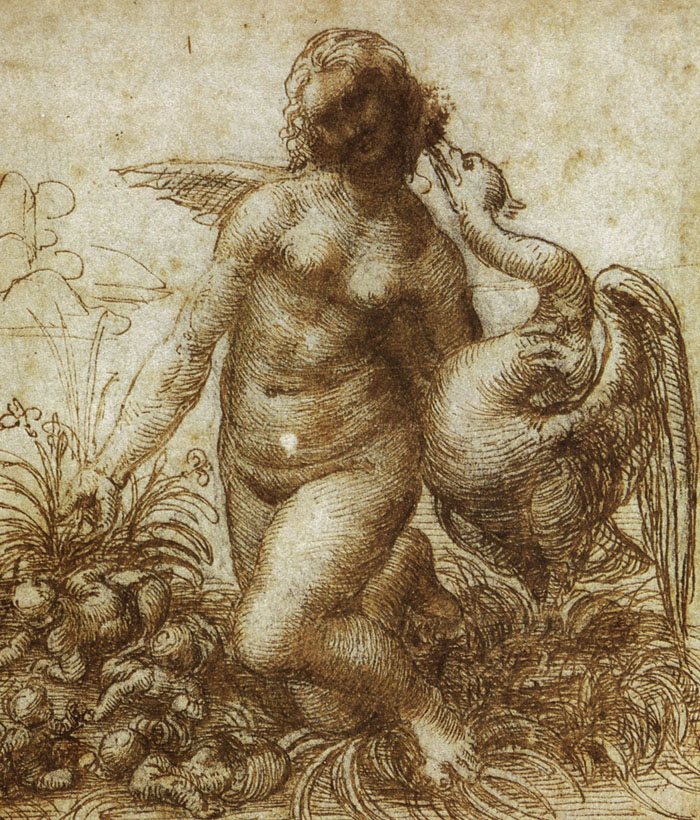
His animals are anything but nature-morte; they are alive with motion and, seemingly, emotion. Within his paintings one can see, for example, a gentle, communicative lion in the unfinished “Saint Jerome in the Wilderness” (c. 1480); an affectionate ermine in “Lady with an Ermine” (1489-90); an erotic swan in the 1503-1507 sketches for a never-produced painting, “Leda and the Swan”); a lamb being hugged by the child Jesus in “The Virgin and the Child with Saint Anne” (1510). And, of course, horses: ceremonial and military (“The Adoration of the Magi” (1481), “The Battle of Anghiari” (preparatory studies, 1504-1505).

All these animals are present in his writing, too, joined by an ark-load more: domesticated, wild, local, exotic, mythical (dragons!) and imaginary (sea-monsters!). Leonardo’s depictions of animals emerge not only as forces that teach us about ourselves and challenge our sense of human primacy, but as powerful, creative forces, on their own terms.

Leonardo chipped away at the walls between “us” and “them” by placing all life on a level field, all things as micro-reflections of a macro-whole. And as he envisioned in his terrifying visual and verbal depictions of catastrophic deluges and global disasters, we’re all in this together.

Arielle Saiber, Professor of Romance Languages and Literatures, Bowdoin College

This article is republished from The Conversation under a Creative Commons license. Read the original article.

The post Leonardo da Vinci Saw in Animals the ‘Image of the World’ appeared first on Towleroad Gay News.


Leonardo da Vinci Saw in Animals the ‘Image of the World’

Buttigieg, Sanders, Warren, AOC Blast Trump for Tweeting Video Inciting Violence Against Muslim Rep. Ilhan Omar

Buttigieg, Sanders, Warren, AOC Blast Trump for Tweeting Video Inciting Violence Against Muslim Rep. Ilhan Omar

Late Friday Donald Trump tweeted out an altered video of Muslim Rep. Ilhan Omar (D-MN) at a March event for the Muslim civil rights organization Council on American-Islamic Relations (CAIR).

Said Omar in that speech: “Far too long we have lived with the discomfort of being a second-class citizen, and frankly, I’m tired of it, and every single Muslim in this country should be tired of it…CAIR was founded after 9/11 because they recognized that some people did something and that all of us were starting to lose access to our civil liberties.”

WE WILL NEVER FORGET! pic.twitter.com/VxrGFRFeJM

— Donald J. Trump (@realDonaldTrump) April 12, 2019

The video Trump tweeted out interspersed Omar’s words with images from 9/11 (warning: graphic).

Trump’s tweet drew immediate backlash.

Tweeted Pete Buttigieg, an Afghanistan veteran: “After 9/11 we all said we were changed. That we were stronger and more united. That’s what “never forget” was about. Now, a president uses that dark day to incite his base against a member of Congress, as if for sport. As if we learned nothing that day about the workings of hate. That day, some people did this: killed thousands of Americans in order to try to make us smaller, more divided and less free. To weaken us by distancing us from our own values through fear and anger. This is the function of terrorism.”

That day, some people did this: killed thousands of Americans in order to try to make us smaller, more divided and less free. To weaken us by distancing us from our own values through fear and anger. This is the function of terrorism.

— Pete Buttigieg (@PeteButtigieg) April 13, 2019

Buttigieg added: ‘I served overseas, at risk to my life, in the struggle against such terrorism. But it can only be fully defeated if we have leaders at home who defuse its capacity to sow hate—hate against Islam or against any number of “others.” The president today made America smaller. It is not enough to condemn him; we must model something better.’

“The threats against the life of @IlhanMN make clear what is at stake if we fail to to do this, and to beat back hate in all all its forms,” he said.

The president today made America smaller. It is not enough to condemn him; we must model something better.

— Pete Buttigieg (@PeteButtigieg) April 13, 2019

The threats against the life of @IlhanMN make clear what is at stake if we fail to to do this, and to beat back hate in all all its forms.

— Pete Buttigieg (@PeteButtigieg) April 13, 2019

Bernie Sanders reacted: “Ilhan Omar is a leader with strength and courage. She won’t back down to Trump’s racism and hate, and neither will we. The disgusting and dangerous attacks against her must end.”

Ilhan Omar is a leader with strength and courage. She won’t back down to Trump’s racism and hate, and neither will we. The disgusting and dangerous attacks against her must end.

— Bernie Sanders (@BernieSanders) April 13, 2019

Elizabeth Warren blasted the President: “The President is inciting violence against a sitting Congresswoman—and an entire group of Americans based on their religion. It’s disgusting. It’s shameful. And any elected leader who refuses to condemn it shares responsibility for it.”

The President is inciting violence against a sitting Congresswoman—and an entire group of Americans based on their religion. It’s disgusting. It’s shameful. And any elected leader who refuses to condemn it shares responsibility for it.

— Elizabeth Warren (@ewarren) April 13, 2019

Rep. Alexandria Ocasio-Cortez spoke out as well: ‘Members of Congress have a duty to respond to the President’s explicit attack today.@IlhanMN’s life is in danger. For our colleagues to be silent is to be complicit in the outright, dangerous targeting of a member of Congress.We must speak out. “First they came…”’

Members of Congress have a duty to respond to the President’s explicit attack today.@IlhanMN’s life is in danger. For our colleagues to be silent is to be complicit in the outright, dangerous targeting of a member of Congress.

We must speak out.

“First they came…” pic.twitter.com/ygOX1vhE9j

— Alexandria Ocasio-Cortez (@AOC) April 12, 2019

Rep. Rashida Talib (D-MI) tweeted: “Enough is enough. No more silence, with NY Post and now Trump taking Ilhan’s words out of context to incite violence toward her, it’s time for more Dems to speak up. Clearly the GOP is fine with this shameful stunt, but we cannot stand by.”

Enough is enough. No more silence, with NY Post and now Trump taking Ilhan’s words out of context to incite violence toward her, it’s time for more Dems to speak up. Clearly the GOP is fine with this shameful stunt, but we cannot stand by.

— Rashida Tlaib (@RashidaTlaib) April 12, 2019

Trump’s tweet was preceded by outrage over the marks on right-wing media. On FOX & Friends, Brian Kilmeade wondered aloud if the Somali-American congresswoman is “an American first.”

Kilmeade later backtracked: “I didn’t intend to question whether Rep. Omar is an American – I am questioning how any American, let alone a United States Congresswoman, could downplay the 9/11 attacks.”

Ilhan Omar responded to Kilmeade’s charge.

This is dangerous incitement, given the death threats I face. I hope leaders of both parties will join me in condemning it.

My love and commitment to our country and that of my colleagues should never be in question. We are ALL Americans! pic.twitter.com/foTZMpiZKv

— Ilhan Omar (@IlhanMN) April 10, 2019

Omar also appeared on The Late Show with Stephen Colbert.

She told Colbert: “When you have people on Fox News question whether I am actually American or I put ‘America first,’ I expect my colleagues to also say, ‘That’s not OK’ and call that out.’ I took an oath to uphold the Constitution. I am as American as everyone else is.”

The post Buttigieg, Sanders, Warren, AOC Blast Trump for Tweeting Video Inciting Violence Against Muslim Rep. Ilhan Omar appeared first on Towleroad Gay News.


Buttigieg, Sanders, Warren, AOC Blast Trump for Tweeting Video Inciting Violence Against Muslim Rep. Ilhan Omar

Lenten Devotional: We Are in This Together

Lenten Devotional: We Are in This Together

People — including the LGBTQ faithful — look to their faith as a source of guidance and inspiration. Throughout the Lenten season, HRC will share devotionals from faith leaders, LGBTQ people and allies. The campaign seeks to create an environment in which LGBTQ people of faith and their allies can practice the spiritual traditions of their faith in a welcoming, inclusive environment.

The Lenten season marks the days leading up to Jesus’ crucifixion and subsequent resurrection. For Christians, the resurrection is both a celebration of life and a reminder that people continue to suffer, including members of the LGBTQ community.

It is important to note that the season of Lent is observed by many Christian denominations and may not resonate with all readers. With this series, HRC seeks to amplify and honor the voices of LGBTQ-affirming faith leaders in many religious traditions.

Today’s post is a reflection on Ruth 1:16-17a, and it comes from J.J. Warren, a certified candidate for ministry in the United Methodist Church denied full certification because of Warren’s queer identity.

For more about the Lenten Devotional, visit hrc.im/Lent.


Do not press me to leave you

    or to turn back from following you!

Where you go, I will go;

    where you lodge, I will lodge;

your people shall be my people,

    and your God my God.

Where you die, I will die —

    there will I be buried.

Lent today is not all that different from the first Lent more than 2,000 years ago. We still grapple with economic imperialism. We are still torn by interreligious strife and apathy. Marginalized people are still harmed by those in power, and God’s presence is still silenced in those who don’t reflect the majority. In many ways, Lent today is exactly like that first Lent.

Within these circumstances, a powerful woman of color provides guidance for us. Ruth, a Moabite (a tribe excluded from the people of God by law), declares her love for and devotion to her mother-in-law, Naomi: “Where you go, I will go … Where you die, I will die.”

As a queer United Methodist, my denomination recently reinforced its ruling that I am excluded from serving the people of God. Still, I follow the wise prophets who have tread this path before me. Where they go, I will go; and when they grow weary of fighting, I will sacrifice myself for the justice they pursued.

Struggling to stay in a faith that rejects us is the Lenten story. Ruth reminds us that no matter how difficult the terrain ahead, we are in this together. We will journey toward justice, and we won’t cease until we’ve reached the Promised Land.


The Lenten Devotional is a faith-driven resource that compiles meditations written by 47 faith leaders from across the U.S. This project and other public education work with faith leaders in HRC’s Project One America states and HRC’s Religion and Faith Program is made possible in part by the generous support of the E. Rhodes and Leona B. Carpenter Foundation.

www.hrc.org/blog/lenten-devotional-we-are-in-this-together?utm_source=rss&utm_medium=rss-feed