Category Archives: MISC

AAUP Condemns Trigger Warnings As A 'Threat To Academic Freedom'

AAUP Condemns Trigger Warnings As A 'Threat To Academic Freedom'
The American Association of University Professors, one of the nation’s leading college faculty groups, announced this week it formally opposes the use of “trigger warnings” in classrooms and on class syllabi.

In a lengthy statement outlining the AAUP’s position, the group called trigger warnings — whether mandatory or voluntary — a “threat to academic freedom.” The use of them by faculty in a classroom setting could skew the choice of course materials and teaching methods, AAUP said, and would prove “counterproductive to the educational experience.”

Trigger warnings have existed for decades in some form, but grew in popularity online from the days of LiveJournal a decade ago to today’s Tumblr and Twitter age of the Internet. As the Associated Press noted in April, the trigger warnings have now made their way into classrooms at some of the most prestigious colleges in the country, sparking a debate about what limit, if any, should be placed on their use.

AAUP took a swipe at Oberlin College in Ohio for issuing a guidance of topics like “heterosexism, cissexism, [and] ableism,” that professors may want to use caution when discussing for fear of “triggering” students. AAUP stated:

The presumption that students need to be protected rather than challenged in a classroom is at once infantilizing and anti-intellectual. It makes comfort a higher priority than intellectual engagement and—as the Oberlin list demonstrates—it singles out politically controversial topics like sex, race, class, capitalism, and colonialism for attention. Indeed, if such topics are associated with triggers, correctly or not, they are likely to be marginalized if not avoided altogether by faculty who fear complaints for offending or discomforting some of their students. Although all faculty are affected by potential charges of this kind, non-tenured and contingent faculty are particularly at risk. In this way the demand for trigger warnings creates a repressive, “chilly climate” for critical thinking in the classroom.

AAUP went on to discuss the cons of trigger warnings, noting one about suicide ahead of literature like “The House of Mirth” or “Anna Karenina” could prevent students from overlooking “the other questions about wealth, love, deception, and existential anxiety that are what those books are actually about.”

The AAUP, mind you, is not oblivious to the intense focus on campus sexual violence taking place over the past couple of years, and the unprecedented federal crackdown on colleges mishandling cases.

The group writes trigger warnings are not going to fix things around that issue:

It is probably not coincidental that the call for trigger warnings comes at a time of increased attention to campus violence, especially to sexual assault that is often associated with the widespread abuse of alcohol. Trigger warnings are a way of displacing the problem, however, locating its solution in the classroom rather than in administrative attention to social behaviors that permit sexual violence to take place. Trigger warnings will not solve this problem, but only misdirect attention from it and, in the process, threaten the academic freedom of teachers and students whose classrooms should be open to difficult discussions, whatever form they take.

www.huffingtonpost.com/2014/09/09/aaup-trigger-warnings_n_5792358.html?utm_hp_ref=gay-voices&ir=Gay+Voices

You’re Invited To The Stoli Guy NYC Finale With Betty Who & Blake Skjellerup

You’re Invited To The Stoli Guy NYC Finale With Betty Who & Blake Skjellerup

Screen Shot 2014-09-09 at 1.46.36 PM

The 12 Stoli Guy finalists are coming to New York City on Thursday, Sept. 18  for the dazzling nationwide finale, where they will all take the stage at the brand-new Space Ibiza NY and compete for a chance to win $10,000.

Pop sensation Betty Who, openly-gay Olympian Blake Skjellerup and designer Andrew Christian will judge the Stoli Guy finalists on their talent, personality and stage presence. NYC drag staple Sherry Vine will join Patrik Gallineaux, Stoli’s national LGBT ambassador, as guest co-host.

New York Queerty readers are invited to come watch the high-energy conclusion to the summer star search produced by GayCities. Cocktails will be included for everyone who RSVPs.

What: Stoli Guy National Finale
When: Thursday, September 18 at 8pm
Where: Space Ibiza NY, 637 W. 50th Street (at 12th Ave.)
Who: Stoli Guy finalists from across the country, Betty Who, Sherry Vine, Blake Skjellerup, Andrew Christian and you!

Click to RSVP to the Stoli Guy Finale

Featured Photo: Betty Who Facebook

Oscar Raymundo

feedproxy.google.com/~r/queerty2/~3/5G0_Qf-vQ44/youre-invited-to-the-stoli-guy-nyc-finale-with-betty-who-blake-skjellerup-20140909

Neil Patrick Harris and David Burtka marry and the "angry itch" takes over social media

Neil Patrick Harris and David Burtka marry and the "angry itch" takes over social media
2014-09-09-nph1024.jpg
Over the weekend, Neil Patrick Harris and his partner tied the knot with their two young kids attending. Harris confirmed on Twitter: “Guess what? David Burtka and I got married over the weekend. In Italy. Yup, we put the ‘n’ and ‘d’ in ‘husband.’ ” In case you missed the joke, that’s “N” for “Neil” and “D” for “David.”

Within hours of Harris’s tweet, news of the actors’ nuptials quickly became a trending topic on Facebook, going viral in the process. Not surprisingly, congratulations and “Likes” poured in, much like those for other married same-sex couples over the years. I’m thinking about celebrities like Ellen DeGeneres and Portia Di Rossi, for example, as well as Elton John and David Furnish. Not to be overlooked this weekend, tennis champion Martina Navratilova’s proposal to her girlfriend at the U.S. Open also garnered strong crowd approval – both in the stands and on social media.

As a columnist who covers LGBT issues, especially same-sex marriage, I posted a photograph of the two husbands on my site, each holding one of their children. The caption:

“Neil Patrick Harris and David Burtka are married. Join me in wishing congratulations to the happy couple.”

Simple enough. Seemingly innocuous. No doubt the editor at People.com thought the same thing in posting the story with this headline:

“Neil Patrick Harris Marries David Burtka”

An hour or so later, though, I realized much more was at stake than a mere congratulations. I found myself witnessing a vociferous and widespread backlash against the newlyweds on both social media services and sites like People and E! Online. Virtual smack downs were taking place all over the Internet, with little regard for civility much less respect. In short order, the Harris-Burtkas were called out as “sad and sick,” “disgusting perverts,” “sodomites,” “trash,” and some anti-gay slurs that can’t be reprinted here. Two posts in particular summed up the newlyweds’ detractors:

“This is evil and we must condemn it no matter what, where or who
is involved.”

“This is NOT marriage. This is a perversion of marriage…. Disgusting & immoral.”

I mentioned in an email what was occurring to a colleague, who immediately wrote back: “HONESTLY, who does not LOVE Neil Patrick Harris deep down inside.” That’s right, the star of “Doogie Howser, M.D.” and “How I Met Your Mother” had become a pariah to those opposed to same-sex marriage.

That’s when the light went off on in my head: Optimists like me look at the most recent Gallup Poll (which showed support for gay marriage at an all-time high of 55%) and tend to forget about that other 45%, who most decidedly do not. Among those over 50 and those in the South, in fact, majorities remain firmly against. According to the poll analysis: “[T]he older an American is, the less likely he or she is to support marriage for same-sex couples. Currently, adults between the ages of 18 and 29 are nearly twice as likely to support marriage equality as adults aged of 65 and older.” As for the year-long string of court wins, I’m reminded of the wisdom of philosopher Edmund Burke: “Manners are of more importance than laws. Upon them, in great measure, the laws depend.”

Court victories aside, the newlyweds’ detractors provided a focused snapshot that the road to marriage equality is not without its speed bumps — and its opponents not without their loud voices. If anything, yesterday’s free-for-all was a powerful reminder of “the angry itch” that persists when it comes to same-sex marriage rights and rites.

www.huffingtonpost.com/steven-petrow/neil-patrick-harris-and-d_b_5793486.html?utm_hp_ref=gay-voices&ir=Gay+Voices

Indiana and Wisconsin Ask Supreme Court To Review Challenges to Gay Marriage Bans, Plaintiffs Agree

Indiana and Wisconsin Ask Supreme Court To Review Challenges to Gay Marriage Bans, Plaintiffs Agree

6a00d8341c730253ef01a73e0b48f0970d-250wiAttorneys General from Indiana and Wisconsin filed petitions with the Supreme Court Tuesday, asking the Court to hear each state’s defense of their respective gay marriage bans that were both struck down by the 7th Circuit Court of Appeals. Notably, the 3 panel judge on the 7th Circuit ruled unanimously in favor of equality and against the bans—the first time such a decision was unanimous. The decision was written by Judge Richard Posner, whose pithy quips garnered media attention after he gutted the anti-equality arguments put forth by Indiana and Wisconsin. Now, the Supreme Court will have a chance to review Posner’s ruling. Chris Geidner from BuzzFeed reports:

6a00d8341c730253ef01a3fcd57649970b-250wiThe petitions are the sixth and seventh petitions seeking a writ of certiorari, which is the technical way the Supreme Court announces that it is taking a case.

Indiana presents a somewhat different case in practical terms — although it has not, thus far, made a difference in the legal analysis — in that the state has no constitutional ban on such marriages. It only has a state law banning them.

Quickly after the states filed their petitions, and as expected, the plaintiffs responded to the two states’ petitions, similarly urging the Supreme Court to grant the writs of certiorari:

6a00d8341c730253ef01a511ee26c6970c-200wiLambda Legal and the ACLU, representing the couples in the Indiana case, responded to Indiana’s certiorari petition, stating that the same-sex couples they represent “agree that the Court should grant review in this case because the issue is of fundamental importance to [the couples] and the country as a whole.”

The ACLU, representing the couples in the Wisconsin case, responded to Wisconsin’s petition on Tuesday as well.

Among the arguments put forth by both Indiana and Wisconsin, the most absurd assertion may have been that put forth by Indiana Attorney General Greg Zoller who, as Joe.My.God points out, argues,

“The court does not, and cannot, justify the assertion that Indiana’s definition of marriage targets homosexuals. The statue itself makes no mention of sexual orientation, and as the case record in this case amply demonstrates, homosexuals often do marry members of the opposite sex in Indiana.”


Sean Mandell

www.towleroad.com/2014/09/indiana-and-wisconsin-ask-supreme-court-to-review-challenges-to-gay-marriage-bans-plaintiffs-agree-r.html

Immoral, Infamous, Scandalous and Notoriously Disgraceful

Immoral, Infamous, Scandalous and Notoriously Disgraceful
Charlie Baker to “show cause.”

The letter was shocking and gobsmack-humiliating. It laid out the most private and intimate details of his sex life. Worse, the government sent the letter to him at his parents’ house where he was staying. Thank God, his parents did not open this letter, thought the gay twenty-two year old, a clerk/typist at the National Bureau of Standards, now the National Institute of Standards and Technology in Gaithersburg, Maryland. He never showed the letter to his parents.

Charles “Charlie” W. Baker returned to Washington last month to confront this obscene government letter he received at his parents’ home more than forty years ago.

“Dear Mr. Baker”, the 1971 letter from the Civil Service Commission began, “Your appointment as a Clerk-Typist GS-2, National Bureau of Standards, was made subject to investigation… because of acts of caressing, kissing, mutual masturbation, anal intercourse, and rubbing your bodies together (with four named males on various occasions) to obtain sexual climax. ” In addition,” the letter continued, the investigation was conducted because of Baker’s “frequent visits to public establishments where persons with homosexual tendencies tended to congregate.” The letter to Charlie Baker concluded with the boilerplate language for sexual “perverts” that the federal government typically included at that time: “In view of the above described immoral, infamous, scandalous and notoriously disgraceful conduct, you are invited to show cause why you should not be disqualified from Federal Employment.”
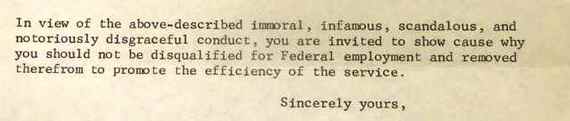
2014-08-27-BakerLtr4.jpg
Source: Kameny Papers, Library of Congress

The Civil Service Commission, the predecessor to today’s Office of Personnel Management and the agency that sent Baker this outrageous letter in 1971, had obtained the information from Baker’s Navy discharge papers. Baker had self-reported that he was gay to the Navy and was required to undergo interviews with a lawyer and a psychiatrist as part of his discharge process. Naïve and scared, Baker told them everything. He was asked deeply personal questions such as “Off duty, what did you do in bed and with whom?”, and “What is your relationship like with your Father?” The Naval discharge report containing answers to such questions would follow him for years chastising him for his sexual conduct as a gay man, until the government-enforced persecution and shaming were forgotten — as if nothing had ever happened.

But something did happen. A young man was wrongfully terminated from his job with the federal government. And his termination was not based on poor performance; on the contrary, his evaluations demonstrated that Baker was an exemplary employee. Rather, Charlie Baker was fired from his job with the NBS simply because he was gay. Nothing more. And being gay in 1971 meant the federal government did not want you regardless of qualifications or talent.

Ordered by the government to prove he was not homosexual, Baker was clueless as to how to proceed. That is, until he heard on the underground network of gay federal employees: “go see a man by the name of Dr. Franklin E. Kameny.” Baker heeded this advice. True to form, Kameny convinced Baker to stand and fight through the courts “up to and including the Supreme Court.” As Baker’s personal counsel, Kameny thundered, “Does the National Bureau of Standards actually believe in this intellectual drivel?” Dr. Kameny wrote to the NBS’ physicist Director, Dr. Lewis Branscomb, “Do you actually believe the employment of a homosexual clerk/typist (or a homosexual physicist, for that matter) is going to inhibit the ability of the NBS in the performance of its mission?”

Notwithstanding the support of his co-workers and superiors at the NBS, Bakers’ Appeal to the Civil Service Commission was denied in 1973. In a letter to Baker, the NBS wrote: “Dear Mr. Baker, this is to advise you that you are to be removed from your position in accordance with the attached letter of instruction from the Civil Service Commission.”

Baker and Kameny fought the case of Baker’s unlawful termination for three years at the Commission level and then again in federal court thanks to the generous and fearless pro bono attorneys from Covington & Burling; and Hogan and Hartson (now Hogan Lovell). The legal team was led by Ralph J. Temple of the American Civil Liberties Union, a civil rights lawyer who had worked for Thurgood Marshall. On behalf of Baker, the attorneys’ goal was to enjoin the federal government from firing government employees solely because they were gay. Baker’s case had morphed into the federal District Court matter of Baker v. Hampton, the first class action lawsuit seeking relief for all homosexuals threatened by the Commission’s most intrusive and disgusting personnel investigations.

In 1973, U.S. District Court Judge June L. Green ordered the NBS to reinstate Baker with back pay, but she would not enjoin the Civil Service Commission from further investigations and firings of gays across the board. In fact, Judge Green said the discriminatory terminations could continue if the Commission could show “particular circumstances… which may justify dismissal on charges relating to homosexual conduct.” Judge Green ruled for Baker, the individual, but she miserably failed the test of history, by allowing federal discrimination to remain an institutionalized practice for years to come.

With the support of his family and his partner of thirty-five years, Charlie Baker returned last month to Washington. The obscene “show cause” letter is now in the Library of Congress as a piece of historical evidence of the animus and discrimination faced by LGBT Americans by the country’s largest employer, the federal government. Baker remains young enough in spirit to embark on a mission of his own: he intends to “show cause” why LGBT Americans can still be fired for being who they are in the workplace. And he intends to “show cause” why it is imperative that Congress finally pass the Employment Non-Discrimination Act (ENDA).

Charlie Baker has come full circle, this time represented by a new Mattachine Society of Washington and a team of pro bono legal counsel from the international law firm McDermott, Will & Emery. Mattachine and McDermott are conducting original archival research to rescue the deleted political pasts of men and women like Baker. Baker is picking up where the ACLU and his former pro bono lawyers left off decades ago. With life experience and maturity behind him, he now stands on the shoulders of civil rights leaders such as Dr. Kameny who taught him how to fight.

“Before returning to Washington”, Baker says, ” I shared the Civil Service Commission letter with my niece who is a lesbian and was a child when all of this happened. Even now, it is hard for any of us to comprehend. Something needs to be done to prevent this hatred and bigotry from ever happening again.” Baker’s niece, Linda Sampson, writes: “The battle Uncle Charlie won in his generation made life that much easier for my generation. I am tremendously proud of him.”

The National Institute of Standards and Technology could help move things along for the next generation with a note apologizing to Charlie Baker for what was done to him. And Congress should listen to what people like Charlie Baker and his niece have to contribute. It would make passage of ENDA a lot easier for all Americans to understand and support when they hear what has happened to good, responsible people for no reason other than their sexual orientation.

www.huffingtonpost.com/charles-francis/immoral-infamousscandalou_b_5722982.html?utm_hp_ref=gay-voices&ir=Gay+Voices