
Category Archives: MISC
(09.12.14) Ok… It's Time!!! The ONLY Party To Be At Tonight Is Here, At #AquaNightClub!!! Get Here Now! #EZsaidEZdone #DMVSocialite #DMVSocialist #DMVCelebrity #ILiveForThisShit #ClubTillIDie #DMVGayEvents #DCNightLife #DMVNightLife

You Don't Tell Your Friends You Have Two Dads?
You Don't Tell Your Friends You Have Two Dads?
“No.”
It wasn’t the answer I was expecting. I asked again.
“You don’t tell your friends at daycare you have two dads?”
“No!”
I had no idea how to respond.
Ever since our kids were born, we’ve tried to help them understand and be proud of the fact that their family looks a bit different than others. We’ve read all the bedtime stories: Daddy, Papa and Me, A Tale of Two Daddies and, of course, And Tango Makes Three. We’ve also joined a few gay parent groups so our kids could meet other families like theirs. But with two active kids, we don’t always have time to attend “gay parent” get-togethers.
I asked one more time. “You don’t?”
“No!”
I started to wonder if we’d made a mistake switching our son to a new daycare last fall. It was rated one of the top daycares in the community and right next to the elementary school our kids were going to attend. When we received a call that a spot was available, we had less than 24 hours to decide to take it. Maybe we hadn’t thought it through completely.
For any family, it’s not easy finding childcare, especially when there are more families than spots. But as two gay dads, we felt an added pressure when searching for the right one. Each daycare we called would put us on the wait list and then explain that we should have contacted them when we were pregnant. Most got the joke when we responded, “Well, with the same man parts — and as much as we tried — we just couldn’t get pregnant.” Others didn’t think we were funny. (We took our name off of those waitlists.)
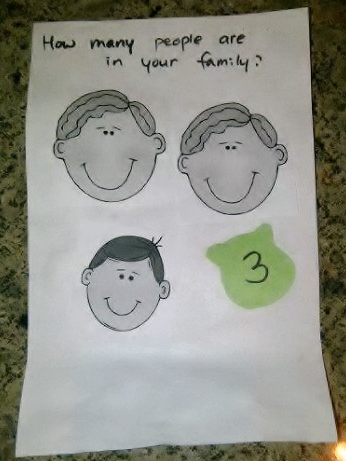 Sense of humor aside, in addition to a loving and caring environment, the most important thing was to find a daycare that supported and celebrated all families, and we thought we had found one.
In fact, just a few months earlier when we asked our son who he wanted to make Mother’s Day gifts at daycare for — maybe one of his grandmas or aunts? — he looked puzzled.
“You guys,” he said. “Don’t you want gifts from me? You’re my parents!”
Of course we wanted the beautiful clay… somethings. I’m not really sure what they are — tea candle holders or maybe paperweights? But who cares, because they were made with love from our beautiful boy and he was so proud to give them to his two dads.
So I changed my question: “Why don’t you tell your friends at daycare you have two dads?”
“Silly, Daddy,” my son said, smiling and rolling his eyes at me. “They already know I have two dads! Duh!”
It was as simple as that — of course his friends knew. We are two dads who are there for every school concert and field trip. We are two dads who give extra huge “dad hugs” when we drop our kids off in the morning. We are two dads who high-five our son’s friends when we see them. And when our son says he’s not ready to leave school at the end of the day because he’s having too much fun — we are two dads who join in and play pirates, police chase or ninja warrior vs. princess unicorn.
In that moment I realized that my “new normal” was actually our son and his friends’ “normal.” In order to instil a sense of pride in our kids about the fact that they have two dads, we just need to be visible and engaged parents who love and support them. Which we do — more than anything else in this world.
It doesn’t mean we’ll stop reading It’s Okay to Be Different. And while I’m hopeful it won’t happen, I do need to prepare myself for the day one of them might come home from school, upset about being teased for having two dads.
But for now, my husband and I will get ready to host the coolest pirate birthday party for our soon-to-be 5-year-old and 18 of his closest friends — who, silly Daddy, already know our kids have two dads. Duh!
This post was originally published on www.GaysWithKids.com.
Calcutta high court drops rape charge against intersex Indian athlete Pinki Pramanik
Centro de promoção e defesa LGBT é inaugurado em Salvador –
Centro de promoção e defesa LGBT é inaugurado em Salvador –
Espaço vai combater a violência e promover a integração social e profissional da comunidade gay da Bahia. Ver episodio: tvbrasil.ebc.com.br/reporterbrasil/bloco/centro-de-promoca…
Gay Jews Shake Their Butts to End the Summer, and Jewish Mothers Plotz Everywhere (VIDEO)
Gay Jews Shake Their Butts to End the Summer, and Jewish Mothers Plotz Everywhere (VIDEO)
The summer might be over, but the Jewish boys of the famed Viagra Falls house in the New York gay getaway Fire Island Pines just released this Hebro-sponsored video mashing up two of this summer’s biggest gay anthems hits: “Anaconda” by Nicki Minaj and “Break Free” by Ariana Grande.
WATCH:
Looks like these boys will have loads to atone for this Yom Kippur.
Dan Bucatinsky's Speech at the LGBT in Entertainment Town Hall
Dan Bucatinsky's Speech at the LGBT in Entertainment Town Hall
This is Dan Bucatinsky speech at the LGBT in Entertainment: Sexual Orientation & Gender Identity Town Hall. Dan Bucatinsky won the 2013 Emmy Award for his portrayal of James Novak on the hit…
HRC Reboots Its Mission Toward Greater Trans Inclusion
HRC Reboots Its Mission Toward Greater Trans Inclusion
When I first came out after transitioning, I joined the Human Rights Campaign (HRC), because they had a women’s holiday party coming up and it seemed a good place to start. I had been dating men, but they were universally skittish once I discussed my gender history with them. So rather than just being frustrated and angry, I looked for an outlet in activism, and HRC was the big kid on the block (literally so, since they were just then dedicating the D.C. headquarters, which I had previously visited when it was the B’nai B’rith building), so I joined them (and many other groups soon thereafter).
This was also the time when HRC was discussing adding the “T” in “LGBT” to its mission statement, and after attending a few events I decided to join the local steering committee. I don’t know if I was the first trans person they had on board, but it certainly seemed like it, based on the general lack of knowledge about trans issues. I wasn’t surprised, because efforts by the trans community to join with the gay community in pushing for inclusive anti-discrimination protections had been very difficult and only occasionally successful over the previous decade. I understood where HRC’s self-interest lay, as their membership was mostly gay and their money was almost entirely gay, so I kept to myself and spoke out only when asked.
In those days certain organizations were more trans-inclusive than others. On the national level the National Gay and Lesbian Task Force was the most avant-garde, and I had made my first LGBT contribution to support their Trans Civil Rights Project, run by Lisa Mottet. On the state level the newly reconstituted Equality Maryland was led by Dan Furmansky, a dynamic executive director who was eager to develop a truly LGBT organization. Mara Keisling had just founded the National Center for Transgender Equality (NCTE) in D.C., as she saw the need for a professional presence on the federal scene, where previous incarnations of national trans organizations had never gained traction.
As a result of all of this ferment, HRC, which, under the leadership of Elizabeth Birch, had discussed and then finally decided to add the “T” to the organization’s mission statement, took the next step in 2004. It was that resolution, lobbied for by Donna Cartwright, Diego Sanchez, Mara Keisling and others inside the new building, while others, including mye, demonstrated outside, that was the first tangible example of true inclusion. It dealt with the Employment Non-Discrimination Act (ENDA), which was to become the lightning rod for HRC and the trans community for the next decade. There was immediate blowback in the gay community, presaging the upcoming battles of 2007.
A few years later I joined the board of governors, at a time when Donna Rose was the only trans person on the board of directors. (To date, HRC has never had more than one trans director out of 45.) With the Democratic takeover of Congress, passage of ENDA through Congress became possible (though it would have been vetoed by President Bush, which lent a surreal atmosphere to all the tumult that occurred). HRC, as the leading LGBT lobbyists on Capitol Hill (but without any trans lobbyists, a condition that has still not been altered), had the opportunity to put inclusion to the test and ultimately failed. That experience has been recounted voluminously elsewhere, but suffice it to say that HRC was left holding the bag for the sexual-orientation-only ENDA. Virtually every other LGBT organization joined the United ENDA coalition. The LGBT community had a raucous debate, for the first time, about the difference between gender identity and sexual orientation and the value of true inclusion. It was extremely ugly, leading to the resignation of Donna Rose from the board and Jamison Green from the HRC Business Council. (I remained as a governor to serve as a bridge, since I was locally based.)
The debate brought real change, but it occurred primarily in the national community and not in HRC. It was several years before they promoted another trans person, Meghan Stabler, to the board of directors, and they have still not added to that number. For many years Allyson Robinson was the only out trans staffer with any significant responsibility. Little changed in the culture at HRC under President Joe Solmonese, including the reluctance to fund trans legislative work on the state level. Inertia was the name of the game within, while progress continued at large, with multiple state and local jurisdictions passing anti-discrimination ordinances, groundwork being laid to remove being transgender from the compendium of mental illnesses and to begin to provide access to health care, and trans persons winning very significant cases in federal courts, culminating in the 2012 Macy v. Holder decision.
As those years passed, the leadership at HRC changed with the departures of Winnie Stachelberg, David Smith and Joe Solmonese. When Chad Griffin arrived in town, he promised me that he had been empowered to create real change in the staffing structure, and he has begun to fulfill that promise, particularly with his promotion of Hayden Mora to Deputy Chief of Staff. I was pleasantly surprised how informed he was about trans issues, both in D.C. and nationally.
Last Thursday at the Southern Comfort Conference in Atlanta, where Joe Solmonese had promised HRC support for a trans-inclusive ENDA in the fall of 2007, only to make that a very hollow promise in just a few weeks, Griffin apologized — not only for that misrepresentation but for all the problems between HRC and the trans community for which HRC had been responsible over the years. He was specific and demanded to be held accountable. These are words the trans community has never heard before from HRC, certainly not in public.
While the president of HRC can only do so much, it’s a major start. As has been said on many occasions, not only about HRC, these organizations take their direction from their board of directors. HRC’s board has changed little over the years, with some members still present since the early years. As I’ve mentioned, there is only one trans board member, and given the importance of fundraising for an organization whose financial support is primarily gay, it’s hard to believe that HRC’s focus can change very much, even with Griffin’s desire to do so.
There is reason for optimism, however, with the winding down of the marriage-equality movement. As HRC and others, such as the Gill Foundation, turn their attention to anti-discrimination work in the South and Midwest, and as gender expression, as distinct from gender identity and sexual orientation, comes to the fore as a major issue for the younger generations, an increasingly trans-based focus makes sense for the nonprofit that bills itself as America’s leading LGBT organization. Ironically, when gender conformity was of primary importance for both the gay and trans communities, a united front was both possible and desirable. It took a great effort to get here, but today’s more diverse expression of gender is demanding greater flexibility within both the gay and trans activist communities. I hope this will help HRC make good on its promises. My colleagues and I will be watching with great hope.
Nick Jonas hints his character in the upcoming DirecTV drama might be bisexual
Nick Jonas hints his character in the upcoming DirecTV drama might be bisexual
‘My character has a big storyline revolving around his sexuality’
Jamesw
HRC Hosts Roundtable on LGBT Refugees and Asylum Seekers
HRC Hosts Roundtable on LGBT Refugees and Asylum Seekers

On Wednesday, over 80 guests gathered in HRC’s Equality Forum to discuss challenges faced by LGBT asylum seekers and refugees in the United States.
HRC.org
