
Gaby Spanic trás cámaras LGBT Hero Awards
Please enter your date of birth to proceed.
Gaby Spanic trás cámaras LGBT Hero Awards
Gaby Spanic LGBT Hero Awards
The Cause of Homosexuality Is Irrelevant
My blog post “The Same-Sex Marriage ‘Debate’ Is Based Upon Ignorance and Inaccurate Information” was published Sept. 11, 2014. The response to that blog post, both positive and negative, has far exceeded anything I could have imagined. In any event, after reading through the numerous comments on that post, I noticed certain themes that deserve further attention and discussion.
Many people seem fixated on the fact that the actual cause of homosexuality has not yet been established with any degree of certainty. As someone who likes to understand the reasons things occur, I respect and appreciate the curiosity. However, the ultimate result remains the same, regardless of whether the cause is genetic, environmental, or some combination of the two. As Jim Kennedy writes on TeachTheFacts.org:
[I]t needs to be understood that there is no scientific debate about whether homosexuality is a choice. The professional mental health and scientific organizations uniformly reject the idea. Many of them make even stronger statements about these issues.
Dr. Gregory Herek of UC Davis tweeted a link to my prior post with the following comment: “No one’s sexual orientation is a ‘lifestyle’ choice.” According to his website:
Professor Herek is an internationally recognized authority on prejudice against sexual minorities, anti-gay violence, and AIDS-related stigma. He received his Ph.D. in social psychology from UC Davis in 1983, then was a postdoctoral fellow at Yale University. He subsequently served as a faculty member at Yale and the Graduate Center of the City University of New York before returning to UCD, first as a research psychologist and later as a tenured professor.
He has been a pioneer in the scientific study of heterosexuals’ prejudice against lesbian, gay, bisexual, and transgender people, as well as the effects of that prejudice on its targets.
In her Sept. 15 article for Religion Dispatches, “Marriage Is for Everybody, Says Former Anti-Gay Evangelical,” Candace Chellew-Hodge writes:
Mark Achtemeier has been a minister with the Presbyterian Church (U.S.A) since 1984, and for much of his ministry he characterized himself as a “conservative anti-gay activist.” As a pastor and an associate professor of theology and ethics at the University of Dubuque Theological Seminary, Achtemeier wrote and spoke against the ordination of gay and lesbian ministers and co-wrote a declaration of faith that an anti-ordination coalition adopted.
That began to change in 2001, Achtemeier says when he made friends with some gay and lesbian Christians, some of whom had tried everything in their power to “change” their sexual orientation or had embraced a life of celibacy.
“It was producing broken people,” he told me, “and it wasn’t just isolated instances of this. I saw more and more of this and came away from these experiences thinking something is wrong with this picture. That got me writing and asking questions.”
By 2009, Achtemeier was a changed man, leading the charge for gay and lesbian ordination. He even preached at the ordination service of Scott Anderson, “the first gay minister” ordained by the PCUSA.
After reading my prior post and the comments on it, Lee Thompson, Esq., stated the following in a comment on the discussion in the Family Law Professionals LinkedIn group:
The comments on the blog are interesting and numerous. This is no doubt a polarizing issue which is why I would take exception to use of the word ignorance. But, the lifestyle choice comments are perplexing.
I’m not sure if at one time I thought it was a lifestyle choice. I do remember having a conversation with my dad, older at the time of the discussion and a conservative man in many respects. He did not believe it to be a lifestyle choice at all (he wasn’t so sure when it came to bisexuals though). His rationale was simple enough and made sense. Who would choose a lifestyle that included discrimination or being subjected to violent acts? In his opinion, and I agree, no one.
I’m still of the opinion it’s a state issue though and more states are passing the right for it through ballot initiative and more will. I always opposed DOMA along these lines. Personally, I have no problem with same-sex marriage, just how it comes about.
I agree with Lee that the belief that homosexuality is a “lifestyle choice” is perplexing. Those who hold such a belief have never been able to explain why anyone would make such a choice. However, they respond with examples of people who claimed to have “changed” their sexual orientation or are otherwise more sexually fluid. But as Ellen Schecter, Ph.D., writes on GoodTherapy.org:
[T]he research does not prove that sexuality is fluid, only that it can be. Studies have shown that sexual fluidity is not uncommon. It is found more frequently in women than men, though it clearly exists in both sexes. This does not necessarily mean that we all experience a degree of fluidity, nor that we are all really bisexual.
When a person’s sexual orientation appears to have “changed,” keep in mind that appearances can be deceiving. Such individuals may be sexually fluid, to some degree, or bisexual. While a person’s bisexuality, like a person’s homosexuality, may or may not be a choice, a bisexual person can choose to disregard their attraction to one gender or the other. Depending upon where on the sexual spectrum a person lies, they may or may not be successful in their efforts to disregard certain sexual feelings.
In her blog post “And Yet Another Reason We Shouldn’t Assume,” Stacey Neil states, “Making assumptions is risky, full of ego, any typically inaccurate by its very nature, and yet most of us do it all the time.” For just those reasons, people should stop making assumptions about a person’s sexuality.
By the way, another very big assumption that people make is that homosexuality is unnatural. But as Arash Fereydooni writes in Yale Scientific Magazine, “Currently, homosexual behavior has been documented in over 450 different animal species worldwide.” And as Sandhya Somashekhar writes in the Washington Post, summarizing the findings of the government’s National Health Interview Survey, “1.6 percent of adults self-identify as gay or lesbian, and 0.7 percent consider themselves bisexual.” If something is occurring in nature and cannot be changed, I’m afraid that it is natural, even though, as Somashekhar writes, “the overwhelming majority of adults, 96.6 percent, labeled themselves as straight in the 2013 survey.” After all, natural is defined by OxfordDictionaries.com as “existing in or caused by nature; not made or caused by humankind.” It’s about time that the 96.6 percent of the population that self-identifies as straight stops telling the 1.6 percent of the population that self-identifies as gay or lesbian that it is a “lifestyle choice.”
As if all of this were not enough, we then have the issue of “morality.” Interestingly enough, morality is defined by OxfordDictionaries.com as “a particular system of values and principles of conduct, especially one held by a specified person or society.” If 96.6 percent of the population self-identifies as straight, who do you think is defining society’s values and principles? The problem is that the 1.6 percent of the population that self-identifies as gay or lesbian most certainly did not have a say in society’s definition of morality. If their behavior is natural and unchangeable, what makes the supermajority so arrogant to believe that they can define what is “normal” to 1.6 percent of the population, just because it is not “normal” to them?
Meanwhile, unless and until all U.S. states come around, a great deal of people and families are being very seriously harmed. I addressed just one such issue in my blog post “Child Abduction and the Same-Sex Marriage Issue.”
In most places, people can be fired from their jobs just because of their sexual orientation, regardless of their performance. Imagine someone learning that they have been terminated from their job because they entered into a domestic partnership, civil union, or marriage. Please note that someone need not be in a relationship to be fired from their job based merely upon their sexual orientation.
Parents subject their children to “conversion therapy,” which has been banned in California and New Jersey because it accomplishes nothing more than injuring the children.
And as the Williams Institute at UCLA explains:
[T]here are between 1.5 to 2 times as many LGBTQ youth living in foster care as LGBTQ youth estimated to be living outside of foster care. …
To date, research on LGBTQ youth in foster care has documented some of the reasons LGBTQ youth enter and remain in foster care. Family rejection and violence is one oft-cited reason for LGBTQ youth entering out-of-home care.
Such “parents” throw their kids out, and those kids have nothing with which to support themselves other than their bodies.
The American Civil Liberties Union (ACLU) is not a gay or lesbian organization. As its website states:
The ACLU is our nation’s guardian of liberty, working daily in courts, legislatures and communities to defend and preserve the individual rights and liberties that the Constitution and laws of the United States guarantee everyone in this country.
These rights include:
- Your First Amendment rights — freedom of speech, association and assembly; freedom of the press, and freedom of religion.
- Your right to equal protection under the law — protection against unlawful discrimination.
- Your right to due process — fair treatment by the government whenever the loss of your liberty or property is at stake.
- Your right to privacy — freedom from unwarranted government intrusion into your personal and private affairs.
The ACLU also works to extend rights to segments of our population that have traditionally been denied their rights, including people of color; women; lesbians, gay men, bisexuals and transgender people; prisoners; and people with disabilities.
If the rights of society’s most vulnerable members are denied, everybody’s rights are imperiled.
Here’s what the ACLU has to say about gay rights:
We face an unprecedented opportunity to achieve the freedom to marry for same-sex couples throughout the country. The ACLU’s historic 2013 Supreme Court decision striking down the Defense of Marriage Act (DOMA) is paving the way for equality for lesbian and gay couples across America, but for a full civil liberties victory we need to strike down barriers to the freedom to marry in states across the country.
While we celebrate all of the progress we’ve been making on marriage, individual states still have anti-gay, anti-marriage laws. In fact these discriminatory barriers are still embedded in 28 state constitutions.
With increased legislative advocacy and grassroots organizing to repeal existing marriage amendments, as well as aggressive litigation across the country, we can decisively win fair marriage laws and relegate discrimination against gay and lesbian couples to the dustbin of history.
Humanity is defined by YourDictionary.com as “the entire human race or the characteristics that belong uniquely to human beings, such as kindness, mercy and sympathy.” However, as Fariss Samarrai writes on Science Daily, “one of the most defining features of humanity is our capacity for empathy — the ability to put ourselves in others’ shoes.”
People often refer to a “gay agenda.” I’m afraid that the “gay agenda” is nothing more than a desire to receive equal treatment. The only reason that gay rights are even an issue is the complete lack of empathy toward the LGBT community. This is all about a lack of empathy. Considering that empathy is “one of the most defining features of humanity,” such behavior is inhumane.
What more must I say? Our society does nothing but abuse a segment of the population for no reason other than an orientation that cannot be changed. To be quite frank, it is nothing less than despicable.
Early Reports Point to Scotland Voting to Stay With the UK
Reports are coming in that the vote on Scottish independence is being called for the “no” side. With more than half the results declared, an estimated 55% of voters are expected to reject independence by the time final votes are tallied.
The Guardian reports that the yes campaign scored a handful of notable successes – succeeding in the largest city of Glasgow by 53% to 47%, winning 54% in West Dunbartonshire and a 57% win in Dundee.
All throughout the campaign, celebrities voiced their opinion on whether or not Scotland should leave the UK and become an independent country.
Those in favor of independence included Sean Connery, Alan Cumming, Franz Ferdinand, Bjork, Russell Brand, Gerard Butler, Rhys Ifans, and Morrissey.
Those opposed included Simon Cowell, Patrick Stewart, Sting, Mick Jagger, Tom Daley, David Beckham, Hugh Grant, Susan Boyle, J.K. Rowling, Eddie Izzard, John Barrowman, Helena Bonham Carter, David Tennant, Dame Judi Dench, Simon Cowell, Ewan McGregor, and Emma Thompson.
Others, such as James McAvoy, Billy Connolly, Annie Lennox, Pierce Brosnan, and Hugh Laurie remained largely neutral.
And for American audiences that were tuned-in to the results tonight, Brett Belding helped put things into context:
Just in case you don’t understand the significance of #ScotlandDecides, the last time Scotland was independent was before America existed.
— Brett Belding (@bbelding) September 19, 2014
Kyler Geoffroy
İzmir Lgbt Onur Yürüyüşü – 2014
Alsancak Garı’nın önünde toplanan homofobi ve transfobi karşıtları, Azra Has Sokağı’ndan geçerken “trans Azra Has ölümsüzdür” sloganı attı.Sloganlarının yanı sıra…
www.youtube.com/watch?v=r8J1GjWx9bw&feature=youtube_gdata
Paul Saltalamacchia Talks Planning a Fabulous Wedding and LGBT Equality (AUDIO)
 This week I talked with Paul Saltalamacchia, Senior Catering Sales Manager for Hilton Worldwide, whom I’m working with to plan my own wedding. Saltalamacchia is currently based at DoubleTree Suites by Hilton Hotel Boston, overlooking the Charles River in Cambridge, Massachusetts. Understanding the full range of emotions that goes into preparing for your momentous day, he guides you through the sometimes-overwhelming process.
I talked with Paul about wedding options and preparations and his spin on LGBT issues. When asked about his personal commitment to LGBT civil rights, he stated:
I believe that every person deserves equal rights, regardless of their sexual orientation, their nationality, religious beliefs or physical or mental restrictions. I truly believe that, and I’ve believed that my entire life, that everyone should be treated equally. So it’s really important to me that gay couples receive that same treatment when they come into the hotel. I remember when it first became a law in 2004, I would have couples call me and say, “I have a question: I’m inquiring about a wedding, but do you allow gay weddings at your hotel?” I was really shocked to hear that a lot of other hotels in the city were actually turning away gay couples because of their sexual orientation, and I thought that was crazy. I went to my general manager when the question was asked of me, and I said, “We’re OK with doing gay weddings at the hotel?” And he said, “Of course we are. It doesn’t matter to us.” I met with my staff for an hour-long kind of orientation to question them to see if they were comfortable working a gay wedding, and it was very surprising how open all the people that worked at the hotel were to it. It was a big deal. The word got out, and it became very popular. I would say maybe 15 to 20 percent were gay weddings.
LISTEN:
Paul Saltalamacchia began his career in healthcare nutrition and made the switch to
hotel event catering and sales in 1998. He has been a certified social event planner since 2006. His focus has been on social events, mainly weddings and bar mitzvahs, and enjoys turning people’s vision into reality. My partner and I are working with Saltalamacchia and acclaimed chef Steve Ali, who are committed to making our dreams come true for our wedding day. Trendy or traditional, extravagant or tastefully modest, they’ll make your exciting day everything you imagined it would be.
Listen to more interviews with LGBTQ leaders, allies, and celebrities at OUTTAKE VOICES™.
Download interviews on iTunes.
The Business Case for Ally Engagement
Around the world, major companies are waking up to the fact that creating a diverse and inclusive workplace requires more than policy change.
For LGBT inclusion in particular, policy alone doesn’t drive culture: 91 percent of Fortune 500 companies prohibit discrimination based on sexual orientation, yet 53 percent of LGBT workers remain closeted at work. Deloitte has documented the detrimental effects of this form of “covering” in the workplace, including negative impacts on sense of self, sense of opportunities available and commitment to the organization. Thus, companies that fail to create environments that enable employees to bring their full selves to work are inhibited in their ability to attract, retain and get the most out of their diverse employee pools.
The modern workplace environment
What makes these work environments so inhospitable for LGBT workers? By and large it’s not overt homophobia and disrespect; it’s more of a subtle feeling that they’ll be misunderstood. In a recent Human Rights Campaign survey, the top 3 reasons LGBT people state for not being out at work are fears of making people uncomfortable (38 percent), being stereotyped (36 percent) and losing connections with coworkers (31 percent). Conversations about social and dating relationships come up all the time (80 percent say on a daily to weekly basis), so an LGBT employee’s only choice is often to withdraw from their coworker community or search for new employment.
This uninclusive culture is not the result of active anti-LGBT sentiment. In fact, approximately 77 percent of Americans consider themselves LGBT allies, and nearly 90 percent believe people should not be discriminated against for employment based on their sexual orientation or gender identity. Modern societal inequality is perpetuated less by a conscious effort to discriminate, and more by a lack of awareness among fair-minded people about the small, unconscious biases and stereotypes that affect those who are different from them, and which they may be inadvertently perpetuating. Workplace environments reflect societal culture, so without explicit efforts to raise awareness and create the conditions for employees to change their behavior, it is only natural for these subtle biases to persist and play out in everyday workplace conversation.
What we can do about it
How can companies create an environment where LGBT employees feel comfortable enough to come out at work, enabling them to thrive and produce better business results? The solution lies in the non-LGBT employees: educating and activating them to proactively and consistently show their support for their LGBT colleagues, through everyday behaviors: language, conversations, items they display on their desks, activities they participate in at work. By tweaking these small behaviors — asking a new employee if she has a significant other rather than a boyfriend, or bringing up the latest LGBT news story at lunch instead of the latest celebrity gossip — and doing it consistently over time, LGBT-inclusive behaviors become the default rather than the exception. And this creates results: in the same HRC study, one in four LGBT workers said they have stayed at a job specifically because the environment was accepting.
Professionals lead busy lives. For non-LGBT people who are not directly affected by LGBT bias every day, it is easy to forget or deprioritize the trainings, email updates and events that maintain momentum and behavior change over time. To address this problem and create the motivation for employees to prioritize inclusiveness, at Friendfactor we launched the first-ever Workplace Ally Challenge earlier this year. The Challenge, a friendly competition among businesses to activate as many employees as possible as allies, utilizes competition and intrinsic motivation to encourage employees to take action to address LGBT bias in their workplaces by tracking their participation and measuring their impact against peer companies.
The results so far have shown that critical mass and consistency lead to results. Within just six months, participating companies activated between 5 and 20 percent of their workforces, and an average of 58 percent more employees reported hearing colleagues speak up about LGBT issues at work as a result.
The future of workplace culture
Imagine what this buzz could turn into if companies kept up the momentum. To give a view of what’s possible, we’ve also been running an MBA Ally Challenge in business schools since 2012, which has doubled year over year and is now in 23 schools across the country. In the most recent school year, participating schools activated an average of 40 percent of their student bodies, and up to 67 percent at the top performing schools. This participation not only got people talking, but improved campus culture such that nearly 50 percent more LGBT students were comfortable being out to everyone on campus by the end of the school year — an increase from 42 percent to 62 percent. As a result, those students are able to be themselves on campus, know they are welcome and concentrate on being the most productive they can as they prepare to re-enter the workforce as managers.
By committing to continuous ally engagement over time, companies can achieve similar results in share of employees engaged and impact on workplace culture. When companies invest in engaging their employees to take action on their values, the sky is the limit on employee engagement, inclusive workplace culture and maximizing employee potential.
Friendfactor is currently accepting registrations for the 2015 Workplace Ally Challenge. Interested companies can learn more and sign up at www.friendfactor.org/workplace-ally-challenge.
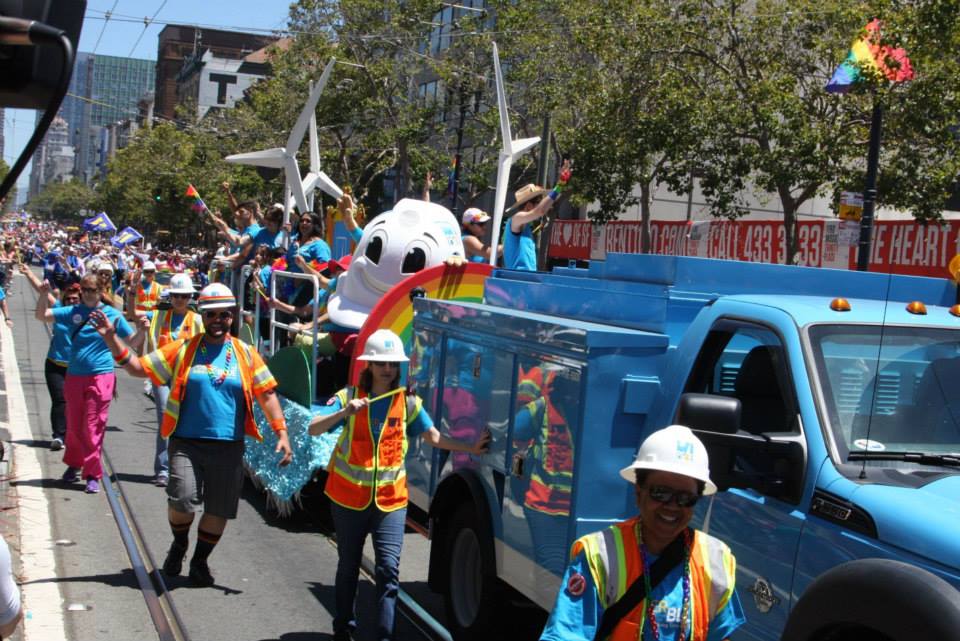
Photo: PG&E at San Francisco Pride 2014
Enhanced Plans to Achieve LGBT Equality in Wyoming

Today, HRC announced that it will have a continuously staffed presence in Wyoming to build on the tremendous momentum for equality in the state.
HRC.org
You must be 18 years old or older to chat
