

Category Archives: MISC
Senator Jim Ferlo Helps Break Down Those Closet Doors
Senator Jim Ferlo Helps Break Down Those Closet Doors
What started out as a routine press conference today for one state senator turned into something a bit more personal. While speaking about a bill that would expand the state of Pennsylvania’s hate crimes law to cover lesbian, gay, bisexual and transgender individuals, retiring Allegheny County Democratic Sen. Jim Ferlo said, “I’m gay. Get over it. I love it.”
Ferlo continued, “I’ve been a practicing homosexual and I am gay since at least the age of 24 or 25. I didn’t need a psychiatrist or psychologist. I just decided this was something normal for me, comfortable.”
The key takeaway from Ferlo’s quote is the word ‘normal.’ What some still perceive as abnormal, is very normal for others.
In fact, more than 50 years ago, Dr. Alfred Kinsey used a sliding scale of one to six to prove that all of us have both homo and heterosexual tendencies. Scoring a six meant you were primarily homosexual, while a score of one meant you were primarily heterosexual. Kinsey believed most people were somewhere in the middle, although many would be afraid to admit it.
In the 21st century, it’s a sad reality that coming out makes headlines. Does it really matter? It shouldn’t, but sadly it does. Unfortunately, moving forward, when some people hear the name ‘Jim Ferlo,’ the first thing to come to mind will be the word ‘gay,’ despite whether you’re in agreement with his political position, or support what he’s accomplished during his term with the Pittsburgh City Council and in the state senate.
Like the guy or not, Senator Ferlo displayed world-class mental toughness in making that announcement. In today’s day and age, it’s not easy for anyone — let alone a public official — to come out to one person or the world.
Politics aside, Senator Ferlo gave us hope today. He gives hope to all the teenagers, young adults and everyone else who are still living in the closet, hiding their deep secret from friends, family and others for fear of being bullied, made fun of or worse, the victim of physical violence and abuse. He gives us hope for equality and all who fight for it, and that one day it won’t matter what an individual’s sexual preference is.
People like Senator Ferlo also help us remember those who have fallen in the battle for equality. For example, televangelists like Jerry Falwell and Pat Robertson have poisoned millions with their hate filled tirades against homosexuals. How many gay, lesbian and transgender Americans have committed suicide because of their hate filled sermons and broadcasts? How many more are in therapy and gulping anti-depressants because these bullies convinced them they are depraved sinners? Scores of innocent, normal human beings have been brainwashed by these bullies when the reality is there is nothing wrong with them.
The bottom line: Senator Ferlo helps instill that the American dream still exists for anyone who identifies as LGBT. It might not be my American dream or your American dream, but it is the American dream of so many of our friends, family members and colleagues, even if we haven’t heard about it yet. The point is we should all be free to live life on our own terms, free from the fear of bigotry, hatred and violence.
As more heroes like Senator Ferlo come out and take a stand, the sooner those closet doors will come crumbling down. Lincoln freed the slaves and it still took another 100+ years for blacks to be treated like equals. As more states continue to embrace and legalize gay marriage, something I personally predict will be a nationwide reality within the next 10 years, America will truly be the land of the free.
As Harvey Milk said, “Politics is theater. It doesn’t matter if you win. You make a statement. You say, ‘I’m here, pay attention to me.'” The world paid attention to Senator Jim Ferlo and the statement he made today.
As Ferlo said, “There’s a million of us in this state and we deserve the same rights and the same protections as everybody else.” Gay or straight, that makes sense on a human level.
Out and About at Pittsburgh LGBT Pride 2014 Segment 1
Out and About at Pittsburgh LGBT Pride 2014 Segment 1
President of The Keystone Alliance and roving reporter for "Brian T World", John DeBartola is out and about at Pittsburgh Pride 2014.
Cheerful

2 Men, 1 Women Charged With Beating Gay Couple In Philadelphia
2 Men, 1 Women Charged With Beating Gay Couple In Philadelphia
PHILADELPHIA (AP) — Two men and a woman were being charged in the beating of a gay couple during a late-night encounter on a Philadelphia street, prosecutors announced Tuesday.
The case gained attention when police posted a video of the well-dressed suspects out on the town that night, and online sleuths used social media sites to help identify them. Several of the approximately 12 men and women in the group have since met with police. District Attorney Seth Williams said Tuesday that charges have been approved for three of them, 24-year-olds Philip Williams and Katherine Knott and 26-year-old Kevin Harrigan, all of suburban Bucks County.
“This vicious attack shocked the entire country. An assault on people because of their sexual orientation has no place in Philadelphia,” the district attorney said in a statement.
The victims told police that the group hurled gay slurs and beat them when the two parties passed on the street on Sept. 11. One man suffered serious facial injuries, including an orbital fracture, and had his jaw wired.
All three suspects were being charged with criminal conspiracy and two counts each of aggravated and simple assault, and reckless endangerment. Philip Williams’ attorney did not return a call for comment and Harrigan’s attorney’s name is not known.
Defense lawyer Louis Busico, who represents Knott, denied that the dispute was motivated by anti-gay bias. He also said his client, who has relatives in law enforcement, did not throw a punch.
“She in no way participated in the assault of anyone,” Busico said Tuesday. “(And) she didn’t hurl an insult or a slur, of any kind.”
Like others seen in the group, Knott graduated from Archbishop Wood High School in Warminster. One man in the group has since stepped down as a part-time basketball coach at the Roman Catholic school. He was not charged Tuesday.
“Violence against anyone, simply because of who they are, is inexcusable and alien to what it means to be a Christian,” Philadelphia Archbishop Charles Chaput, speaking about the case, said last week in a statement.
Pennsylvania’s hate-crimes law does not cover crimes motivated by a person’s sexual orientation.
Philadelphia Police Commissioner Charles Ramsey, along with openly gay state Rep. Brian Sims of Philadelphia and others, have said the case illustrates the need for a change in the law.
National Voter Registration Day
National Voter Registration Day

Today is National Voter Registration Day, and it’s the perfect reminder to register to vote if you haven’t yet. V
HRC.org
www.hrc.org/blog/entry/national-voter-registration-day?utm_source=rss&utm_medium=rss-feed
Vlogger RJ Aguiar Answers Questions About Being A 'Bi Guy': VIDEO
Vlogger RJ Aguiar Answers Questions About Being A 'Bi Guy': VIDEO
In honor of Bisexual Awareness Day, bisexual vlogger RJ Aguiar took questions from Twitter users about his own experience as a bisexual guy. Reacting to the oft recited statement, “I don’t believe in bisexuality” Aguiar remarks,
“I mean, just because people don’t believe in something doesn’t make it not real. There are people out there who don’t believe in climate change or evolution — that doesn’t mean those things don’t exist. Same goes for my sexuality. I’m not the f***ing tooth fairy.”
Asked if he has a preference for one gender over the other, Aguiar responded that it’s the person not the gender that gets him going, and right now that person would be his fiance Will Sheperd, who proposed to Aguiar last fall.
Watch Aguiar break down some common misconceptions about bisexuality, AFTER THE JUMP…
Sean Mandell
www.towleroad.com/2014/09/vlogger-rj-aguiar-answers-questions-about-being-a-bi-guy-video.html
Gay critica duramente causas do movimento LGBT.
Gay critica duramente causas do movimento LGBT.
Saiba mais: goo.gl/PwQGiy Deixe a sua opinião…
www.youtube.com/watch?v=VHnm5MlDJ8E&feature=youtube_gdata
Couple's Wedding Ceremony Interrupted by Slurs From Hidden Onlooker
Couple's Wedding Ceremony Interrupted by Slurs From Hidden Onlooker
As a couple exchanged vows before 30 of their close friends and Congresswoman Kyrsten Sinema, someone in a nearby building shouted homophobic words at them.
Michelle Garcia
The Joys of Being Gay Then and Today
The Joys of Being Gay Then and Today
Two books of photographs reflect a new vision of gay life, one looking forward, the other back. Both boggle the mind with what they reveal about the changing comédie humaine of gender and same-sex love.

(Photo Scene4 Magazine)
The Invisibles: Vintage Portraits of Love and Pride, by French filmmaker Sébastien Lifshitz (Rizzoli, May 2014) was announced in the Huffington Post with a brief interview of the author by James Nichols. The book shows a homosexual world that couldn’t be seen before Stonewall.
I am not talking about transvestite performance shots, like Man Ray’s series of a Paris cabaret performer named Barbette, or those lecherous lesbian postcards and other soft-porn images that kiosks used to sell from under the counter, or street vendors from the inside of their coats — contraband of the verboten, the louche underground of “the love that dare not speak its name.” 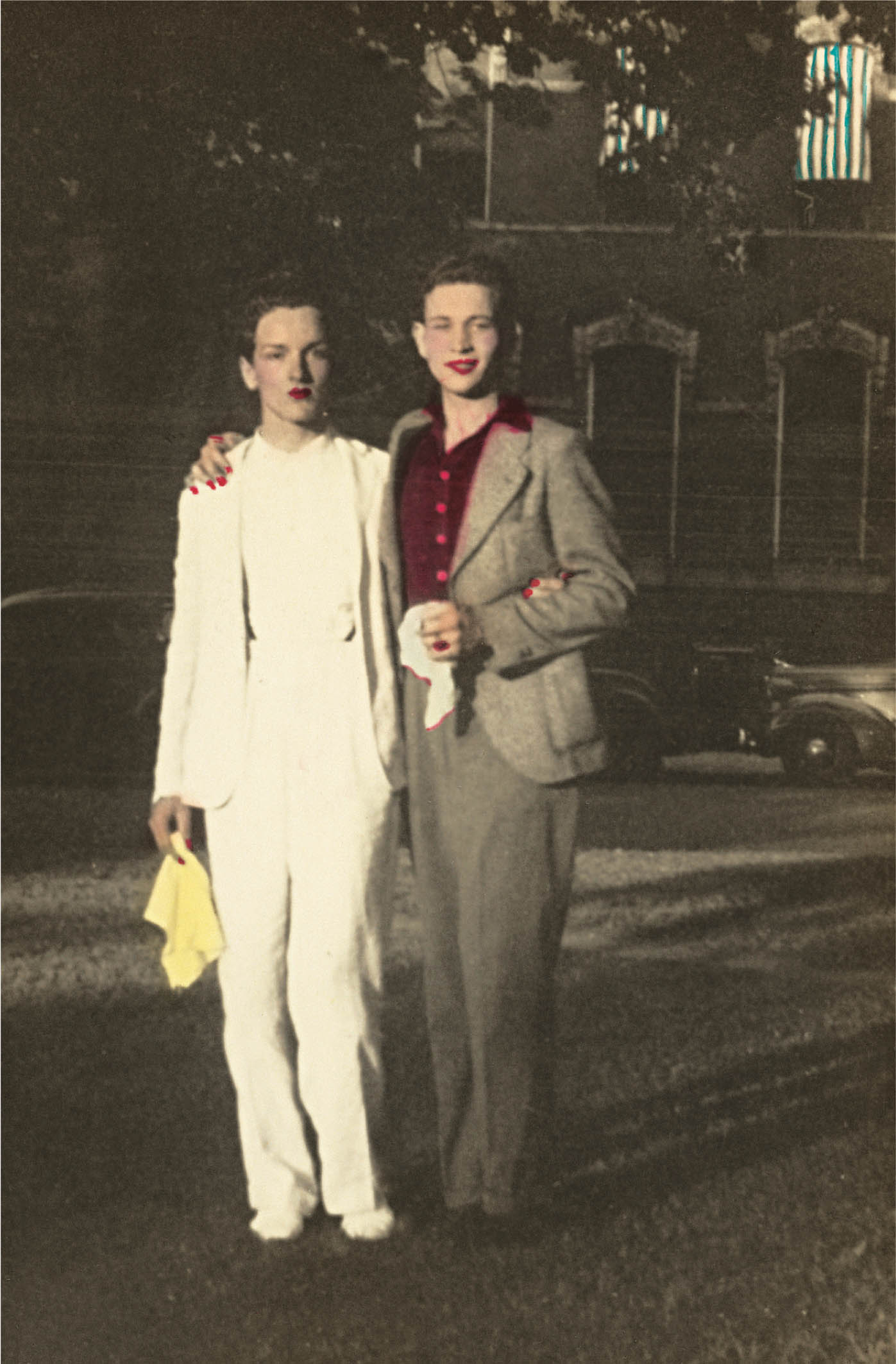
Lifshitz discovered that this love spoke volumes. Men and women in the first half of the 20th century, in the middle of severe oppression, took pictures of themselves and each other that tell a radically different story. In lovingly preserved photo albums this story wound its way to the French flee markets and garage sales of today, waiting in secret to be seen.
Surprise discovery
Lifshitz one day came across a Kodachrome family album from the sixties that had belonged to two seasoned ladies. The well-bred women were posing together in ways that caught his eye and puzzled him. They clearly were a lesbian couple, but how could they dare to have their intimate images processed at a lab – and thus quite in the public eye — at a time when discretion was paramount? Looking for further evidence of this desire to leave a record Lifshitz found that the two daring ladies were not alone. The vintage photo boxes and albums he began collecting rendered a rich harvest of “Invisibles,” more than enough to fill a book with six decades of evidence.
What surprises at first glance in this collection is the continuity, from 1900 to the sixties, of a spirit of joy and subversive celebration. There is a prevailing delight in playing with gender, alone, coupled, or in a group of friends, mocking social codes and misbehaving. The complicity between the partners of this playful as well as serious pursuit is extraordinarily life-affirming and sexy. Sometimes elaborate costumes and transvestite disguises are used, at times for a grand, even staged, theatrical effect or for a simple cross-dressing party at home. Just as often the merest touch, a slightly feminine or masculine pose, a trace of lipstick or a high-heel shoe are the possible give-away that makes you look twice, and then look again. Like in a Rohrschach puzzle, you begin to wonder: men masquerading as women? Women playing men? Who is who in these photographs? And what is really going on?
The mystery of funny, erotic, or mocking gender twists permeates the book, starting with the cover photo. Lifshitz’s collection frequently takes gender over the top into a no-man’s land, no-woman’s land, where one keeps hunting for clues to decode the message.
Mysteries
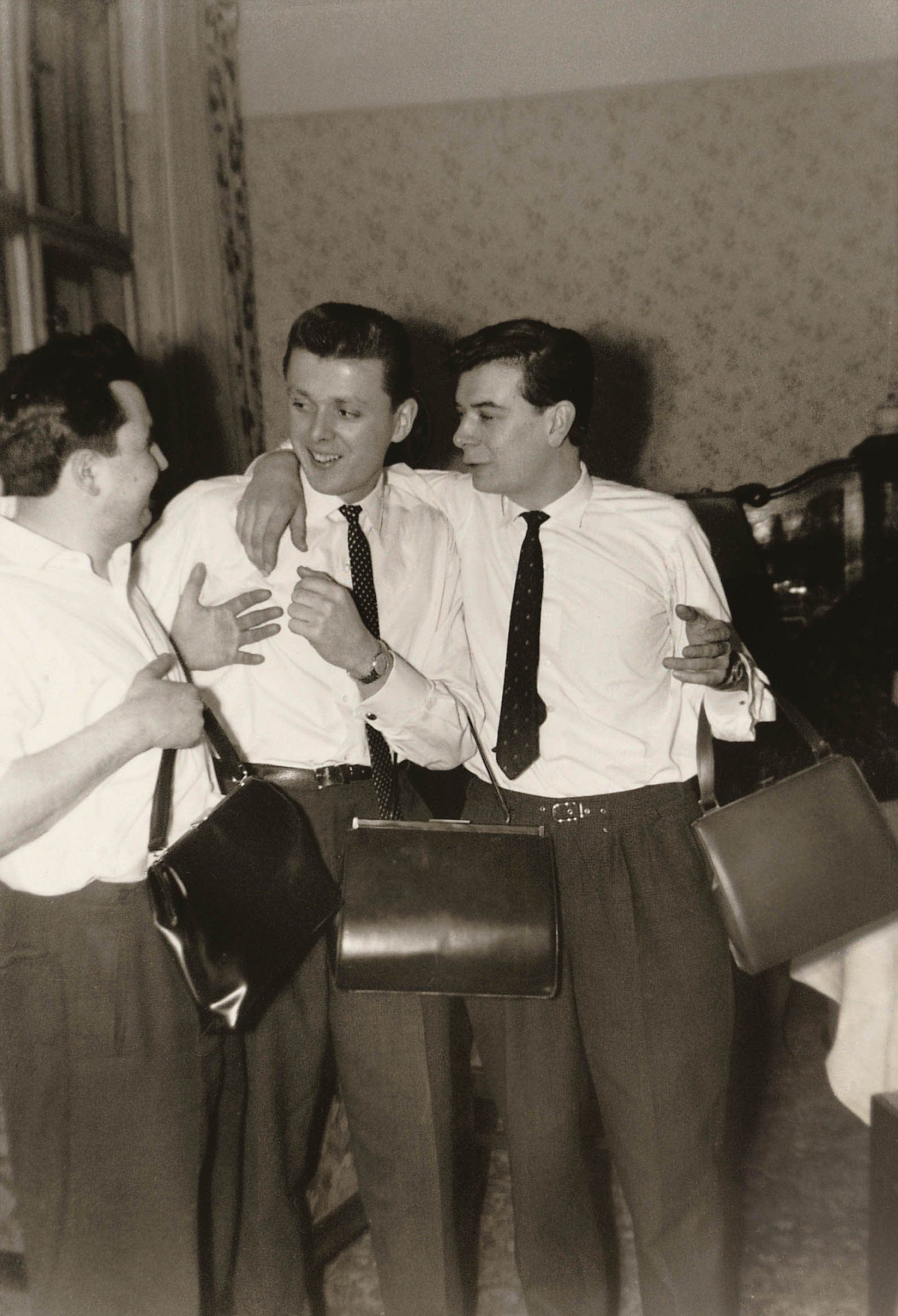
One photograph, for example, shows three good-looking young men in white dress shirts and black ties engaged in a lively conversation, seemingly having fun at a frat party, but at second glance it turns out that each man holds a ladies’ handbag by the elbow. Who are they? What’s the story with these handbags? While women dressed as dandys camp it up with fedoras, mustaches and cigars, other women enact a wedding ceremony with such sacred earnestness that there is no doubt they mean “until death do you part.”
In another photo, a chubby middle-aged man with a girl’s barrette in his short hair and a dainty bracelet on his arm, looks with serious eyes at the camera while he breast-feeds a doll. A couple of seasoned, rugged-faced men present themselves (in a snapshot that may have been a “selfie”) with worker women’s scarves on their heads.
Who would have thought that gays and lesbians from repressive eras left such a trace of pleasure and playfulness (at least in France), facing the camera with such obvious pride?
Capturing love
Interestingly, this collection of historical photographs — gay pride before the hour – has a modern equivalent in the book, The New Art of Capturing Love, a book of photographs of gay and lesbian couples on the way to tying the knot. The subtitle: “The Essential Guide to Lesbian and Gay Wedding Photography ” jumps half a century forward into the glorious Now of gay wedding rights.

What a leap and what a change! Here, gay love and commitment “for better or worse” are celebrated in public, involving family, friends and whole tribes of equally proud supporters. In the ten years of struggles to break the gridlock for gay marriage in state after state (20 states have legalized it and all the others are faced with legal challenges) a new industry has evolved – the gay wedding industry. So many gays and lesbians are stepping to the altar, with so many more to come, that guidance is in demand. How do you document your great day? How do you create poignant, romantic, funny, authentic wedding photographs – from the engagement to the preparations, the ceremony and celebration to the final toss of the bouquet? Author Kathryn Hamm is the founder of the first gay online wedding boutique (gayweddings.com) and Thea Dodds is a seasoned photographer who invited a number of other great photographers to join in for this book.

(Photo: Authentic Eye Photography)
Aren’t wedding celebrations always the same, following the same old, basic tradition? The authors make a convincing case for the sometimes subtle and sometimes dramatic differences that must be taken into consideration. LGTBQ couples see themselves, present or pose themselves, differently. They may have no family present for their wedding, may prepare together, and may have married the same person already multiple times as wedding rights kept evolving. They may have been together for decades, may not be comfortable with public display of affection, and may not be legally marrying at all. How does the gay wedding photograph reflect the changes? No more big groom in black hovering over little woman in white. Gone is the “bridal bias”: the focus is always equally on both spouses.
The big surprise for me as a reader was that today’s same-sex couples present themselves very much as the couples in The Invisibles did so many decades earlier. The wedding scenes are now mostly in rich color, perfectly staged and captured, but the spirit is delightfully similar. There is romance, erotic intensity, playfulness and pride. Some of the same props appear, like the jaunty umbrella; there is of course fashionable elegance but also the theatrical use of costumes. There are arresting stagings like rooftops or a fire escape. Like the “Invisibles,” the contemporary brothers and sisters in Capturing Love opt for humorous snapshots: a bridesmaid in flip-flops is surrounded by her male fashion police, pointing with comic outrage at her feet; male nymphs cavort in a romantic outdoors celebration; double bouquets are tossed in the air; two ecstatic newly-wed lesbians flip out on a New York escalator. 
Men kissing
As if the new book had taken the historic photographs as a role model, the gay men of today adopt eye-to-eye and skin contact. Instead of standing shoulder to shoulder, as men tend to do, looking out into the middle distance while they converse, these men are openly affectionate. Sexy, tender shots of men kissing fill the pages in both books, with the modern tenor being delicacy, respectfulness and good taste. The women, of course, have no problem being hands-on and emotional; they in turn are encouraged to break role stereotypes in their stance even if their look is butch-femme.
Capturing Love is beautifully written and the quality of the photographs is superb, with a natural and spontaneous look, although most pictures are carefully and cleverly posed. What is obviously missing from this new statement of gay marriage pride and respectability is outright provocation, two women cross-dressing as grooms or two men dressed as brides. It may take another half century for some author to collect and publish gay pictures of our time that mock all wedding traditions and demonstrate a subversive spirit that may already exist in private, invisible for now.
