

All posts by GayFriendschat.com
WATCH LIVE: Appeals Court Hears Marriage Cases
WATCH LIVE: Appeals Court Hears Marriage Cases
Starting at 1 p.m. Pacific, the Ninth Circuit Court of Appeals will hear arguments regarding marriage equality in Idaho, Nevada, and Hawaii.
Sunnivie Brydum
Primary Season Comes To A Close As Scott Brown, Martha Coakley Seek Redemption
Primary Season Comes To A Close As Scott Brown, Martha Coakley Seek Redemption
WASHINGTON — Voters in five states go to the polls Tuesday to bring this year’s primary cycle to a near close. Louisiana holds a nonpartisan primary on Nov. 4, and that race could be drawn out until early December if no candidate gets at least 50 percent of the vote.
In Massachusetts, Attorney General Martha Coakley is running for political redemption. And former Sen. Scott Brown (R-Mass.) is trying to return to the chamber to represent New Hampshire, where he could end the state’s all-female congressional delegation. While Rhode Island’s Democratic gubernatorial primary is competitive, New York’s isn’t — though law school professor Zephyr Teachout has still managed to draw attention to some of Gov. Andrew Cuomo’s (D) shortcomings for progressive voters.
Here’s a look at the key races The Huffington Post is watching:
NEW HAMPSHIRE SENATE: Though Brown called his December move to New Hampshire “strictly personal,” the relocation was immediately seen as a transparent bid to unseat Sen. Jeanne Shaheen (D-N.H.). What’s followed has been a handicapped by missteps, as Brown has driven around the state in his trademark pickup truck to cement his Granite State credentials. The former senator has hidden in a bathroom to avoid a reporter’s questions about his position on the Supreme Court’s Hobby Lobby ruling, said he doesn’t believe the science supporting man-made climate change has been proved (despite past statements to the contrary) and criticized Shaheen for voting to increase the debt ceiling, though he did too.
Brown is expected to clinch the Republican nomination Tuesday, despite the occasional slip-up as to which state he’s running in. Democrats have practically ignored Brown’s opponents, who include former state Sen. Jim Rubens — the only Republican senate candidate whose website affirms that global warming exists and is caused by human activity. Brown has notably changed his strategy since he lost to Sen. Elizabeth Warren (D-Mass.) in 2012 — Democrats have hit him for rejecting a “people’s pledge” to discourage outside electoral spending, which Warren and Brown agreed to during that race. Indeed, opposition researchers have even gone so far as to chase Brown by canoe as they look for his next gaffe. HuffPost Pollster, which combines all publicly available polling data, shows Shaheen leading Brown by more than 5 percentage points, so he has two months to make up that difference.
NEW HAMPSHIRE-1: LGBT-rights groups are working to elevate former University of New Hampshire Dean Dan Innis, who is one of three openly gay GOP House candidates running this cycle, over former Rep. Frank Guinta (R-N.H.), who is attempting to return to the seat he once held. The district is undeniably competitive, as Rep. Carol Shea-Porter (D-N.H.) lost it to Guinta in 2010 only to beat him in 2012. Conservative groups such as Americans for Prosperity, which is funded by the billionaire brothers Charles and David Koch, have run ads tying Shea-Porter to her early support for health care reform.
NEW HAMPSHIRE-2: In the Granite State’s slightly less competitive 2nd District, Republicans have waged a bitter primary to take on Rep. Ann McLane Kuster (D-N.H.). State Sen. Marilinda Garcia is considered one of the GOP’s bright young prospects. She’s acknowledged as much, saying her party has an optics problem and is “being populated mostly by old, white men.” Though Garcia’s opponents have accused her of supporting a pathway to citizenship for undocumented immigrants, Sen. Ted Cruz (R-Texas) didn’t seem to have a problem with her past statements on the matter, as he came to promote her candidacy on Sunday. Though the National Republican Congressional Committee has called former state Sen. Gary Lambert one of their “Young Guns,” Garcia, who has also received support from the conservative Club for Growth, seems to have the edge heading into Tuesday’s primary.
MASSACHUSETTS GOVERNOR: Recent polling indicates that Coakley will likely beat state Treasurer Steve Grossman and former federal health care official Don Berwick in the mostly amicable Democratic primary to succeed Gov. Deval Patrick (D), who is stepping down after eight years in office. Coakley would be the state’s first female governor if she beats former health care executive Charlie Baker (R), who lost to Patrick in 2010. She has run a disciplined to avoid the missteps that doomed her bid to succeed the late Sen. Edward M. Kennedy (D-Mass.) that same year. Baker, who faces a little-known tea party challenger on Tuesday, could still eke out a general election win in a state that isn’t afraid to elect Republican governors despite its progressive leanings.
MASSACHUSETTS-6: Both party’s primaries in this district are intriguing: Immigration lawyer Marisa DeFranco and former Marine Seth Moulton are challenging Rep. John Tierney on the Democratic side, while former Massachusetts Senate Minority Leader Richard Tisei, who is openly gay, is running on the GOP side once again. Tisei, who boycotted the state’s Republican Party convention to protest its platform on marriage equality, has received support from the national Gay and Lesbian Victory Fund. Tierney continues to be vulnerable due to his family’s gambling scandal. Moulton has capitalized on voter awareness of the past controversy, saying he’d provide fresh representation in Congress. His received a boost with The Boston Globe’s endorsement.
NEW YORK GOVERNOR: Voters in the Empire State will chose candidates in statewide elections on Tuesday. (The state held its congressional primary elections in June.) Though Cuomo is expected to coast to the nomination, Teachout’s bid has highlighted his administration’s controversial move to hinder an ethics panel the governor created. And despite Cuomo’s best efforts, Teachout will be on Tuesday’s ballot. She has received support from Mayday PAC, an anti-corruption PAC, as well as the Progressive Change Campaign Committee. Polls have shown Cuomo maintaining a strong cushion against Westchester County Executive Rob Astorino, as voters don’t seem to be widely aware of the news about the governor’s incapacitating of the anti-corruption commission.
RHODE ISLAND GOVERNOR: In one of this year’s rare competitive Democratic gubernatorial primaries, state Treasurer Gina Raimondo, Providence Mayor Angel Taveras and attorney Clay Pell are vying to succeed retiring Gov. Lincoln Chafee (D). Taveras, who has the backing of most local labor groups (the teachers unions are supporting Pell), has slammed Raimondo for her role in crafting polarizing pension reform legislation. While Raimondo would be Rhode Island’s first female governor, Taveras would be the state’s first Latino governor and is banking on strong support from Providence’s Latino community to make that outcome happen. Pell had his wife, figure-skating star Michelle Kwan, cut an ad for him, has the familial name recognition as the grandson of the late Sen. Claiborne Pell (D-R.I.) and possesses the personal wealth to self-fund his , but polls show him trailing the other two candidates.
Embracing Faith and LGBT Equality in Mississippi
Embracing Faith and LGBT Equality in Mississippi

HRC Mississippi faith organizer Denise Donnell had a life-changing experience at a Spiritual Renewal Retreat in Canton, Mississippi.
HRC.org
Wilson Cruz Still Cries When Remembering The Impact His ‘My So-Called Life’ Character Had On Gay Kids
Wilson Cruz Still Cries When Remembering The Impact His ‘My So-Called Life’ Character Had On Gay Kids
 This was before the internet. I think the internet had been born three seconds before we aired. So today, I would get a message on Facebook. Then, people, we still were dealing with snail mail. I remember getting a letter at the production office. God, I’m such a sap! I still have the letter. I remember getting a letter from a young boy from the Midwest, and he just said how important the show was to him, and how he didn’t — he thought that he was the only person in the world who was having these feelings, and he was afraid that he was going to do something to hurt himself. And the thing about it was, yes, the letter was very moving. But the thing that was really heartbreaking was that you could see where his tears fell on the page. [Long pause.] I can’t believe I’m still crying about this letter. And I wouldn’t get that today. I would have gotten some words on the computer screen. I wouldn’t have seen how his hand was shaking, how he could barely write the words. How the tears had fallen on the page. So I remember that really vividly.
 But you know, the other thing about it is that a lot of the kids who were moved or affected by the show, in regards to Rickie, were teenagers, and they weren’t brave enough to write a letter or didn’t know where to send it. So I ended up meeting a lot of them after they became adults. When I would be out at a bar and they’re in their 20s. I remember right around the time I was doing Rent in New York, in ’97 or ’98, I think some of them were coming of age at that point. And people [were] coming up to me to say, ‘When I was a teenager, that show was my life. I’d never seen anyone like that on TV.’ I remember how gratifying that was, for me to hear them and for them to be able to have that conversation with me. So it’s really interesting. For Claire [Danes, obviously], for A.J. [Langer, who played Rayanne], it was easy for girls to come up to them and say, “Hey, I relate to you.” It was not going to be easy for a teen gay boy to come up to me with his parents and tell me that they could relate to me, because he was probably still deeply closeted or didn’t even know what he was feeling. So I had that experience five or six years after they did. It’s a very fascinating experience.”
— Wilson Cruz speaking with Vulture about his gay teen character Ricky on the ’90s drama My So-Called Life
Jeremy Kinser
Be A Voyeur And Peek In On 'American Horror Story: Freak Show' With First Official Trailer: VIDEO
Be A Voyeur And Peek In On 'American Horror Story: Freak Show' With First Official Trailer: VIDEO
Siamese twins, strong men, bearded ladies, and…Jessica Lange? The world of American Horror Story: Freak Show is populated by a bevy of twisted individuals, and the new official trailer lets you act the voyeur, peeking in on the oddities. With some sex, glamor, and big top intrigue in the mix as well, it looks to be the most promising season of Ryan Murphy and Brad Falchuk’s anthology series yet.
Come look at the freaks, AFTER THE JUMP…
American Horror Story: Freak Show premieres Wednesday, October 8th on FX.
Joseph Ehrman-Dupre
RAFALALA I LGBT | Nocne Gadanie
RAFALALA I LGBT | Nocne Gadanie
ATOR ▻ youtube.com/wideoprezentacje ▻ FANPAGE ▻ facebook.com/GimperOfficial ▻ KOSZULKI ▻ gimperowski.cupsell.pl ▻ E-MAIL ▻ [email protected].
www.youtube.com/watch?v=iSKWDLPiNKw&feature=youtube_gdata
Gaytheist by Tai's Tees

Op-ed: Slut-Shaming Is a Cause of HIV
Op-ed: Slut-Shaming Is a Cause of HIV
Sexual shame creates a breeding ground for HIV within the gay community, says activist Hussain Turk.
Hussain Turk
election2008.advocate.com/commentary/2014/09/08/op-ed-slut-shaming-cause-hiv
Don't Call It a Comeback: The Resurgence of HIV Among Young Gay Men
Don't Call It a Comeback: The Resurgence of HIV Among Young Gay Men
During the last part of the 20th century, the topic of HIV and AIDS was on the main stage of every news outlet in the U.S. and abroad. And for gay men, it was a source of constant fear and anxiety as well as the focal point for activism inside and outside of our community. Because of this, medical researchers were pushed to the fire to do whatever it took to make the death toll drop. And in the late 90s, the world finally took a breath and gay men didn’t have to worry about which friend’s funeral they should attend after anti-retroviral medications came onto the market. Since then, HIV and AIDS has faded out of the limelight as more pressing issues took precedent. But for gay men, as soon as HIV drifted away save for our worst of nightmares, and we allowed other issues to become more important, we once again gave HIV the chance to make a comeback.
It was during the election cycle of 2004 when the pendulum finally swung. The issue of same-sex marriage was on the tip of most American’s tongues and both sides of the spectrum were on fire over homosexuality. I was sitting in my mother’s living room, watching the Bush v. Kerry results slowly come in. Each update gave way to an irascible feeling of defeat. Not only was President W. Bush staying in office for another term, but also Texas, my home state, along with many other states, had passed a ban on gay marriage.
And out of the ashes of the 2004 election cycle, a new symbol finally eclipsed the little red ribbon that had been they predominate symbol of activism in the gay community. The image of the happy gay or lesbian family became the subterfuge for American media to act as is HIV was over and a new issue flooded the headlines. It was the moral majority vs. gay families and their allies, with clear heroes and villains for both sides to cling to. HIV programming was cancelled and gay marriage was must-see-T.V.
‘Gay’ was officially mainstream, and HIV was no longer the ominous death knell that it was just a decade prior. Even though many people living with HIV or who were at risk of becoming infected were still undereducated about prevention and care, the medication worked and that seemed to be good enough.
A little blue box with a yellow equal sign was slapped on almost every LGBT American’s automobile and the fight for same-sex marriage secured its new place as the centerpiece of the gay rights movement. Even though the Human Rights Campaign was founded in 1980, the unrest over gay marriage in the 2000s put this organization at the helm of the gay rights movement.
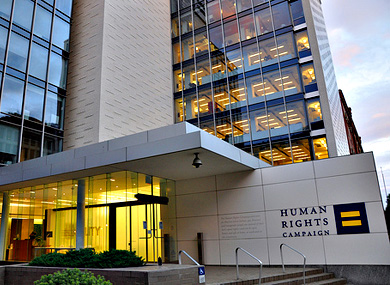
The Human Rights Campaign headquarters in Washington, D.C.
Similarly, Focus on the Family is a conservative evangelical organization founded in 1977 by psychologist, James Dobson. But in 2003, Dobson issues a statement during the 2004 election cycle about gay marriage, saying that the institution of marriage “…is about to descend into a state of turmoil unlike any other in human history.” Similar sentiments were echoed by many other evangelical organizations, and the threat of gays spreading their gay germs, so to speak, was now also overshadowed by the threat of same-sex hand holding on top of a wedding cake. And organizations like Focus on the Family surpassed HIV as enemy number one.
One look at the 2004 HRC annual report provides glaring evidence that HIV/AIDS was entirely removed from the discussion of LGBT equality in the United States. Even in discussions around domestic partner health insurance coverage, the issue of HIV among the gay population was completely absent.
But it wasn’t just HRC that caused the LGBT movement to direct their attention away from HIV. Popular movements such as the NO H8 sparked the attention of gay youth. Businesses like Chik-fil-a, Walmart and Hobby Lobby took the place of the Food and Drug Administration and big pharma companies that were the previous targets of organized gay rage. And the Human Rights Campaign put virtually all of its chips on the table for gay marriage.
For the whole of gay culture, this was a major step in the right direction. Battle after battle in the state courts around the country, the same-sex marriage movement has proven victorious. The U.S. Supreme Court overturning of Prop 8 and DOMA helped change the tide in the court of national public opinion. For the first time, the majority of Americans believed that LGBT people deserved equal rights and the HRC has been marking off state after state for legalized same-sex marriage.
But these victories have come at a cost. When same-sex marriage became the singular virtual focus of the gay community, HIV virus received the break it needed to stage a comeback among gay and bisexual youth who were too busy fighting in courtrooms to worry about the bedroom.
Since gay marriage became the focus of the LGBT community, the rate of infection among gay and bisexual men has increased by a staggering 132.5 percent between 2001 and 2011.
Many older gay men shake their fists at this report, angry that these young boys would be so stupid to make this mistake after countless of their friends and lovers passed away from AIDS. But to elude any of the blame would be quite hypocritical, since the older generation is equally to blame for the shift away from HIV education and prevention once the wedding bells started ringing.
That is not to say that youth wasn’t a major focus for many LGBT organizations. The Trevor Project, founded in 1998, is a national non-profit organization focused on suicide prevention efforts among LGBT youth. The organization gained mainstream notoriety in the late 2000’s with multiple A-list celebrities, including Lady Gaga, Ellen DeGeneres, Katy Perry and Neil Patrick Harris, who lent their support through fundraising efforts and outreach events.
In 2010, outspoken LGBT activist, Dan Savage, launched the It Gets Better Project, a viral video movement with the mission to inspire LGBT youth that, well… “It gets better.” The movement became an international phenomenon, inspiring 50,000 user-created videos viewed more than 50 million times. The project has also received massive celebrity support, with people like Kesha, Joe Jonas and Anne Hathaway making their own videos for the project.
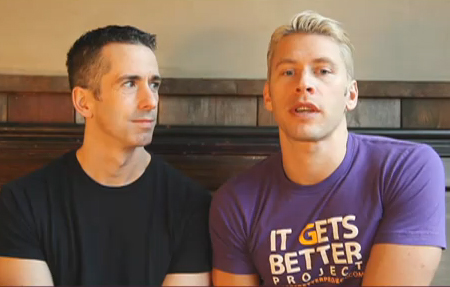
LGBT activist and founder of the It Gets Better Project, Dan Savage and his partner.
The Trevor Project and It Gets Better has made windfall change in how the LGBT community is viewed in society and how gay youth deal with their sexuality. But there is a stark absence in HIV programming and messaging that a young, newly HIV positive individual can relate to, and are still to afraid to talk about.
In 2012, the HRC Annual Report dedicated an entire page to the issue of LGBT youth. The organization highlighted the fact that over half of LGBT youth say they have used alcohol and drugs while only 22 percent of non-LGBT youth say they have. They reported that LGBT youth are profoundly more disconnected than their straight peers from their families, schools and communities. And the report claimed that non-LGBT youth are nearly two times as likely as LGBT youth to say they are happy. But starkly absent from the LGBT youth page is the fact that young gay and bisexual males make up 69 percent of new HIV infections among persons aged 13-29.
Specifically, the CDC reported that, “Young MSM may be at risk because they have not always been reached by effective HIV interventions or prevention education–especially because some sex education programs exclude information about sexual orientation.”
Now that sounds like a human rights issue that deserves some national attention.
Luckily, HRC has now partnered with the Greater Than AIDS to release a comprehensive resource guide, which focuses on prevention and treatment for the LGBT community. And if HRC was slow to take up the reigns of HIV awareness in the past, they are now leading the charge with other progressive organizations such as the San Francisco AIDS Foundation and the World Health Organization in recommending the use of Truvada as PrEP for people who are at-risk for HIV infection.
HRC, the Trevor Project and the It Gets Better Movement are just examples, or merely symbols of the priority shift that took place once impending death did not come with an HIV diagnosis. There is no one person or group of people responsible for the rise in infection; the entire community is liable for letting their guard down. But now we have an entire generation of young gay and bisexual youth who are completely under prepared to battle an enemy that we know how to beat.
It would be great if LGBT media programs and gay and bisexual civil rights movements could skirt the HIV issue all together. But you are only as strong as your weakest player, and with a 132.5 percent increase in HIV infection, the team is looking pretty weak. Of course, there are organizations that focus solely in the issues of HIV prevention in youth. But it’s the responsibility of any LGBT youth organization to make HIV prevention a part of the discussion.
Even though HRC, and many other gay rights organizations have racked up many trophies in the past decade when it comes to treatment and condition of the LGBT community, this number represents a glaring stain our exemplary record of progress. It is time to, once again, make ending HIV a top priority within the gay community. Gay marriage and equal rights are central to the progress of our community, but these victories aren’t anything if part of our people is silently suffering from a preventable disease while others rush to the aisle.
