All posts by GayFriendschat.com

Things Are Improving For LGBT Students, But They're Still Really Bad

Things Are Improving For LGBT Students, But They're Still Really Bad
Schools are getting better at fostering a friendly environment for LGBT students, but they still have a long way to go.

A survey released Wednesday by the Gay, Lesbian & Straight Education Network, which advocates school safety for students, regardless of sexual orientation or gender expression, showed notable improvement for LGBT students during the 2012-2013 school year from 2010-2011.

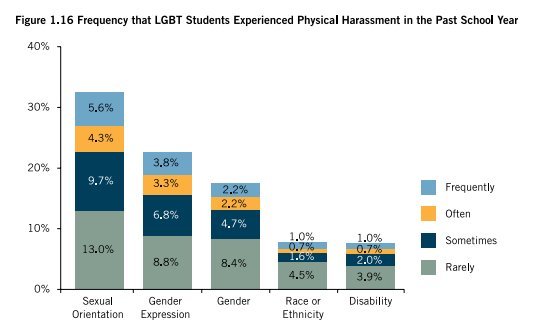
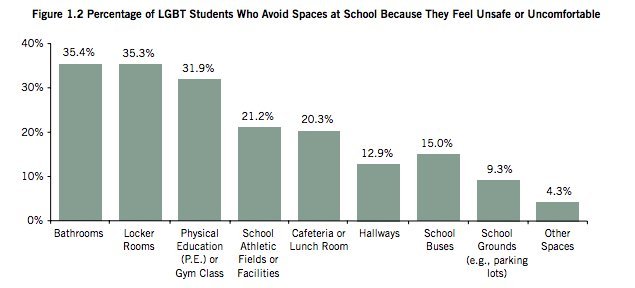
But huge numbers of LGBT students reported problems at school. Of the nearly 8,000 students ages 13 to 21 who were surveyed, more than 55 percent reported feeling unsafe at school due to their sexual orientation, down from 64 percent in 2011. Thirty-six percent faced physical harassment, including pushing or shoving, a drop of 2 percentage points from the earlier survey. And more than 16 percent said they were physically assaulted, sometimes with a weapon, a decline of 2 percentage points. Many students said they avoided places at school that made them feel unsafe.

“You see tremendous progress since 2011,” Eliza Byard, executive director of Gay, Lesbian & Straight Education Network, told The Huffington Post. “That being said, it still means far too many students are experiencing anti-LGBT violence and discrimination.”

harassment

avoid

The survey found that certain school policies contribute to discrimination. More than half of students who were surveyed reported hearing teachers or school staff make homophobic remarks against LGBT students. Further, school staff often fail to protect LGBT students, the survey showed. The number of students who said school staff members intervened to stop bullying was unchanged from 2011.

Byard said the new report provides greater detail than earlier surveys on how schools discriminate against LGBT students. For example, nearly 18 percent of students reported being prevented by from “discussing or writing about LGBT topics in school assignments.” Nearly 16 percent were prohibited from wearing clothing or items supporting LGBT issues. For the first time, the survey asked students whether they had heard negative remarks about transgender people.

“We don’t know if that’s on the way up or way down,” Byard said. “The increased visibility in trans students and issues makes it a place where we have to pay attention.”

Byard said she worries that school structures and policies are not keeping pace with changes in student behavior.

“In our current political climate, that makes me really worried,” Byard said.

www.huffingtonpost.com/2014/10/22/glsen-2013-survey_n_6024742.html?utm_hp_ref=gay-voices&ir=Gay+Voices

'Wasn't He Gay?': A Revealing Question About Mister Rogers

'Wasn't He Gay?': A Revealing Question About Mister Rogers
“Wasn’t he gay?” That’s what people often ask me when they learn that I’m working on a book about Fred Rogers — the beloved creator, writer, and host of Mister Rogers’ Neighborhood. I’ve come to believe that the question, however intended, reveals just as much about the questioners as it does about Rogers.

Sure, the question makes complete sense if a lack of machismo means that a man is gay. After all, Fred Rogers was the opposite of macho. He showed no hint of physical brawn; his chin was weak, his muscles underdeveloped, and his face smooth. Nor was he aggressive. He talked softly and carried no stick; his spirit was gentle and tender, patient and trustworthy, and receptive and loving. A model of male softness and sensitivity, Rogers cut a striking figure on and off television.

But wait a second: Lots of gay men are tough guys — muscular, aggressive, and downright rough. So the mere fact that Rogers was the opposite of macho really proves nothing about his sexual orientation.

The question is also reasonable if gay men prefer that their friends and social groups be gay or at least gay-friendly. After all, Fred Rogers knowingly hired gays to appear on Mister Rogers’ Neighborhood, even counting two of them, John Reardon and Francois Clemmons, among his closest personal friends. Rogers also attended a Presbyterian church in Pittsburgh that remains well known for welcoming the LGBT community and supporting its full inclusion at all denominational levels.

But wait another second: Isn’t it true that some gay men don’t use sexual orientation as the major criterion when selecting their best friends, and that others even closely identify with institutions and movements that are historically and vehemently anti-gay, like the Catholic Church, conservative Protestant churches, and the Boy Scouts of America? If this is indeed true, Rogers’ choice of friends and church also doesn’t give us any firm evidence about his sexual orientation.

The nagging question is also understandable if we acknowledge that gay men of Rogers’ generation (and discretion) often hid their gay sexuality by marrying women and having children, all the while engaging in gay sex on the sly. Rogers was married to one woman, Joanne, for almost all his adult life, and their relationship, by all accounts a loving and devoted one, resulted in the birth of two sons. But there’s a significant point to add here: There’s no publicly available evidence that Rogers ever engaged in gay sex.

None.

Zip.

Zilch.

Nothing there.

OK, but don’t we also have to concede that some (heterosexually married or single) gay men, for a wide variety of reasons, don’t engage in gay sex? I can easily think of a famous name or two I’d rather not mention here. And if this is the case, we’re still left unsure about Rogers’ sexual orientation — much, I suspect, as others are about, well, our orientations.

Hmmm…

Everything becomes a bit more complicated when we consider that in the late 1960s Rogers encouraged Francois Clemmons, who played the role of Officer Clemmons, to remain in the closet, marry a woman, and focus on his singing career as ways to rein in and channel his gay sexual orientation. Rogers evidently believed Clemmons would tank his career had he come out as a gay man in the late 1960s.

But — and this is a crucial point — Rogers later revised his counsel to his younger friend. As countless gays came out more publicly following the Stonewall uprising, Rogers even urged Clemmons to enter into a long-term and stable gay relationship. And he always warmly welcomed Clemmons’ gay friends whenever they visited the television set in Pittsburgh.

Nevertheless, Rogers was never a public advocate of gay rights, even in the post-Stonewall era, and he told colleagues that a public stance on the issue would alienate many of the viewers he wanted to reach with his message.

And what was that message?

“I like you just the way you are.”

Unconditional acceptance, arguably the most positive and compassionate message that any gay child, youth, or adult could find anywhere on television during Rogers’ tenure.

Perhaps it’s this queer- and straight-friendly message that we would do well to recall as we wonder about Rogers’ sexual orientation, revealing so many of our prejudices along the way, deep-seated prejudices about the lives of gays and straights and about our own uneasiness with sexual orientations and behaviors.

At last, perhaps we should turn the camera lens toward ourselves and assure Fred Rogers that we like him just as he was: the opposite of machismo, a loving husband and father, a close friend and employer of gays, a man who grew to support at least one friend’s desire for an openly gay relationship and, above all else, a compassionate human being who assured each of us that, no matter who we are or what we do, we are always and everywhere lovable and capable of loving…

Anyone.

Just as they are.

www.huffingtonpost.com/michael-g-long/wasnt-he-gay-a-revealing-_b_6014538.html?utm_hp_ref=gay-voices&ir=Gay+Voices

EXCLUSIVE: U.K. Documentary 'Patchwork' Puts Spotlight on Trans Love

EXCLUSIVE: U.K. Documentary 'Patchwork' Puts Spotlight on Trans Love

In this exclusive clip from the upcoming trans-focused British documentary series Patchwork, lovebirds Darcy and Rosa talk about 13 years of partnered bliss through and beyond gender transition.

read more

Mitch Kellaway

www.advocate.com/arts-entertainment/2014/10/21/exclusive-uk-documentary-patchwork-puts-spotlight-trans-love

Botched Robbery or Hate Crime?

Botched Robbery or Hate Crime?
Over the past two weeks, community members in Los Angeles have held a vigils to mourn the death and celebrate the life of Aniya “Ray Ray” Parker. The murder of Ms. Parker marked the eighth homicide of a transgender woman of color reported in the U.S. since June. She was shot in the head and killed as she was fleeing from three men who had confronted her on a sidewalk in Hollywood.

Los Angeles Police Department officers immediately told news reporters at the scene that this tragic incident appeared to be a “robbery gone bad.” Within hours, local media ran headlines of a transgender person killed in a “botched robbery.” The police, they reported, were not considering this a hate crime but simply a random “robbery gone sideways.” These accounts were echoed in national reports, even from LGBT news sources.

Local community members and activists responded with an adamantly different perspective on what happened: This was not a robbery, in fact, they left the purse behind,” one resident told reporters. “This is a cold-blooded hate crime and this type of violence needs to end.”

A surveillance video of the incident showed the assailants engaging in a verbal exchange with Ms. Parker and then physically assaulting her. Ms. Parker fled and was shot as she ran across the street, not during a struggle for her belongings. When the video was shown on local television news, it strengthened community members’ resolve that this was not a “botched robbery” but a hate crime against an individual from a marginalized and too-often-targeted community.

According to the newest hate-crime statistics released last week by the Los Angeles County Commission on Human Relations, the number of incidents against transgender people jumped by nearly 46 percent last year, and the majority of the victims were people of color. Just as staggering, the report revealed that 100 percent of those crimes were violent.

The tragic murder of Ms. Parker and the frenzy of news reports in the aftermath have elevated concerns around the investigation and handling of violent crimes against trans people and illuminated misconceptions regarding the role of law enforcement.

During the investigation, it is not law enforcement’s role to decide whether or not this murder was a hate crime. That is largely up to the district attorney when suspects are arrested and charged. As stated by LAPD Detective Scott Masterson in response to another recent LGBT homicide, “The hate crime aspect doesn’t come into play until we’re meeting with the district attorney. A hate crime is determined by the evidence. It’s what we can prove, not what we think.”

Whether a crime is deemed a “hate crime” is based on the specific motivation of the perpetrators. In California, any crime may be deemed a “hate crime” if it was “committed, in whole or in part, because of one or more … actual or perceived characteristics of the victim.”

While it is not law enforcement’s role to conclude whether or not this was a hate crime, it is part of their job to thoroughly investigate crimes. An informed perspective around the victim’s identity and the broader context of the crime should act as guidance. This recent homicide involved a victim who was part of a vulnerable population disproportionately experiencing hate violence: African-American trans women.

It appears that an understanding of Ms. Parker’s identity within the broader context of violence fueled by transphobia, homophobia, sexism and racism in our society has been missed. When asked by a reporter at the vigil for Ms. Parker about whether this was a hate crime, an LAPD captain remarked, “Just because of a person’s lifestyle and they’re a victim of a violent crime, it doesn’t necessarily make it a hate crime.” Detectives repeatedly expressed that the trans community should not be concerned about their safety in the wake of this murder. Unfortunately, these statements convey a lack of awareness about the trans community and the threats of violence we live with every day.

Being transgender is not merely a “lifestyle.” An acknowledgement of our identities and experiences is a prerequisite for recognizing hate crimes and investigating how and why hate-motivated violence happens. Moreover, in cases such as this one, law enforcement have an opportunity to build trust with a historically marginalized population, which ultimately will improve investigations and community safety.

Ms. Parker may have indeed been targeted for a robbery, as the investigators have indicated, but why was she chosen as a victim? And why did the violence escalate to such brutality? While I am not advocating that we jump to the conclusion that the murder of Ms. Parker was a hate crime, the possibility that her transgender identity or her race, or both, were motivating factors should be a critical component of the investigation.

The current investigative premise seems to be: A crime is not a hate crime until proven otherwise. When the victim is a trans woman of color, this approach flies in the face of our current reality. I propose a different approach for law enforcement: A violent crime against a transgender person should be investigated under the presumption that it was motivated by anti-transgender bias and hatred, until the evidence shows otherwise.

Critical consideration of a crime’s context should guide the investigative process and how law enforcement agencies think about and talk about incidents such as this one. With video footage clearly showing that perpetrators engaged in a violent interaction with a trans woman and shot her as she was running away, this investigation should be guided by the real possibility that Aniya Parker’s murder was, indeed, a hate crime.

www.huffingtonpost.com/christopher-argyros/botched-robbery-or-hate-c_b_6011560.html?utm_hp_ref=gay-voices&ir=Gay+Voices
Madonna’s “Sex” Book Inspired This Guy To Come Out 22 Years Ago So He Did This To Thank Her

Madonna’s “Sex” Book Inspired This Guy To Come Out 22 Years Ago So He Did This To Thank Her

BOOK COVERTwenty-two years ago Madonna was more inescapable than ever. Her pulsating single “Erotica” was climbing the charts, an album of the same name had just been released (and it was even more sexual than any of the the singer’s past work), and the anticipation for her Basic Instinct knock-off ill-fated sensual thriller Body of Evidence was still high. But the project that was really causing a commotion was Sex, the icon’s notorious coffee table book filled with provocative S/M images of the entertainer cavorting with adult film stars, celeb friends — often completely nude — and indulging in all sorts of activities usually not explored outside of an urban fetish club.

It was a liberating time for scores of the pop queen’s gay fans. Among them was Greg Scarnici, familiar to Queerty readers by his pretty lady drag persona Levonia Jenkins, who felt so inspired by all the pro-sex and mostly pro-Sex coverage in the media that he swung open his mirrored closet door and told his friends and family that he was a big queen.

vmvyhz“Seeing a huge pop star shooting at The Gaeity Male Burlesque with my favorite porn star at the time, Joey Stefano, made me realize it was not only okay to be gay, but it was also okay to embrace my sexuality,” Scarnici tells HuffPo.

As the book remained a source of inspiration, Scarnici decided to pay homage to the 1992 tome by creating his own slightly more twisted version, which he’d appropriately title Sex in Drag. He donned a blond wig and enlisted a group of pals including Chris Harder, Dallas Dubois, Logan Hardcore, Bob The Drag Queen, Quamin Ellis and Z100’s “Uncle Johnny for a sordid sexy shoot in Fire Island.

Scarnici describes those few days to HuffPo as a blast to recreate. He recalls:

“Even though a lot of the images were sexual, we were all hysterical laughing while shooting it: ‘Is my bush showing through the vodka bottle?’ The whole thing was so much fun. And while we were shooting it, no one on Fire Island batted an eye! They just looked at us like it was normal to see a naked man/woman eating a slice of pizza at the Cherry Grove pizzeria.

Learn more about the book or purchase your own copy here. See a few of the less explicit images from Sex in Drag below.

TOE LICK

ASS SHOT

SHOE LICK

Jeremy Kinser

feedproxy.google.com/~r/queerty2/~3/4sFvb_ADq_c/madonnas-sex-book-inspired-this-guy-to-come-out-22-years-ago-so-he-did-this-to-thank-her-20141021