
Op-ed: One Little Word Means the World
The word ‘bisexual,’ from President Obama’s lips to America’s ears.
Aud Traher
www.advocate.com/commentary/2015/01/29/op-ed-one-little-word-means-world
Please enter your date of birth to proceed.
Op-ed: One Little Word Means the World
The word ‘bisexual,’ from President Obama’s lips to America’s ears.
Aud Traher
www.advocate.com/commentary/2015/01/29/op-ed-one-little-word-means-world
How Ryan Scott Oliver Is Shaking Up Musical Theater With His Dark, 'Twisted And Genius' Work
Ryan Scott Oliver could very well be musical theater’s answer to an auteur filmmaker or a gothic novelist, and for good reason: the 30-year-old composer-lyricist says he’s equally inspired by the likes of Quentin Tarantino and Stephen King as he is Stephen Sondheim.
“I like to think of my artistic perspective as being morbidly optimistic,” Scott told The Huffington Post in an interview. Like Tarantino and King, he sees darkness as the common denominator in all of his work, noting, “I believe in happy endings, but I also believe that there’s a lot of really, really awful sh*t that people have to go through in order to get there.”
New Yorkers who aren’t familiar with Scott’s shows, like 2014’s “Jasper In Deadland” and 2009’s “Mrs. Sharp,” will get an opportunity to be introduced to the scope of his musicality at Manhattan nightspot 54 Below on Feb. 2. The composer will join Broadway veterans Jay Armstrong Johnson, Lindsay Mendez, Andy Mientus and Derek Klena (among others) for two back-to-back concerts showcasing his eclectic — and occasional eccentric — melodies.
Jay Armstrong Johnson sings a tune from “Jasper in Deadland.”
Though he’s yet to be produced on Broadway, Oliver has already garnered a cult-like following among legions of theater fans, as evidenced by the fact that both performances were nearly sold out at the time this story was first published. That comes as little surprise to Johnson, who praises Oliver’s music as “deep, rich, innovative and new.”
“His stuff is never based on a movie or a book — the source material is always his brain, which is twisted, genius and exciting,” Johnson, who is currently starring in the Broadway revival of “On The Town,” said. “He’s always dealing with religion, he’s always dealing with sexuality … things that are dark and semi-uncomfortable, but which always make you think. As an actor, you don’t really come across many composers of that breadth and depth.”
Oliver, who set out to become a composer in high school and aims to pen at least one new show every year, also acknowledges the inherently queer themes that thread his work. One example is his 2010 musical “Darling,” which put a “dark, jazzy and sexy” spin on the story of “Peter Pan” by, among other things, recasting the Lost Boys as male hustlers. He says he’s most drawn to narratives that feature the “fabulousness” and “shimmer” of traditional musical theater, but also that highlight the triumph of an underdog.
“I really like creating underdogs as well as the people who will suppress them and aim to destroy them,” he said. “I’m really fascinated by monsters that take human form.”
Oliver married photographer Matthew Murphy (left) in 2014. 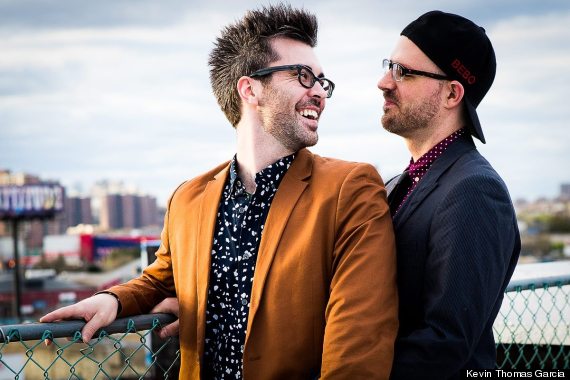
Fortunately, Oliver has found an ideal personal and professional partner in the form of dance and theater photographer Matthew Murphy. The couple collaborated on an experimental multimedia exhibition, “35MM,” in New York in 2010 and 2012; Murphy has since gone on to shoot many of Oliver’s shows, including “Deadland.” In May 2014, they tied the knot in a Brooklyn ceremony officiated by Mendez.
Noting that he and Murphy have a “loving creative competition” with each other, Oliver added, “Our relationship is never jealousy-inducing, but I’m always aware of the fact that I’m married to very talented, driven person. We set a good example for one another, and that’s a very, very special thing. He’s a genius, so that doesn’t hurt either.”
Actress (and longtime pal) Lindsay Mendez sings from “35MM.”
So what’s next for Oliver following his 54 Below engagement? These days, much of his creative energy is focused on a new, folk-driven musical called “Rope.” A production of “Jasper in Deadland” opens in Seattle in May, and Oliver says he is hopeful a full-scale production of “Darling” will be staged in New York in the imminent future, following a reading in late January.
For now, however, Oliver is content to be creating the niche musicals he wants to make, even as mainstream Broadway audiences flock to jukebox shows like “Mamma Mia!”
“There’s a crowd who wants to go to a musical for a good time, and there’s a crowd who wants to see a musical to be changed,” he said. “For me, if I write a good story, I think people will want to see it. You have to write the show that speaks to your heart in a given year.”
“RSO at 54 Below” opens at New York’s 54 Below on Feb. 2. Head here for more details.
State Equality Index Spotlight: New Mexico

New Mexico is one of 18 states in the country that has explicit state-level workplace protections for all LGBT employees. It is also one of 36 states with marriage equality.
HRC.org
www.hrc.org/blog/entry/state-equality-index-spotlight-new-mexico?utm_source=rss&utm_medium=rss-feed
Marriage At the Supreme Court 2.0: The Cases
This article is one in a multipart series leading up to a future Supreme Court decision on marriage equality. The Court has granted review of four marriage cases from the Sixth Circuit and a decision may be handed down at the end of June. Between now and then, Towleroad will break down the cases step by step. Today’s topic: The Cases.
Last time, we spoke about the importance of framing the case through the Questions Presented. I argued that despite some concern, the two questions posed in the Supreme Court’s order do not indicate that the justices are looking for a way out. They are ready to rule. Before we discuss the substance on which the justices will rule, let’s review the four cases that will decide the marriage equality question.
CONTINUED, AFTER THE JUMP…
This matters because not all cases are fungible. Some come with better facts, others come with messy complications; some come with sympathetic plaintiffs, others have unfortunate optics. Especially when it comes to appellate review, the record on appeal can even tilt the outcome of the case. Plus, the cases are fun to talk about at nerdy cocktail parties.
Bourke v. Beshear is the Kentucky case and it was one of the earlier (though not the earliest) post-Windsor pro-equality decisions from a federal district court. It is about both the right to have a valid out-of-state marriage recognized in a home state and Kentucky’s own in-state ban. The judge, the Honorable John G. Heyburn, relied heavily on Windsor and found that Kentucky’s marriage laws discriminated against gay persons in violation of the Equal Protection Clause as applied to the states. Using rational basis review — the lowest form of scrutiny that only requires a rational connection between a law and a legitimate government objective — the court said there was no rational reason to treat gays this way. He struck down the anti-recognition law.
DeBoer v. Snyder is the Michigan case. It is unique for several reasons. First, it started out as a challenge to Michigan’s ban on same-sex couples jointly adopting children, but it ended up as a consolidated case challenging the state’s marriage ban. Second, it became one of only three marriage equality cases to ever go through a trial. Third, that trial featured the obviously discredited study by Mark Regnerus that even the court said was “unbelievable.” After a trial in which Judge Bernard Friedman, a Reagan appointee, considered evidence from experts and made findings of fact about the state’s purported rationales for its discriminatory laws, he concluded that Michigan’s marriage law violated the Equal Protection clause. The trial record is important because, on appellate review, factual findings have to be accepted unless clearly erroneous: there is nothing clearly erroneous about Judge Friedman’s findings.
Tanco v. Haslam is out of Tennessee and deals strictly with the question of recognizing valid out-of-state same-sex marriages. The Tanco parties will be arguing on Question 2. Tanco is also a unique case because it started as a motion for a preliminary injunction to stop Tennessee from continuing to discriminate against gay couples married out of state. Preliminary injunctions are granted when, without them, the moving parties would suffer irreparable harm. There are other elements to the preliminary injunction standard, but suffice to say that Judge Trauger agreed that the deprivation of equal rights occasioned by marriage discrimination in Tennessee was so worrisome and irreparable that she granted the injunction.
Finally, Obergfell v. Hodges comes to us from Ohio. Obergfell is another out-of-state recognition case. Ohio has had a flurry of marriage equality litigation since Windsor. In fact, one of the early cases in the post-Windsor winning streak was an order requiring Ohio to recognize same-sex marriages for the purposes of death certificates. The ruling was extended to all valid out-of-state same-sex marriages.
Although the cases have different elements and some raise different legal questions, they are all covered by the underlying legal question of whether the Fourteenth Amendment countenances state marriage discrimination against gay persons. They are all covered by the two Questions Presented. With this background, we can now move on to discuss some of the arguments we can expect from both sides.
In the next installment of Marriage 2.0, we will discuss the anti-equality arguments from the states and, in particular, consider what, if anything, will happen with the Baker v. Nelson misdirection.
***
Follow me on Twitter and on Facebook.
Ari Ezra Waldman is a professor of law and the Director of the Institute for Information Law and Policy at New York Law School and is concurrently getting his PhD at Columbia University in New York City. He is a 2002 graduate of Harvard College and a 2005 graduate of Harvard Law School. Ari writes weekly posts on law and various LGBT issues.
Ari Ezra Waldman
www.towleroad.com/2015/01/marriage-at-the-supreme-court-20-the-cases.html
@SubLGBT: A esta hora @juanflorians Subdirector #LGBT entre

Rep. Jared Polis Wants Sen. Marco Rubio Under 24/7 Surveillance
Anti-gay Senator Marco Rubio (R-FL) is a huge fan of the federal government’s invasive monitoring of private citizens in the name of fighting ISIL, Al Qaeda, and preventing another 9/11. So much so that he wants an permanent extension of the Foreign Intelligence Surveillance Act, the 1978 act that was used to justify the Bush administration’s warrantless wiretapping.
Wrote Rubio in an op-ed published on Foxnews.com:
This year, a new Republican majority in both houses of Congress will have to extend current authorities under the Foreign Intelligence Surveillance Act, and I urge my colleagues to consider a permanent extension of the counterterrorism tools our intelligence community relies on to keep the American people safe.
Its subsequent amendments – the USA PATRIOT Act of 2001, the Terrorist Surveillance Act of 2006, and Protect America Act of 2007 – greatly expanded the federal government’s right to spy on its citizens through “electronic surveillance”.
In a challenge of putting one’s money where one’s mouth is, Representative Jared Polis (D-CO) called on the United States Intelligence Community to begin twenty-four hour per day monitoring of Senator Rubio, saying:
If Senator Rubio believes that millions of innocent Americans should be subject to intrusive and unconstitutional government surveillance, surely he would have no objections to the government monitoring his own actions and conversations. Senator Rubio is asking for American technology companies to ‘cooperate with authorities,’ so I believe he will have no objection to authorities being given access to his electronic correspondence and metadata. Maybe after his 2016 strategy documents are accidentally caught up in a government data grab, he’ll rethink the use of mass surveillance.
Rubio’s offices has not yet commented on Polis’ proposal.
Christian Walters
www.towleroad.com/2015/01/rep-jared-polis-wants-sen-marco-rubio-under-247-surveillance.html
FanX, Wildcat Basketball, LGBT Resource Center: The Cat Call January 29th, 201
Hey Wildcats! Today we will be talking about The Ralph Nye Lecture series, The LGBT Resource Center Safe Zone Training, Women’s basketball, and Salt Lake Comic-Con’s Fan Experience!
www.youtube.com/watch?v=ZyltzVg-oMQ&feature=youtube_gdata
#TBT: What I Know About Football
Now, that’s the one with the pointy ball, right?
Christopher Harrity
www.advocate.com/comedy/2015/01/29/tbt-what-i-know-about-football
'Matt Shepard Is a Friend of Mine,' and My Son
The film “Matt Shepard is a Friend of Mine” is a documentary by Matt’s high school friend Michele Josue, focused on sharing the story of “Matt,” the person, friend and son that the world didn’t have the opportunity to know when a brutal anti-gay hate crime cost him his life and turned him a historical figure in the LGBT civil rights movement.
After Matt’s death, Dennis and I started the Matthew Shepard Foundation with the hopes that we could prevent similar tragedies from happening again. By sharing our story, by talking about Matt, maybe we could reach other parents whose children might be questioning their sexuality. We wanted to share the message that it’s important they choose to accept and love their kids rather than throw them away.
We felt we needed to make sure we were doing everything we could to stop another parent from losing a child to such hateful violence. As time went on and we shared Matt’s story with more people around the world, this also became a way we could keep his memory alive, to humanize our son and remind the world he was so much more than how he died.
But as years passed, Dennis and I also came to the conclusion that there was this “Matthew Shepard” we didn’t recognize. People who didn’t know him were making him into this angel, this perfect human who was lost to tragedy, and that wasn’t Matt.
I always felt that Matt’s story would be more authentic and powerful if his friends told their stories, too. But they needed time, and they needed to be ready. We knew it was only a matter of time before Michele would approach us about telling this story–and the film she’s now made is her story of Matt, and his friends’ story of the life they knew with him in his short time with us.
I thought this was the perfect way to do it, and we trusted Michele completely to find balance among the different stages of Matt’s life for those who don’t know his story, for those who didn’t know the Matt we knew. She accomplished that, and has helped people realize that he was a three dimensional person, not just a newspaper story. That he was a human being with issues and flaws, family and friends who loved him, and that it’s unfair to think of him in any other way. Michele set out to remember the Matt she knew and find others who were ready to share their stories as well, and this made Matt real to people.
This film is entirely Michele’s vision and the memories of Matt’s friends, who in some ways had a better idea of who he was at any given time because they were actually with him while Matt was in school or living in Denver or Laramie. Every time Dennis and I watch it, we see something different. Every time we watch it, it’s difficult, because Matt’s there on the screen, and we see him, and then he’s gone again.
The reactions to the film have been really rewarding for us. Viewers hear more about who he was and how he had changed throughout the years, getting a glimpse of how he lived instead of only how he died. It helps them see the true depth of the tragedy and the terrible cost of hatred.
Matt Shepard is a Friend of Mine has already been screened all over the world. It’s been named a top documentary at numerous festivals and it seems every critic has their own meaningful take away for the film. But for us, this is about honoring the authentic Matt and giving people the chance to see someone beyond a headline.
With the film now opening in theaters across the country, I hope people will be reminded that Matt was an ordinary boy who experienced both struggles and triumphs in his life, that he was real to so many people. He was a human being who was attacked and killed simply because of who he was. But more importantly, that Matt is one of many who have been made victims of anti-gay violence. Our work to influence and pass legislation, to share our story, is not about Matt. It’s about all the men and women, young and old, who are still targets to this day because of who they love.
People see parts of themselves in Matt, both good and bad, and then the message sinks in, that these victims are more than icons or figures. They’re people who feel love, pain, happiness and sadness. They had lives familiar to our own, but somehow some of us are allowed to live when others aren’t. When people see and hear about the real Matt, the Matt we knew, it’s my hope they’ll understand what we’re fighting so tirelessly for.
You must be 18 years old or older to chat
