
All posts by GayFriendschat.com

The death of Lord Montagu and why his notorious gay trial was a turning point for Britain

The death of Lord Montagu and why his notorious gay trial was a turning point for Britain

Lord Montagu of Beaulieu has died at the age of 88. The name might not mean much nowadays, except that it became synonymous with one of the most notorious gay trials of the 20th century.

In March 1954 he, the journalist Peter Wildeblood and another aristocrat, Michael Pitt-Rivers, were convicted – on sketchy evidence at best – of gross indecency and sentenced to terms of imprisonment of one year to 18 months.

‘People can’t understand it now,’ Montagu said in an interview with the Evening Standard in 2007. ‘They can’t imagine the furtiveness. As someone said at the time, the skies over Chelsea were black with people burning their love letters.’

It all boiled down to what did or didn’t happen during a party in a beach hut in Beaulieu, on the south coast of England, one summer night. The prosecution embroidered a lurid tale aimed at the nation’s press of all-night male orgies and vice-laden drunkenness.

Wildeblood, in his account published the year after the trial, demurred, pointing out the party was rather boring and, furthermore, throughout the whole time the hut was surrounded by girl guides, apparently engaged in birdwatching.

But gross indecency was a very easy offence to commit, essentially a catch-all for any form of intimacy. Montagu himself confessed to having kissed one of the men present, which would have been enough without press-fuelled fables of Bacchic excess.

This was, in any case, a show trial, part of a concerted effort, truly a witch hunt, to ‘rid England of this plague’ of homosexuality, in the words of the then British Home Secretary David Maxwell Fyfe. It was a hunt which saw over a thousand men imprisoned at any one time for consensual same-sex sexual activity.

The year before his more famous trial, Montagu had been the subject of another police investigation based on earlier supposed gay Beaulieu shenanigans, allegations he always denied and which were eventually thrown out of court because of forged evidence. A high profile figure, clearly, the authorities had him in their sights.

To that end the police made every effort to secure a conviction this time round and to make sure the trial was as well publicized as possible.

‘There was this crash-bang bang-bang on the door,’ Montagu remembered. ‘The press had been tipped off and were already there,’ a point corroborated by Wildeblood, himself a newspaper man.

Lurid headlines followed, of rampant homosexual wickedness threatening the very lifeblood of the nation – headlines, as it happens, towing the government line; an all-too familiar tale.

The defendants were denied access to lawyers for hours after their arrests, the police bungled their own accounts and the three men’s convictions were secured on the statements of two witnesses, young airmen present at the beach hut, who gave evidence in exchange for immunity from prosecution.

All the publicity, however, backfired. Despite their convictions, the mood among the public was sympathetic.

They were cheered when they left the court to begin their sentences. The injustice of it all became a key factor in the move towards decriminalisation of homosexuality.

Wildeblood, who had openly confessed his sexuality during the trial, became a key witness to the Wolfendon Committee – that committee’s report would later help secure the decriminalization of homosexuality in Britain.

Montagu, understandably perhaps, wanted none of this. We may require victims of these brutal laws to become poster boys and girls for the cause, but few ever want to. Montagu was just one of the many who didn’t.

The terrible fear the state had imposed on gay and bisexual men in the post-War period took its toll. A public trial, the humiliation of conviction and the cruelty of imprisonment, the sense, as he confessed, of having let his family down somehow, induced him to deny everything.

It was only in his 2000 autobiography that he came out as bisexual, and only in 2007 that he felt able to talk publicly about the trial.

In the interim he’d married, thrown himself and his estate into the world of classic racing cars and went back to, as he saw it, a world of normality. In one of the interviews he gave, Montagu did make a belated claim for recognition as a sort of LGBTI hero.

‘Maybe I’m being very boastful about it,’ he told the Evening Standard, ‘but I think because of the way we behaved and conducted our lives afterwards, because we didn’t sell our stories, we just returned quietly to our lives, I think that had a big effect on public opinion.’

Maybe it did, although Wildeblood’s published account rather suggests that he, at least, did not return quietly to his life. It was his more active role before the Wolfendon Committee that almost certainly had a greater impact on the change in the law.

But Montagu’s long silence is entirely understandable. In the context of the 1950s he was supposed to be a pillar of the community, to take his punishment and carry on, not to make a fuss – to offer a veneer, at least, of respectability.

When, eventually, in 1967 the law was changed, one of the sponsors of the Sexual Offences Act, Lord Arran, warned gay men against any form of ostentatious behavior which might ‘make the sponsors of the Bill regret that they have done what they have done’.

Montagu’s enforced quiet would have conformed perfectly to this demand. But it’s Wildeblood who, I think, had the last word, concluding his account of the trial and his imprisonment with a plea for understanding, a demand for a more honorable sort of quiet.

‘The right which I claim for myself, and for all those like me, is the right to choose the person whom I love… to choose a partner and, when that partner is found, to live with him discreetly and faithfully.’

Kevin Childs can be followed on Twitter here.

The post The death of Lord Montagu and why his notorious gay trial was a turning point for Britain appeared first on Gay Star News.

Kevin Childs
www.gaystarnews.com/article/the-death-of-lord-montagu-and-why-his-notorious-gay-trial-was-a-turning-point-for-britain/

Russia cancels its only LGBTI film festival

Russia cancels its only LGBTI film festival

Russia has abruptly cancelled the country’s only LGBTI film festival, only to replace it with a ‘positive, youth-oriented’ alternative.

Organizers of Moscow Premiere received the news days before the 13th edition of the festival was scheduled to kick off on 2 September, according to the Hollywood Reporter.

‘Due the difficult economic conditions, the culture department of Moscow has to limit the use of budgetary resources in 2015 and cancel funding of several events, including Moscow Premiere,’ a letter from city’s culture committee read.

Funding was diverted to the new Youth Festival of Life Affirming Film.

The move comes two years after the introduction of a gay ‘propaganda’ law, which bans the ‘promotion’ of homosexuality to minors.

Moscow Premiere is a week of free screenings of films not given wide release in the country, such as Russia 88 and Winter Journey, a mockumentary about neo-Nazis and a gay-themed debut feature.

Festival head Vyacheslav Shmyrov said it was too late to save this year’s event and that they would not would not affiliate with the new festival for their ‘self-esteem.’

The post Russia cancels its only LGBTI film festival appeared first on Gay Star News.

Darren Wee

www.gaystarnews.com/article/russia-cancels-its-only-lgbti-film-festival/

Here's How Religious Exemption Laws Can Hurt Women And The LGBT Community

Here's How Religious Exemption Laws Can Hurt Women And The LGBT Community

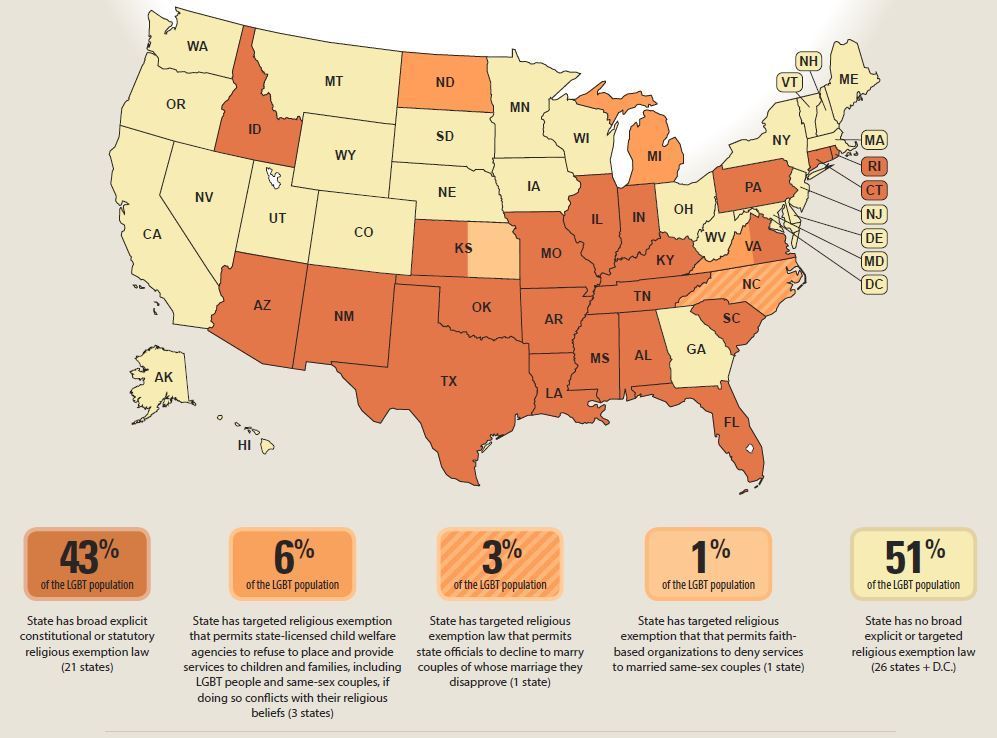
Forty-three prercent of Americans live in a state with religious exemption laws, which can potentially harm women and the LGBT community, according to a new report.

For its “LGBT Policy Spotlight” report released Tuesday, the Movement Advancement Project broke down the history of religious freedom laws, including recent Supreme Court rulings like Burwell v. Hobby Lobby that play a role in how state and federal religious freedom laws are interpreted.

“The original federal RFRA may have been passed with good intentions, but the Supreme Court’s interpretation of the law in Hobby Lobby — alongside states’ ever-increasing roster of religious exemptions, both broad and targeted — raise serious concerns about how these vague exemptions are being used to harm others, interfere with law enforcement, and undermine the rule of law,” the report says.

Earlier in 2015, both Indiana and Arkansas passed religious freedom laws that drew criticism nationwide over concerns that they could be used as legal justification for discrimination against LGBT individuals. A Reuters/Ipsos poll from April showed a majority of Americans believe businesses should not be allowed to refuse services based on their religious beliefs.

The Movement Advancement Project’s report examines how much of the U.S. population lives under potentially harmful religious freedom laws:

lgbt

 (Click the map to view a larger image)

The report says the increase in these laws across the U.S. is “no coincidence,” arguing the legalization of same-sex marriage and and the coverage of contraception under the Affordable Care Act are among the reasons people are fighting to pass more religious freedom legislation. 

Read the full report below:

For more from The Huffington Post, download our app for iOS or Android.

Also on HuffPost:

— This feed and its contents are the property of The Huffington Post, and use is subject to our terms. It may be used for personal consumption, but may not be distributed on a website.


feeds.huffingtonpost.com/c/35496/f/677065/s/49757d20/sc/7/l/0L0Shuffingtonpost0N0C20A150C0A80C240Creligious0Eexemption0Elaws0Ereport0In0I80A6860A20Bhtml0Dutm0Ihp0Iref0Fgay0Evoices0Gir0FGay0KVoices/story01.htm

BREAKING: Supreme Court Rules Against Kentucky Anti-Marriage Equality Clerk Kim Davis

BREAKING: Supreme Court Rules Against Kentucky Anti-Marriage Equality Clerk Kim Davis

Kim-DavisThe Supreme Court on Monday ruled against the Kentucky county clerk who has refused to issue same-sex marriage licenses, and the clerk will face her moment of truth.

Rowan County Clerk Kim Davis will have to choose whether to issue marriage licenses, defying her Christian conviction, or continue to refuse them, defying a federal judge who could pummel her with fines or order that she be hauled off to jail.

“She’s going to have to think and pray about her decision overnight. She certainly understands the consequences either way,” Mat Staver, founder of the right-wing law firm representing Davis, said on Monday, hours before a court-ordered delay in the case expired. “She’ll report to work tomorrow, and face whatever she has to face.”

A line of couples, turned away by her office again and again in the two months since the U.S. Supreme Court legalized gay marriage across the nation, plan to meet her at the courthouse door.

Related: Kentucky County Wants To Fire Kim Davis, Clerk Who Won’t Issue Marriage Licenses To Same-Sex Couples

Davis stopped issuing all marriage licenses in the days after the landmark decision. Two same couples and two opposite sex couples sued her, arguing that she must fulfill her duties as an elected official despite her personal religious faith. A federal judge ordered her to issue the licenses, and an appeals court upheld that decision. Her lawyers with the Liberty Counsel filed a last-ditch appeal to the Supreme Court on Friday, asking that they grant her “asylum for her conscience.”

Justice Elena Kagan, who oversees the 6th district, referred Davis’ request to the full court, which denied the stay without comment. Kagan joined the majority in June when the court legalized gay marriage across the nation.

Meanwhile, a couple that had been turned away went to Rowan County Attorney Cecil Watkins to ask that she be charged with official misconduct, a misdemeanor defined by state law as a public official who “refrains from performing a duty imposed upon him by law or clearly inherent in the nature of his office.” The crime is punishable by up to a year in jail.

Watkins cited a conflict of interest and forwarded the complaint to Kentucky Attorney General Jack Conway, whose office will decide whether to appoint a special prosecutor, generally a county attorney from a surrounding jurisdiction, who would decide whether to file charges.

As the clock wound down for Davis on Monday, the tension intensified between dueling groups of protesters outside her office window on the courthouse lawn.

Hexie Mefford has stood on the lawn waving a flag nearly every day for more than two months. The flag is fashioned after Old Glory, but with a rainbow instead of the red and white bars.

Mike Reynolds, a Christian protesting in Davis’ defense, shouted at her that he found the flag offensive: He is an Army veteran, he complained, and they had desecrated the American flag. The two groups roared at each other. The Christians called on the activists to repent; the activists countered that their God loves all.

It was a marked difference from the cordial protests that unfolded there every day since Davis declared she would issue no licenses.

Rachelle Bombe has sat there every day, wearing rainbow colors and carrying signs that demand marriage equality. One particularly hot day, Davis, the woman she was there to protest against, worried Bombe would get overheated and offered her a cold drink. In turn, Bombe said she’s checked in on Davis, whose lawyer says she’s received death threats and hate mail, to make sure she’s holding up despite the difficult circumstances.

“She’s a very nice lady, I like her a lot,” Bombe said of Davis. “We’re on the opposite sides of this, but it’s not personal.”

On Monday, the Christians stood on the grass and sang “I am a Child of God.”

The marriage equality activists chimed in after each refrain: “So are we.”

By CLARE GALOFARO /Associated Press

© 2015, Associated Press, All Rights Reserved.
This material may not be published, broadcast, rewritten, or redistributed.

H/T LGBTQNATION

Chris Bull

feedproxy.google.com/~r/queerty2/~3/ByobNuFamDY/breaking-supreme-court-rules-against-kentucky-anti-marriage-equality-clerk-kim-davis-20150831

Supreme Court Turns Away Kentucky Clerk Who Turned Away Gay Couples Wishing To Marry

Supreme Court Turns Away Kentucky Clerk Who Turned Away Gay Couples Wishing To Marry

The U.S. Supreme Court declined to delay a federal court order Monday that effectively requires a Kentucky clerk to begin issuing marriage licenses to gays and lesbians within her jurisdiction.

The court’s one-line order offered no explanation for its response to Rowan County Clerk Kim Davis.

Around the time Davis filed her plea with Justice Elena Kagan on Friday, the federal judge who initially ordered her to not enforce her “no marriage policy” against gay couples declined to put on hold his own ruling to that effect, according to BuzzFeed News’ Chris Geidner.

Absent an extraordinary move by Davis on Tuesday, she would seem to have no other option but to comply with the judge’s order.

In her emergency petition with the court Friday, Davis argued that her “conscience forbids her from approving” marriage documents for gays and lesbians “because the prescribed form mandates that she authorize the proposed union and issue a license bearing her own name and imprimatur.”

Lawyers for Davis had argued in court papers that if she couldn’t be accommodated based on her religious objections, “then elected officials have no real religious freedom when they take public office.”

After the Supreme Court ruled in June that same-sex couples have a constitutional right to marry, Kentucky Gov. Steve Beshear (D) — who was a losing party in that case — ordered state clerks to begin issuing marriage licenses to all couples without regard to sexual orientation.

But Davis refused time and again, even in the face of a federal lawsuit against her and an order from U.S. District Judge David Bunning telling her to comply. Last week, an appellate court told her that she had “little or no likelihood” of winning on her religious-freedom claim.

I hope Ms. Davis will resume issuing marriage licenses tomorrow not just to our clients but to everyone who is eligible under the law,” tweeted Joe Dunman, a local civil rights attorney who was also involved in the case the Supreme Court decided in June.

Despite the Supreme Court’s refusal to intervene in Davis’ case, her dispute remains alive in the court system: She remains free to challenge the merits of Bunning’s decision before the U.S. Court of Appeals for the 6th Circuit. 

— This feed and its contents are the property of The Huffington Post, and use is subject to our terms. It may be used for personal consumption, but may not be distributed on a website.


feeds.huffingtonpost.com/c/35496/f/677065/s/497543d2/sc/7/l/0L0Shuffingtonpost0N0C20A150C0A80C310Csupreme0Ecourt0Ekim0Edavis0Emarriage0Elicenses0In0I80A683240Bhtml0Dutm0Ihp0Iref0Fgay0Evoices0Gir0FGay0KVoices/story01.htm

US Supreme Court denies Kentucky clerk’s request to continue no marriage license policy

US Supreme Court denies Kentucky clerk’s request to continue no marriage license policy

Rowan County Clerk Kim Davis suffered another legal setback late Monday (31 August) – this time from the highest court in the United States.

The US Supreme Court denied an emergency request from Davis to continue to not issue marriage licenses to any couplesgay or straight – as she continues her legal battle in a lower federal court.

Davis, citing religious beliefs, has refused to issue marriage licenses from her Kentucky office since the Supreme Court’s 26 June ruling that made same-sex legal in all 50 US states.

The court issued its denial without comment.

‘Today  the U.S. Supreme Court resoundingly affirmed that government officials must carry out the duties of public office,’ Steven R. Shapiro, legal director of the American Civil Liberties Union, said in a statement.

‘Davis has no basis for any further delay in denying couples the freedom to marry.’

The ACLU is suing Davis on behalf of four couples – two gay and two straight – who have been denied licenses by her office.

All eyes will be on the Rowan County Clerk’s office on Tuesday (1 September) as there will no doubt be couples seeking marriage licenses. If they are refused, this could result in Davis being held on contempt of court charges.


The post US Supreme Court denies Kentucky clerk’s request to continue no marriage license policy appeared first on Gay Star News.

Greg Hernandez

www.gaystarnews.com/article/us-supreme-court-denies-kentucky-clerks-request-to-continue-no-marriage-license-policy/

U.S. Supreme Court Declines Emergency Stay Request from Anti-LGBT Rowan County Clerk

U.S. Supreme Court Declines Emergency Stay Request from Anti-LGBT Rowan County Clerk

Today, the U.S. Supreme Court declined a petition from Kentucky’s Rowan County clerk Kim Davis for an emergency stay on a court order requiring her to immediately start issuing marriage licenses to all eligible applicants, including same-sex couples.
HRC.org

www.hrc.org/blog/entry/u.s.-supreme-court-declines-emergency-stay-request-from-anti-lgbt-rowan-cou?utm_source=rss&utm_medium=rss-feed

Anti-gay Kentucky Clerk Kim Davis’s SCOTUS Emergency Stay Request Denied

Anti-gay Kentucky Clerk Kim Davis’s SCOTUS Emergency Stay Request Denied

supreme court

Rowan County clerk Kim Davis has failed in her efforts to get the highest court in the land to intervene in her anti-gay crusade.

The Supreme Court today turned down Davis’s emergency request for a stay on a federal order calling on her to issue marriage licenses to same-sex couples. BuzzFeed’s Chris Geidner reports Justice Elena Kagan, who handles such claims from the Sixth Circuit, referred the request to the full court.

#SCOTUS denies #KimDavis application for a stay pic.twitter.com/LDLzlmHVMd

— Equality Case Files (@EQCF) August 31, 2015

The stay on the federal order expired today. Davis has a big decision to make tomorrow, as Kentucky station WKYT notes:

kim davisDavis will have to choose whether to issue marriage licenses Tuesday, defying her Christian conviction, or continue defying a federal judge who could fine her or send her to jail.

A gay couple who was denied a marriage license three times have filed a federal lawsuit against Davis, saying they were deprived of their “fundamental, Constitutional right to marry.”

The lawsuit was filed Aug. 25 in U.S. District Court by William Smith Jr. and James Yates, but a summons was delivered Monday to Rowan County Judge Executive Walter Blevins, who is named as a defendant with Davis and the county. Other defendants, including Davis, were expected to be served this week, attorneys have told WKYT.

The AP adds:

“She’s going to have to think and pray about her decision overnight. She certainly understands the consequences either way,” Mat Staver, founder of the law firm representing Davis, said on Monday, hours before a court-ordered delay in the case expired. “She’ll report to work tomorrow, and face whatever she has to face.”

The Rowan County Attorney’s Office has already filed a charge of official misconduct against Davis.

Related, Anti-LGBT Kentucky Clerk Kim Davis Unknowingly Issued a Marriage License to a Trans Man in February

The post Anti-gay Kentucky Clerk Kim Davis’s SCOTUS Emergency Stay Request Denied appeared first on Towleroad.


Kyler Geoffroy

Anti-gay Kentucky Clerk Kim Davis’s SCOTUS Emergency Stay Request Denied