All posts by GayFriendschat.com

Intersex Veteran Denied Passport For Refusing to Choose Gender, Files Lawsuit

Intersex Veteran Denied Passport For Refusing to Choose Gender, Files Lawsuit

An intersex person from Colorado who identifies as neither male nor female is suing the U.S. State Department after being denied a passport after they refused to select a gender on the application.

Dana Zzyym, a U.S. Navy veteran, claims the application violates the Constitution, Reuters reported Monday. Zzyym confirmed with The Advocate that they prefer the gender-neutral pronouns they, them, and their to refer to themselves. 

Zzyym filed a federal discrimination lawsuit in Denver this week, stating it was a constitutional violation to force an intersex person to select a gender in order to travel abroad. At the time, they were trying to travel to Mexico City for the International Intersex Forum, according to Reuters.

“I am not male, I am not female, I am intersex, and I shouldn’t have to choose a gender marker for my official U.S. identity document that isn’t me,” Zzyym said in a statement obtained by Reuters.

Countries such as Malta, India, Nepal, Australia, and New Zealand provide a third gender option on passports, and some nations are considering making a similar change, Kyle Knight wrote in The Advocate this week.

Zzyym’s complaint said that at birth in 1958, they had “ambiguous external sex characteristics,” and the gender box on their birth certificate was initially left blank, the wire service reported.

They were raised as a boy. “Similar to many other intersex children, by age five, Dana had been subjected to several irreversible, invasive, painful, and medically unnecessary surgeries designed to make Dana’s body conform to binary sex stereotypes,” the complaint said, according to Reuters.

Zzyym joined the U.S. Navy in 1978 and served as a machinist mate during several tours of duty, but left in 1984 and decided to explore their gender identity.

After living as a woman, which didn’t feel right, they adopted the name Dana Zzyym and determined gender identification was “arbitrary,” the suit reportedly said.

Zzyym’s lawyer, Paul Castillo of Lambda Legal, told Reuters his client isn’t seeking compensation, but merely to force a change in U.S. policy.

“Dana is being deprived of the right to lawfully exit the United States because of personal characteristics, and that’s discrimination, pure and simple,” Castillo told Reuters. 

Elizabeth Daley

www.advocate.com/travel/2015/10/27/intersex-veteran-denied-passport-refusing-choose-gender-files-lawsuit

I'm Tired of Pretending Figure Skating Isn't the Best Sport Ever (But It Needs Help)

I'm Tired of Pretending Figure Skating Isn't the Best Sport Ever (But It Needs Help)
I remember my first time watching figure skating with eerie clarity.

February 1994. Like millions upon millions of other people around the world, my 9-year-old eyes were glued to the television to watch the skating competitions during the Olympic Games in Lilllehammer, Norway. I distinctly remember Tonya Harding’s skate lace meltdown, Nancy Kerrigan’s twinkling beige dress and Scott Hamilton’s commentary yelping exuberantly about it all.

I was totally hooked. In the years that followed, I began to obsessively follow every competition and show on TV, filling up hundreds of blank VHS tapes so that I could re-watch Michelle Kwan’s every moment of glory whenever I wished. (Oh, the days before DVR.) I also attended dozens of events in person, including the Olympic-qualifier national championships in St. Louis in 2006.

After that, my interest waned. At the same time, figure skating’s popularity in the United States has plummeted. While endless hours of skating coverage used to fill the airwaves, just more than a handful of events are broadcast on network television today. And while the sport is more popular than ever in Asia, it has been on steady decline here for years, retreating into obscurity.

Almost more than a decade since my last live event, I attended the Skate America competition in Milwaukee, Wisconsin last weekend.

gracie

Gracie Gold points to the crowd after she performed in the ladies short program at the Skate America figure skating competition Friday, Oct. 23, 2015, in Milwaukee. (AP Photo/Jeffrey Phelps)

Kicking off the six-part Grand Prix international series, Skate America is the first major competition of the figure skating season. It’s an important event, where skaters earn points toward their goal of qualifying for the Grand Prix Final, a competition that serves as a lucrative preview of the World Championships in the spring. But you wouldn’t necessarily know that by looking around the half-empty stands at the UW Milwaukee Panther Arena.

With a 7,000-person capacity for figure skating events, the Panther Arena attracted, at its best-attended of four ticketed sessions, an audience only half that size. The event’s first session of four, Friday afternoon, was attended by only 2,700.

Skate Americas as recently as 2008 have enjoyed a total attendance as high as nearly 30,000 for the full multi-day event, so where was everyone?

I have a few thoughts on where the gangly cousin of the American sports family went wrong, and how it can regain cultural relevancy anew:

1. Celebrate the sport for what it is, rather than making it something it’s not.

Let’s get the obvious out of the way: The action on the ice all weekend was remarkable. The achievements of top figure skaters, combining the athletic skill required, the strength and agility, with the artistry of performance factor is a tall order. Few achieve the rare moments of transcendence when it all falls into place all at once. On top of that, the costumes are stunning, often more intricate than the outfits worn by many pop stars on their arena tours, and the drama between rival skaters, coaches and nations is palpable.

All things considered, figure skating is the original reality show. And that’s enough to let the sport, in many ways, speak for itself. It doesn’t need an in-arena DJ spinning pop and hip-hop all weekend long during breaks and between performances. It doesn’t need an in-arena host leading awkward trivia contests with fans. Just let the skaters skate — and find a way to make it easier for interested viewers to find it on television. Only one hour of the event was broadcast on its network partner, NBC, over the weekend. This is insufficient exposure to build an audience.
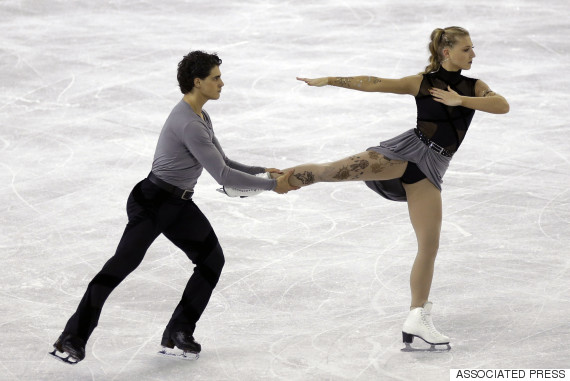
gilles poirier

Piper Gilles and Paul Poirier, of Canada, compete in ice dance at the Skate America figure skating competition Saturday, Oct. 24, 2015, in Milwaukee. (AP Photo/Jeffrey Phelps)

2. But can we talk about the scoring system?

For anyone who hasn’t watched figure skating in a long time, the days of a 6.0 marking a perfect score ended about a decade ago. The sport’s new judging system assigns different point values to each move performed — the harder it is, the more points you get — and bonus points are offered, or taken away, based on how well it was executed. This means that a “good” score means something different for each skater, depending on what they planned to perform.

The winning total for Skate America’s women’s champion, Russia’s Evgenia Medvedeva, was 206.01. That number is meaningless to the average person. Context is needed to educate viewers about what factors contributed to a skater’s score being either low or high, why a skater who fell on a jump might still place high based on their overall performance, for example. To avoid fully explaining so, both on television and especially at a live event, causes only confusion. This is already a kind of ridiculous sport, let’s not make it more so!

evgenia
Evgenia Medvedeva, of Russia, performs in the ladies free skating at the Skate America figure skating competition Saturday, Oct. 24, 2015, in Milwaukee. Medvedeva won the gold medal. (AP Photo/Jeffrey Phelps)

3. But don’t dumb it down.

While context is important, don’t assume an audience is completely clueless. During one in-arena interview with a former champion about what to expect during the pairs event that was broadcast on the arena Jumbotron, the commentator explained that the male pairs skaters were throwing their partners the length of a couch during their throw jumps. That comparison is meaningless to the scoring system and somewhat demeaning to the audience.

More thorough commentary might have noted the difference in difficulty and point value of different throw jumps, which jumps top pairs were planning for their programs and how much of a role successful completion of their throw jumps plays in a pairs team’s overall performance.

4. Send in the music consultants.

Beginning last year, the figure skating powers that be allowed, for the first time, all four disciplines of skating — pairs, men’s, ice dancing and women’s — to use music with lyrics for their programs. One would think this would open the floodgates to all sorts of different music being used in competition but, for the most part, most skaters continue to stick to generic, conservative musical selections that serve as Ambien for audiences.

At Skate America, the musical selections for the men’s final were almost entirely dreary, ranging mostly from dirge-y movie soundtracks like The Piano and The Mission to tinkly, piano or string-heavy ballads. The uniformly dreary music created a low-energy vibe in the arena and, had it been on television, likely would have turned away viewers. Many of the musical selections among the ice dancers were similarly lacking in excitement, but more unexpected, energetic and diverse music choices could make a huge impact. (I heard enough Il Divo this weekend to last a lifetime.)

shoma uno

Shoma Uno, of Japan, shows off his unique cantilever move during the Skate America exhibition program Sunday, Oct. 25, 2015, in Milwaukee. (AP Photo/Jeffrey Phelps)

5. The sport is at its best at its most eccentric. Embrace and encourage that.

The weekend’s highlights were the moments where a skater stuck out from the crowd. Pairs champions Wenjing Sui and Cong Han of China’s incredible lateral quadruple twist. Men’s runner-up Shoma Uno of Japan’s unusual, program-ending cantilever bend. Canadian ice dancers Piper Gilles and Paul Poirier’s strange and exciting “She Said/Neverland” free dance.

These are the sorts of moments that fans of the sport from long ago, the days of Tonya and Nancy, will be drawn to if given the chance. These are the moments skating promoters in the U.S. need to be emphasizing if they are to bring the sport back from its death spiral.

— This feed and its contents are the property of The Huffington Post, and use is subject to our terms. It may be used for personal consumption, but may not be distributed on a website.


feeds.huffingtonpost.com/c/35496/f/677065/s/4b031de4/sc/38/l/0L0Shuffingtonpost0N0Cjoseph0Eerbentraut0Cfigure0Eskating0Eskate0Eamerica0E20A150Ib0I83982680Bhtml0Dutm0Ihp0Iref0Fgay0Evoices0Gir0FGay0KVoices/story01.htm

Open Question: Why do Christians get upset when you say they are confused or deluded or suffer from a mental illness?

Open Question: Why do Christians get upset when you say they are confused or deluded or suffer from a mental illness?
Some Christians claim that Lgbt people are delusional, confused or suffer from mental illnesses and to them it’s ok saying it. If however I say the same thing to Christians they say I’m evil and to go away or generally lash out.

answers.yahoo.com/question/index?qid=20151027090357AAkHK4n

Hot Aussies Pluck Each Other’s Nose Hair and Wax Each Other’s Legs: WATCH

Hot Aussies Pluck Each Other’s Nose Hair and Wax Each Other’s Legs: WATCH

wax

Manscaping can be an arduous and at times painful task, as a handful of guys from down under recently came to learn.

In videos created by BuzzFeed Australia, total strangers were paired together and tasked with plucking each other’s nose hair and waxing each other’s legs with an at-home waxing kit. The guys quickly bond over their mutual pain and even share some bromantic moments. Reactions range from the well-composed to the “Holy sh*t, that really hurt!”

Can you guess which form of manscaping caused the guys to cry more? Watch below and find out:


The post Hot Aussies Pluck Each Other’s Nose Hair and Wax Each Other’s Legs: WATCH appeared first on Towleroad.


Sean Mandell

Hot Aussies Pluck Each Other’s Nose Hair and Wax Each Other’s Legs: WATCH

STUDY: Intimate Partner Violence Still a 'Critical Issue' for LGBTQ Americans

STUDY: Intimate Partner Violence Still a 'Critical Issue' for LGBTQ Americans

Cisgender men killed by their male partners continue to represent the most intimate partner homicides in the LGBTQ and HIV-impacted population, while bisexuals, transgender people, and people of color are also disproportionately affected by intimate partner violence, reports the National Coalition of Anti-Violence Programs.

The coalition today released its report Lesbian, Gay, Bisexual, Transgender, Queer and HIV-Affected Intimate Partner Violence in 2014. The report is the most comprehensive of its kind, collecting data from 16 anti-violence programs in 13 states: Arizona, California, Colorado, Illinois, Massachusetts, Michigan, Minnesota, Missouri, New York, Ohio, Rhode Island, Texas, and Vermont.

These programs received 2,166 reports of intimate partner violence in 2014, a decrease of nearly 20 percent from 2013, after an increase from 2012 to 2013. However, a decrease in reports does not necessarily indicate a decrease in prevalence, anti-violence activists pointed out, and the total number of reports tends to fluctuate from year to year. “The need to bring visibility and resources to the experiences and needs of LGBTQ survivors of IPV remains a critical issue facing our country,” said Beverly Tillery of the New York Anti-Violence Project, which administers the coalition, in a press release announcing the report.

The NCAVP documented intimate partner homicides in 2014, down from 21 in 2013. For the fourth year in a row, the data showed cisgender (nontrans) men to be disproportionately affected. Of the 15 reported homicides, eight were cis men, seven of whom were killed by current or former male partners. “We know from the National Intimate Partner Violence Survey by the Centers for Disease Control that lesbians, gay men, and bisexual people experience IPV at the same or higher rates as non- LGB people, and actual homicide numbers are likely much higher,” said Vanessa Volz of Sojourner House in Providence, R.I., in the press release “The lack of awareness and visibility in the media — and in society generally — around fatal intimate partner violence as it affects LGBTQ and HIV-affected people needs to change.”

Also for the fourth consecutive year, people of color made up the majority of survivors of intimate partner violence, this year coming in at 51 percent. African-Americans were 1.89 times more likely than all other racial groups to experience such violence, the report notes.

Bisexuals were twice as likely as others to experience intimate partner violence of a sexual nature, according to the report. This was the second year in a row the coalition had found bisexual people to be disproportionately affected in this manner.

Transgender people, meanwhile, were nearly twice as likely as nontrans people to experience intimate partner violence in public, and they were more than three times as likely to experience discrimination, which makes it difficult to access services. Undocumented transgender survivors faced even higher levels of discrimination.

Economics also played a role in intimate partner violence. For the first time, the NCAVP gathered data on survivors who are on public assistance and found that they experienced physical violence and injury at a greater rate than others, while people of color and transgender people were more likely to be receiving public assistance.

“Economic violence is often a central form of abuse within IPV, and survivors who face societal economic vulnerabilities may be more vulnerable to economic abuse and exploitation from their abusive partners, said Chai Jindasurat of the New York City Anti-Violence Project. “Policymakers and funders should fund economic empowerment programs targeted at LGBTQ and HIV-affected communities, particularly LGBTQ and HIV-affected communities of color, transgender communities, immigrant communities, and low-income communities.”

An encouraging development is that more survivors sought orders of protection in 2014 — 24 percent, up from 17 percent in 2013 — and that a much higher percentage of these orders was granted — 85 percent, up from 58 percent in 2013. There were also increases in the percentage of survivors seeking shelter services and reporting their experience to police.

The response of police and social service agencies to LGBTQ and HIV-affected survivors of intimate partner violence has been improving, the report notes, partly due to the Violence Against Women Act reauthorization of 2013, which put in place prohibitions on discrimination based on sexual orientation and gender identity. But much remains to be done, the report’s authors say.

Key recommendations from the report, for policymakers, researchers, and funders:

• Ensure that the federal government collects comprehensive and inclusive information on sexual orientation and gender identity whenever demographic data is requested in studies, surveys, and research, including intimate partner violence.

• Ensure that LGBTQ survivors are included in all prevention assessments and that coordinated community responses include specific and targeted programming for LGBTQ survivors.

• Fund specific intimate partner violence prevention initiatives for LGBTQ and HIV-affected people.

• Fund economic empowerment programs targeted at LGBTQ and HIV-affected people, particularly people of color, transgender people, immigrants, and low-income people.

• Enact compassionate, comprehensive immigration reform to reduce barriers for LGBTQ and HIV-affected immigrant survivors of IPV.

You can download the full report here.


Trudy Ring

www.advocate.com/crime/2015/10/27/study-intimate-partner-violence-still-critical-issue-lgbtq-americans

Intersex Navy Veteran Sues State Department For Denying Passport

Intersex Navy Veteran Sues State Department For Denying Passport

DENVER, Oct 26 (Reuters) – A Navy veteran from Colorado who identifies as neither male nor female has sued the U.S. Department of State after being denied a passport for refusing to select a gender on the application, court documents showed on Monday.

Dana Zzyym claimed in a federal discrimination lawsuit filed in the U.S. District Court in Denver that it was a constitutional violation to force an “intersex” person to pick either a male or female when seeking to travel abroad.

“I am not male, I am not female, I am intersex, and I shouldn’t have to choose a gender marker for my official U.S. identity document that isn’t me,” Zzyym said in a statement.

The lawsuit names U.S. Secretary of State John Kerry and the director of the Colorado passport agency as defendants.

The State Department did not respond immediately to a request for comment.

Zzyym was born in 1958 with “ambiguous external sex characteristics,” and the gender box on the birth certificate was initially left blank, the lawsuit said.

Zzyym’s parents and doctor decided “Dana would be raised as a boy” with the name Brian Orin Whitney and “male” was later added to the birth certificate, it said.

“Similar to many other intersex children, by age five, Dana had been subjected to several irreversible, invasive, painful, and medically unnecessary surgeries designed to make Dana’s body conform to binary sex stereotypes,” the complaint said.

Whitney enlisted in the U.S. Navy in 1978 and served as a machinist mate during three tours of duty in Beirut and one throughout the Gulf, it said.

Leaving the Navy in 1984, Whitney later realized that the male gender identification was “arbitrary” and explored living as a woman, which did not feel right either, according to the lawsuit.

Whitney ultimately adopted the name Dana Zzyym and was denied a passport last year when attempting to travel to Mexico City for the International Intersex Forum.

Zzyym’s attorney, Paul Castillo of the LGBT-rights group the Lambda Legal Defense Fund, said India, Nepal, Malta, Australia and New Zealand allow a third gender option for passports, and other countries are considering making a similar change.

Zzyym is not seeking a monetary award, Castillo said, but merely to force a change in U.S. policy.

“Dana is being deprived of the right to lawfully exit the United States because of personal characteristics, and that’s discrimination, pure and simple,” Castillo said. (Reporting by Keith Coffman in Denver; Editing by Paul Tait)

— This feed and its contents are the property of The Huffington Post, and use is subject to our terms. It may be used for personal consumption, but may not be distributed on a website.


feeds.huffingtonpost.com/c/35496/f/677065/s/4b026c67/sc/27/l/0L0Shuffingtonpost0N0C20A150C10A0C270Cintersex0Eveteran0Epassport0In0I8398290A0Bhtml0Dutm0Ihp0Iref0Fgay0Evoices0Gir0FGay0KVoices/story01.htm

Chris Lilley Nails Drake’s ‘Hotline Bling’ as Summer Heights High’s Mr. G – WATCH

Chris Lilley Nails Drake’s ‘Hotline Bling’ as Summer Heights High’s Mr. G – WATCH

Chris Lilley Hotline Bling

Those familiar with the Australian mockumentary TV series Summer Heights High are familiar with thirty-six-year-old drama teacher Mr. G, played by Chris Lilley (one of three characters he plays on the show).

Those unfamiliar with Mr. G are now being introduced to him on Facebook, in a clip that’s quickly going viral in which Lilley, as Mr. G, gives a lesson in dance to a classroom of kids.

Says Mr. G: “An important part of being a performer is begin to to express yourselves through movement. Being able to move your body to convey a message, to get something across.”

And that’s when Mr. G launches into one of the most bizarre takes on Drake’s “Hotline Bling” so far:


DON’T MISS: Sam Smith and Disclosure Brighten Up Drake’s ‘Hotline Bling’: WATCH


The post Chris Lilley Nails Drake’s ‘Hotline Bling’ as Summer Heights High’s Mr. G – WATCH appeared first on Towleroad.


Andy Towle

Chris Lilley Nails Drake’s ‘Hotline Bling’ as Summer Heights High’s Mr. G – WATCH

This Powerful Photo Campaign Puts A Face To Men's Depression

This Powerful Photo Campaign Puts A Face To Men's Depression

Depression is often viewed as some sort of flaw or frailty, but a new campaign is working to change that outlook one photograph at a time.

The project, led by the Canadian mental health organization HeadsUpGuys, features visuals submitted by men on how depression feels and what it means to “feel better.” The goal is to help men realize they’re not isolated in their experience, according to the project’s coordinator, Joshua Beharry. 

“The more you talk about depression, the more the stigma surrounding the illness erodes away,” he told The Huffington Post. “Depression needs to be tackled head on … You wouldn’t try to tackle heart disease or diabetes on your own. It shouldn’t be any different for depression.”

The photos not only bring awareness to depression, but are a much-needed representation of a highly stigmatized group of individuals who suffer from the disorder. Research shows that men are less likely than women to seek treatment.

“I think society places an emphasis on the need for men to be considered ‘strong,’ and a person with a mental illness is often considered to be ‘weak,'” said Robby Cavanaugh, who submitted photos. “For this reason, men suffering from mental illness bottle their feelings up, and I believe this is a contributing factor as to why the suicide rate for men is so much higher than it is for women. They need encouragement to feel free to express their emotions and ask for help, without fear of ridicule. “

Approximately 11 percent of Canadian men will experience major depression at some point in their lives, according to Canada’s public health agency. The condition also affects approximately 6 million American men each year. Around the globe, nearly 350 million people suffer from depression. 

Although the condition is fairly common, the conversation is still fairly quiet among men — and that’s exactly why Nathan Milner says he decided to get involved by submitting images. As someone who has experienced mental health issues since he was a teen, he wanted to raise awareness about something that felt incredibly personal to him.

“I want everyone to know that men’s depression is real. It takes lives and we all need to realize this,” he said.

Milner also hopes the campaign encourages others to seek treatment if they feel like they may be battling the same issues.

“As hard as it is, asking for help is the first step to recovery,” he said. “Being able to speak aloud about what you are going through only helps with self acceptance. There is never anything to feel ashamed of.”


Check out the images below for more from HeadsUpGuys’ photo project.

This post is part of ShameOver: It’s Time To Talk About Men’s Mental HealthHuffPost Healthy Living editorial initiative that aims reclaim what it means to “be strong” by addressing the stigma men face in disclosing and seeking support for mental health issues. Each week we’ll share features and personal stories about men and their caregivers as it relates to suicide, mental illness and emotional well-being. If you have a story you’d like to share, email us at strongertogether@huffingtonpost.com.


If you — or someone you know — need help, please call  1-800-273-8255 for the National Suicide Prevention Lifeline. If you are outside of the U.S., please visit the International Association for Suicide Prevention for a database of international resources.


Also on HuffPost:

— This feed and its contents are the property of The Huffington Post, and use is subject to our terms. It may be used for personal consumption, but may not be distributed on a website.


feeds.huffingtonpost.com/c/35496/f/677065/s/4b011616/sc/38/l/0L0Shuffingtonpost0N0C20A150C10A0C230Cbetter0Estarts0Ehere0Ecampaign0In0I83969340Bhtml0Dutm0Ihp0Iref0Fgay0Evoices0Gir0FGay0KVoices/story01.htm