
Open Question: I feel like my mom doesn't love me anymore?? Help me!!!?
I was walking with my mom earlier and I brought supposedly a touchy subject about having my grandfather drive me over to my friends house who I met at an LGBT group recently. But my grandparents are supposedly homophobic and I thought my mom said it was okay for him to take me there but my mom exploded at me and made me feel so horribly about myself. I’ve tried apologizing and she’s still mad at me. I feel like I want to die 🙁 someone please help me!!!
Monthly Archives: October 2015
Majority of Idaho Schools Fail to Implement LGBT Protection Policies
Majority of Idaho Schools Fail to Implement LGBT Protection Policies

Idaho’s Fairfield Citizen reports that the majority of public schools in the state have failed to adopt new policies on protections for LGBT students.
Among the guidelines provided to schools, it was specified that dress codes remain gender neutral, same-sex couples not be treated differently and transgender students be given the option to use a separate bathroom or changing room. School principals were also encouraged to meet with transgender students to help meet their needs.
RELATED: LGBT Non-Discrimination Ordinance Passes In Bellevue, Idaho
 Of 115 districts, only the Teton School District in eastern Idaho has included protections that apply to education opportunities, school-sponsored activities and specific situations involving bathrooms and overnight trips.
While a small number of public school boards have rejected the proposed guidelines, many more have not even considered the issue in discussions of policy updates.
Although 14 other districts include LGBT non-discrimination policies, little in the way of implementation details have been provided.
Thirty-three schools have anti-harassment policies that specify discrimination based only on hazing, bullying and threats.
While the proposed guidelines state that failure to implement policies would result in disciplinary action, no deadline was provided.
Idaho’s Human Rights Act doesn’t include housing or employment protections for LGBT residents.
The post Majority of Idaho Schools Fail to Implement LGBT Protection Policies appeared first on Towleroad.
Michael Fitzgerald
Majority of Idaho Schools Fail to Implement LGBT Protection Policies
The Avatar Adam and Rexx
adamwright1989 resident posted a photo:

Human boy Adam with his Fae/Demon Rexx. Rexx protects Adam with his life.
TSA Says It Will Stop Calling Trans Bodies 'Anomalies'
TSA Says It Will Stop Calling Trans Bodies 'Anomalies'
In an exclusive conversation with The Advocate, Transportation Security Administration officials contend that they are working diligently with trans advocacy groups to improve training and standard protocol for agents who encounter transgender passengers.
Most notably, TSA agents will stop describing perceived inconsistencies in a person’s anatomy when going through a body scanner as an “anomaly,” agency administrators told The Advocate. Officials have yet to settle on what term will be used instead to identify a discrepancy that requires additional screening, but they contend they are working with trans advocates and the broader community to arrive at a solution.
Kimberly Walton, assistant administrator of TSA’s Office for Civil Rights and Liberty, also suggested that, while the agency implements new guidelines and renews “Transgender 101” trainings, nervous transgender passengers should call (855) 787-2227 to inform TSA of their travel plans, identify themselves as trans, and ask to notify staff working at security checkpoints about their identity before arriving at the airport.
This new focus on how TSA treats its trans travelers comes about in the wake of trans woman Shadi Petosky’s live-tweeting of her harrowing experience being disrespected, detained, and delayed while trying to pass through a TSA checkpoint at Orlando International Airport last month. Indeed, the TSA officials who spoke with The Advocate acknowledged the possibility that Petosky may have been mistreated, though an initial compliance investigation found no misconduct. They also stressed that while that compliance investigation regarding Petosky’s experience was completed within days of the incident, two separate civil rights investigations, one through the TSA’s Office for Civil Rights and Liberty and another through the Department of Homeland Security, are both still ongoing.
In a wide-ranging conversation, Walton and TSA spokesman Mike England reiterated that the entire agency’s goal is to ensure “that all of our passengers are treated with dignity, respect and courtesy,” as Walton put it. “We emphasize that screening is to be conducted without regard to a person’s race, color, national origin, religion, disability, sexual orientation, or gender identity.”
When asked if TSA’s written policy explicitly lists sexual orientation and gender identity in its nondiscrimination clause, Walton was unsure, saying she did not have the policy in front of her. Nevertheless, she stressed that for the past few years, TSA has been working alongside transgender advocacy organizations, including the National Center for Transgender Equality and Gender Justice Nevada, to conduct webinar trainings and offer some key TSA staffers with a “Transgender 101” competency training. A spokeswoman with NCTE confirmed that the organization has assisted TSA in such trainings.
Read on to see The Advocate‘s complete conversation with TSA officials, including discussions of Petosky’s alleged experience, the recent letter sent to TSA leadership from 32 members of Congress demanding that the agency revise its trans screening protocol, and specific advice for transgender travelers who may need to fly before the TSA’s website redesign is completed and the page with trans-specific tips is updated or restored.
The Advocate: I have some questions about Shadi Petosky’s case, specifically, but first I want to start with the more broad protocol, because I’d like to be able to get a good idea on what TSA’s current protocol is when agents encounter transgender passengers at security screenings.
Mike England, TSA spokesman: FYI, we can’t really say much about Ms. Petosky’s specific case, because it is an ongoing civil rights investigation. We can speak, of course, about our policies, procedures, training, and all of that, so feel free to ask anything you want about that.
OK, that’s fine. Let’s start with that: What is TSA’s standard protocol for when an agent encounters a transgender passenger at an airport security screening port?
Kimberly Walton, assistant administrator at TSA Office of Civil Rights and Liberty: Our policies and procedures focus on ensuring that all of our passenger are treated with dignity, respect, and courtesy. And we emphasize that screening is to be conducted without regard to a person’s race, color, national origin, religion, disability, sexual orientation, or gender identity.
With that said, we screen travelers as they present. So if a person presents as a female, they are screened as a female. If a person presents as a male, they are screened as a male. If our workforce is not sure, they are trained to discreetly and politely get clarification. But the general rule is that we screen people as they present at a checkpoint.
Can you give me an example of specific phrases agents might use to discreetly and politely ask a passenger how they identify their gender?
Walton: Generally, it probably doesn’t come up. Because they screen as a person presents. But I’m sure you’ve traveled through an airport and you realize that it is a public setting, and so [the agents] are trained to walk closer to the traveler, so as to not be overheard, and simply ask, indicate that they are unsure, and to, if they could self-identify, discreetly, so that that person can tell them how to screen them.
The technology that we deploy, the best technology for the current and historical threat, does require the transportation security officer to either identify the person as a male or female. And that technology, it does depend on human anatomy. And so in a situation where a transgender traveler is coming through the checkpoint, that decision is made based on the way the individual presents.
Since this incident, if you don’t mind, I can just kind of tell you a few things, since this incident came to our attention. We’ve done a number of things, and a number of things are ongoing.
One thing, we went back to our website, our TSA website, to see if we were communicating very clearly and readily, guidance to the transgender community. So we’ve updated that, but we’re still in the process of providing more detail, and once that is complete, we will provide those links to a number of groups that we work with on a regular basis.
We have over 300 organizations that we work with, but specifically, groups that represent the transgender community, like the National Center for Transgender Equality, GLAAD, the National Gay and Lesbian Task Force; we’ve also worked with Gender Justice Nevada, and Equality Florida, Equality Illinois, and Equality North Carolina, and additionally the Northern California Transgender Law Center are some of the groups that we’ve worked with. So we’ll be providing them links to our website once we’re completed updating the website.
Those are the organizations you’ve been working with since Ms. Petosky’s experience came to your attention?
Walton: Clarification, I will repeat the names. We’ve been working with these groups for a long period of time. We have a large coalition of over 300 organizations — obviously they represent different groups of individuals — these are specifically the groups that are focused on the transgender community. And so they are NCTE, National Gay and Lesbian Task Force, Pride Center of New Jersey, Equality Florida, Equality Illinois, Equality North Carolina, Northern California Transgender Law Center, and Gender Justice Nevada.
And we work with these groups on many different levels. One, we provide them a window into our operations, so that they can, outside of any complaint, give us feedback. We also utilize these organizations in some of the trainings that we do, and so I want to turn to training too.
Over the last year, we have provided to our workforce Transgender 101, which covers a number of items, but specifically preferred terms when referring to a transgender woman or man, terms to avoid, so best practices to be used at our security checkpoints, that include things like providing advisement to passengers, making sure you’re discreet with a transgender passenger, making sure we offer them a private screening if that is their desire, we will also provide our workforce in this training, information on prosthetics, that the organizations I just mentioned have brought to our attention. And so those are some of the things that we have already been utilizing.
And in fact, the NCTE and Gender Justice Nevada have assisted us in providing that training. Sometimes via a webinar, and sometimes in person.
As a result of this incident coming to our attention, we’re going to expand the same training, to provide it more widely to our frontline workforce.
That was going to be one of my questions — if you have this training ongoing. How frequently is it offered, and to what scope of the workforce is it offered, as the TSA undoubtedly employs many people to keep U.S. airports safe?
Walton: We started it last year, and again, the NCTE and Gender Justice Nevada have assisted us in delivering it. Our primary focus was the supervisors of the frontline workforce. And a subset of our workforce called passenger support specialists, who are specially trained to handle a variety of matters.
And after this incident, it became clear to us that we should expand that, and so we are here in the process of working with our office of training to deploy that to all of our workforce on the frontline.
And how frequently do those who’ve been trained receive “refresher courses,”or is the training a sort of “one-and-done” thing?
Walton: So, it’s an ongoing process, and we will work with training to figure out how often in the future we would provide it. That’s sort of a part of the ongoing dialogue with the office of training as we expand it.
The other thing, which was already mentioned, is shortly after this incident, my office, the civil rights office here at TSA, and the civil rights office at the Department of Homeland Security, recently went to Orlando to begin a civil rights investigation, and that is still under way and ongoing. Which is distinct from the compliance investigation that was done at the airport.
You mentioned that TSA is actively in the process of revising and updating its internal staff guidelines for how staffers who encounter transgender passengers should interact with those individuals. We have noticed, however, that at the moment, the TSA’s webpage for transgender travelers returns a “page not found” error. Can you tell me why that is, or when we might see that page revised or come back online? Because there was a page there previously that outlined some specific steps for transgender travelers.
Walton: I’m unaware it’s returning that way, because I had someone on my staff bring me what we had up this morning, so we do have something under our Frequently Asked Questions, and if it’s not coming up, then we need to go fix that information. But we are also actively updating the information that would be responsive if a traveler who was transgender went to our website.
OK. I’ve got the page open now, the URL reads www.tsa.gov/traveler-information/transgender-travelers, and that page returns a “page not found” error. I do see, on the Frequently Asked Questions page, there’s a separate option there that discusses transgender people. But there had been prior, a separate page that specifically indicated what transgender travelers should be prepared for, what they should do to be sure they have a smooth encounter. I’m wondering if you all are aware that that page is no longer active and if there’s a plan to revive that, or if that page has just been lost into the digital ether, and the FAQ is what is now being offered in place of that dedicated webpage.
Walton: The TSA website was recently redesigned for ease of use by travelers, and as a result of the Orlando incident, we are looking to update the website. So the link that you’re referencing, I’m not sure that it will be that link. All I can say is that we are looking to expand information to put up on the website, but it will be consistent with the new design of the website. So I’m not sure that that link will be put back up.
England: If that link is months old, we actually recently redesigned the entire website, so that specific link might be broken. But as Ms. Walton just said, we are actually working to update that portion of the website as we speak.
OK, I understand that. But it sounds like you are still planning to have a dedicated, specific page for transgender travelers, in addition to the bullet point about the screening procedures for transgender persons, which I do see on the FAQ page.
Walton: So, I guess, the format that it will take is still in discussion. What I am committing to is providing more information for the transgender employees. I am not the webmaster here. I will provide the content, and they will place it in the website in the appropriate place.
Good to know. You touched on it briefly, but you said the training, as you currently conduct it, includes supervisors of frontline employees as well as passenger support specialists. Is there discussion ongoing to expand that training to a more broad swath of employees, to the extent of training any employee who might encounter a transgender passenger?
Walton: Yes, that’s the goal, is to expand that to all of our frontline workforce, and that would be our transportation security officers.
And do you have a timeline for when that goal might be achieved?
Walton: I do not have a timeline, but we will deploy it as quickly as feasible. Our workforce is always being trained — it’s a regular process. And so I will have to work with our training office to find when we can do an end date.
In addition to not traveling with prohibited items like weapons or large quantities of liquid, are there other steps transgender passengers can take in advance to ensure they have a smooth passage through a TSA checkpoint?
Walton: Thanks for that question. The first thing, I want transgender passengers to be assured that our policies and procedures focus on ensuring that all passengers are treated with dignity, respect, and courtesy. As I said, that is critical, in that we train our workforce to conduct our screening without regard to a person’s race, color, national origin, religion, sexual orientation, or gender identity. So I would like all transgender passengers to know that.
Second, I would like them to know that they can ask for a private screening. That is available at every airport across this country, if they need to have a private screening.
The other thing is that they can call in to our call center to get information, if they have questions, if they have concerns, they can call in advance. We also have a protocol where, if a person has concerns, that we can even notify the airport in advance of their travel, and the travel itinerary, so they should absolutely call.
We are working to update our website so that it’s easy for them to just get information off of their website if they don’t want to call.
Is there a specific number we can share with our readers, to direct them where to call if they’d like to notify TSA about their travel plans in advance?
Walton: Yes. Absolutely. And the number is (855) 787-2227.
Does TSA have a response to the letter sent to the head of TSA from 32 Democratic members of Congress, asking for the policies on trans travelers to be revised?
Walton: We have received that letter, and we are actively working a response. However, many of the things that I’ve said already, apply [to that letter]. As I’ve said, training was an issue, and I’ve already indicated that training, we’ve already been doing training, we have a Transgender 101 that we’ve provided, that we’re going to expand. The other issue is making sure that our website, that we provide clear and readily accessible guidance to the transgender community and that is under way.
I believe the question of an investigation is raised [in the letter] and as I told you, our civil rights office, along with DHS’s civil rights office, has an investigation under way. I think they reference Health and Human Services, and of course we will comply and cooperate fully if there is such a thing; it has not actually been brought to my attention. So we will do that.
And then finally, it’s really around what I’ve said, and I will repeat, that our policies and procedures are focusing on all of our passengers are treated with dignity, respect, and courtesy. And to the extent that our workforce needs to screen people as they present. If a transgender traveler needs to communicate to us, we provide the venue for them to do that discreetly, and we respond discreetly and provide them with alternative screening if necessary.
Do you have any message on behalf of the TSA to trans individuals who feel that they have been mistreated by TSA in the past?
Walton: I hate to sound like a broken record, but what I want to say to the transgender community is first of all to express any regrets, and that they should bring that to our attention if they do not feel like they have been treated appropriately. But that our policies and procedures are designed to treat passengers with dignity and respect and to make sure that the screening is done appropriately, and that’s without regard to whether or not the person’s sexual orientation or gender identity. And so that would be my message.
And just to be clear, the statement that you’ve been reiterating as TSA’s official policy does explicitly enumerate that passengers should be screened without regard to their sexual orientation or gender identity? The policy includes those four words?
Walton: So, without having it in front of me, I don’t want to say that, but I certainly will say that we train to that. That is certainly what we train to. But without having it in front of me — I can look at it and get back to you. But that is our policy.
Finally, the TSA’s use of the word “anomaly” to refer to unexpected results on a body scan has caused a fair amount consternation among the trans community. Is the TSA planning to —
Walton: We are changing that word.
Do you know what you’re changing it to?
Walton: We’re going to actually work with the — we’re working on that now.
England: The short answer is no, we don’t know what we’re changing it to yet. But we’re going to work with the transgender community and figure that out.
Sunnivie Brydum
www.advocate.com/transgender/2015/10/13/tsa-says-it-will-stop-calling-trans-bodies-anomalies
Dear Queers and Transpeeps: You Are Precious to Me
Dear Queers and Transpeeps: You Are Precious to Me
On October 11, for National Coming Out Day, I shared a graphic on my Facebook wall that a kind pal made for me a few years ago. It was just an image version of my Facebook status from NCOD in 2013 he’d particularly enjoyed, laid over a rainbow flag.
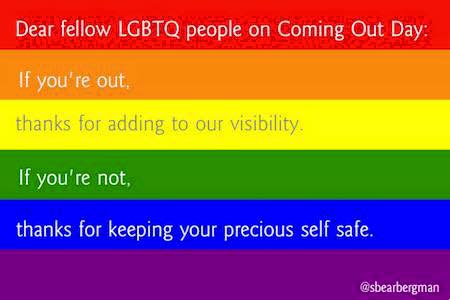
When I posted it this time in the image form, it spread across the internet fast — much faster than it had a few years ago. Something else was different about this time, too: a small subset of people, maybe 5 percent, seemed to read it as snide, sarcastic or ironic. While the overwhelming majority of the people who interacted with the image and accompanying sentiment clearly understood that it (and I) was sincere, I was taken to task in a few places for being thoughtless, heartless and so on.
“How odd,” I thought, as the likes and shares and retweets poured in, as I got a flood of positive feedback about the image. But as the day wore on, I saw it pop up again, and then somewhere else again, enough times that I was eventually able to triangulate the place where some people fell off the sincerity bus and splashed into the sarcasm gutter: it was the word precious.
Now me, I am a sop and a sap, an optimist and a romantic, a tender-hearted storyteller who uses words like precious (and tender, for that matter) every day. For better or for worse, I am pretty often looking for the nicest part of a bad situation, giving people the benefit of the doubt, investing in people’s intention rather than their impact and so forth. I want people to be good, and I want them to be well, too. So you can take it to the bank that when I am talking about your precious self I for sure mean, without even the whiff of sarcasm, your very precious actual self.
I’m aware that we live in an Age of Snark, and it’s not that I have never engaged in that fine and sharp art. I can quip and crack — if not with the best of them, then certainly at a semi-pro level. But not about so important a concept. I absolutely and unreservedly believe that the most important thing for lesbian, gay, bi, queer and trans people to do is stay alive and keep trying if they possibly can. If today is not a safe day to come out — don’t. Play your cards close, strategize to launch, make a safe place for yourself in a private social space or on the internet or in the garden of your own thoughts of that’s all that’s available to you but make it lovely and loving.
On the flip side, if you can come out — if you have the social and economic privilege to be out (and the patience on any given day to sort through the aftermath if need be), to tell people your truth and stand in it, then please oh please: do it. One of the things I have learned in over a decade of running around the country like the proverbial chicken is that it’s actually not the work I do behind a podium that matters most but the work I do in the grocery line. It’s coming out as a gay dad while waiting for my plane to board and revealing myself to be a transsexual at the library that seems to touch hearts in the most direct way. Out people provide models; we are features on the landscape of the imagination. When we can be out, we give people who are trying to figure out who they could possibly be in the world more options.
Here’s the thing, though: I don’t think it was choosing the word precious that sunk my status. Or rather, I don’t think a different word would have done better, even if I meant something else (which I do not). I think the problem is that we all, under the LGBTQ tent, have been told so loudly and for so long that we are worthless — that we’re broken, rotten, intrinsically bad, harmful, dangerous, poisonous, that we can and should be treated like garbage — that many of us can’t hear precious. It has to be sarcastic, right? It has to be, because who in the world could be saying precious, valuable, desirable and when they say those things, mean us?
Well, me for starters. However ridiculous I am, it is also true that I am sincere as a bell and I absolutely hold all of us queers and transfolks as precious. We are necessary and valuable, in addition to being tender and strong and thoughtful and great-looking and frequently very well accessorized. I am in totally non-ironic love with queer communities even when individual people make me tired, tired, tired, and I will spend all the time I have with the other lesbians and gays and bis and enby folks and transpeeps and queer queer queerios of all stripes (and our co-resistors too, and you know who you are) whenever I have choices about where to spend it.
There’s a line that Jewish husbands sometimes say to their wives on Shabbos, adapted from Proverbs: “A woman of valor, who can find? She is more precious than rubies; no treasure can match her.” That’s how I feel, is the truth. No matter what anyone else says or ever has said, no matter what the echo chamber of meanness and snark that the interwebs can be might magnify or amplify, here’s the bare fact: I treasure you above all things. If you can hear that today, I am so glad and grateful. If not, please reread this at intervals until you can because the other very real fact is this — you deserve to hear it and feel reflected in it.
You’re precious. We all are.
— This feed and its contents are the property of The Huffington Post, and use is subject to our terms. It may be used for personal consumption, but may not be distributed on a website.

New Web Ad in Support of Houston Equal Rights Ordinance
New Web Ad in Support of Houston Equal Rights Ordinance

With less than a month until Election Day, Houston Unites released a new web ad in support of the Houston Equal Rights Ordinance (HERO).
HRC.org
NYC Fire Department Tells LGBTQ Kids They’re “Worthy Of Love”
NYC Fire Department Tells LGBTQ Kids They’re “Worthy Of Love”
Yep, folks are still making “It Gets Better” videos. In support of the campaign which helps inspire hope among LGBTQ youth, the FDNY has just released the following video, which features a dozen active FDNY firefighters, paramedics, and EMTs discussing challenges they’ve faced throughout their lives, and the success they’ve found both as adults as members of New York’s Bravest. Many of the participants encourage viewers to choose good friendships. “A lot of my queer community I consider family more than my blood family,” says one person. “Love yourself, be OK with yourself,” says another. “You’re worthy of love.”
Watch their inspiring video below:
Jeremy Kinser
More than half of Russians want to ‘liquidate’ or exclude gays
More than half of Russians want to ‘liquidate’ or exclude gays
submitted by Areann
[link] [8 comments]
More than half of Russians want to ‘liquidate’ or exclude gays
byu/Areann inlgbt
Read Donald Trumps’ Live Tweets of the Democratic Debate
Read Donald Trumps’ Live Tweets of the Democratic Debate

Republican Presidential frontrunner and controversy connoisseur Donald Trump has promised to live tweet tonight’s Democratic presidential debate and we will bring you all of his 140 character quips throughout the night.
Keep refreshing this page all night long for Trump’s latest tweets.
At the request of many, and even though I expect it to be a very boring two hours, I will be covering the Democrat Debate live on twitter!
— Donald J. Trump (@realDonaldTrump) October 13, 2015
Hillary Clinton had a response for that.
.@realDonaldTrump Glad you’ll be watching. It’s going to be “huge.”
— Hillary Clinton (@HillaryClinton) October 13, 2015
Everybody’s talking about my doing twitter during the likely very boring debate tonight. @realDonaldTrump #DemDebate
— Donald J. Trump (@realDonaldTrump) October 13, 2015
The post Read Donald Trumps’ Live Tweets of the Democratic Debate appeared first on Towleroad.
Sean Mandell
WATCH: Vanessa Carlton Debuts 'Operator' Video
WATCH: Vanessa Carlton Debuts 'Operator' Video
Singer-songwriter Vanessa Carlton has shared a video for her new single, “Operator.”
The singer, who came out as bisexual in 2010, told Billboard the song is about an older woman seducing a younger man, but added that its story is not gender-specific.
“She ‘operates’ the way things happen around her to benefit herself,” Carlton said of the song’s subject. “That’s what operators do. Also, the song happens to be about a woman and a boy but it could easily be the story of two women or two men.”
The video, filmed in Nashville, tells its own story. It’s a dark exploration of how children behave when their parents run away.
“Operator” appears on Carlton’s upcoming album Liberman, out October 23. It’s available for pre-order here.
Check out “Operator” below:
Gina Vivinetto
www.advocate.com/music/2015/10/13/watch-vanessa-carlton-debuts-operator-video
