

Monthly Archives: July 2015
ASSEMBLAGE: Meet Queer Punk Band bottoms
ASSEMBLAGE: Meet Queer Punk Band bottoms
“ASSEMBLAGE“ is an inquiry into the different ways artists utilize performance and technology to explore and express different notions of identity. An effort to push forward marginalized artists with a focus on people of color, non-western nationalities and those along the queer/trans spectrum, “ASSEMBLAGE” provides a platform for analysis of how art and performance intersect with the lives of these individuals who are visibly and openly existing in the digital age. This is the eighth installment.
Queer punk band bottoms is a musical grouping unlike any other. Made up of two performers — Jake Dibeler and Simon Leahy aka Babes Trust — and drummer Michael Prommasit, bottoms is a project that in many ways explores the complicated, nuanced relationship queer people have with themselves and the world around them in 2015.
bottoms came into fruition a bit over a year ago following the break-up of Leahy and Prommasit’s previous band Teeth. Dibeler joined the group as the lead vocalist — a style of vocalization that can only be described as high-pitched screaming in a way that almost sounds manufactured but, in reality, is Dibeler’s actual voice.
Dibeler’s voice aside, what makes bottoms so unique and important is the hyper-political nature of their work and the shades of queer identity and experience encapsulated in the group’s lyrics.
The queer community is at a strange and significant moment in time, as we move out of the aftermath of the AIDS crisis and into an era marked by PrEP, instantaneous access to sex, mainstream transgender visibility and the legalization of same-sex marriage. As specific types of queers become more visible and our relationships with sex, institutions and governance shift, we are at a place where many people are reimagining or rethinking what it means to be queer.
bottom’s music heavily explores the intersection of this complicated history marked by violence and disease and modern day realities surrounding visibility and sex.
“We’re really interested in a lot of the culture surrounding the gay community during the time of the AIDS crisis,” Diebler told The Huffington Post. “There was a great resistance from the conservatives to acknowledge the crisis, so the gay community had to look to each other for support. I hope that bottoms can harness that same sort of energy — angry queers with a message. I think that we’re in this place as gays that’s very apathetic. Being able to fuck dudes from your phone in minutes is amazing, PrEP is amazing, but it really makes for this sort of ‘pre-AIDS-there’s-nothing-wrong’ mentality — and maybe that’s true, maybe nothing is wrong and this is the end of HIV and AIDS. But at the moment — I think we need to balance this ‘have unprotected sex with a stranger in an alley’ attitude with one of respect and care for a community that lost a huge chunk of themselves in the 90s.”
bottoms also deals with notions of shame and self-hatred, shared realities for queer people navigating the world we operate in since the beginning of time. As with any way of existing the world, it can be hard to communicate the realities of queer experience to those who haven’t felt the effects of growing up as a faggot, trans person, or anywhere along the queer spectrum. For this reason, music — or more broadly, performance — serves as an immensely valuable tool to tell these stories authentically and unapologetically and, hopefully, change our culture.
As Dark Matter mentioned in a previous installment of ASSEMBLAGE, “no matter how many policies we change, no matter how many legislations we pass, people’s hearts and minds aren’t going to change. The only way to actually change people’s hearts and minds is to engage them with feeling and emotion. Because often oppression is incredibly irrational.” Using art and performance to open a dialogue about these different shades of queer experience, like learned shame and self-hatred, is very present in the work of bottoms. The group’s first music video, “My Body,” is about the complicated relationships queer people have with their bodies, from issues of gay body shame to the spectrum of transgender identity. Brooklyn performer Macy Rodman stars in the “My Body” video, below.
Performance, of course, also serves a dual role for the performer in the exploration of their own sense of self throughout this process of authentic storytelling. Within the context of a queer punk band like bottoms, the experiences being talked — or screamed — about are tangible, real and felt by every queer person in the room. At the risk of making a claim about universal queer experience (of which there is none) it can often feel very much that the pain, struggle, freedom and history of what it means to be a queer person bleeds through bottoms’ performances in an unapologetic way that truly does connect with any random queer watching from the audience — which is truly a remarkable accomplishment for any artist.
“I’m definitely always performing — literally always,” Dibeler elabprated. “‘All the worlds a stage,’ all that bullshit. It’s true, every moment is basically a standup comedy show for me, whether you want to be there or not. bottoms doesn’t really step into a role when we get on stage, and it’s the same with my own performances. I think a reason why it’s relatable in this way is because you can actually see a real person on the stage. That’s actually why I don’t really like being on stage when I perform. I’d rather be in the audience because I think it’s important to break down that wall of this ‘We’re a band and you’re an audience and you’re here to stand and listen to us.’ We want the audience to be, like, ‘Those fags in wigs are screaming about death and disease and fear are me, and I am a part of this too.'”
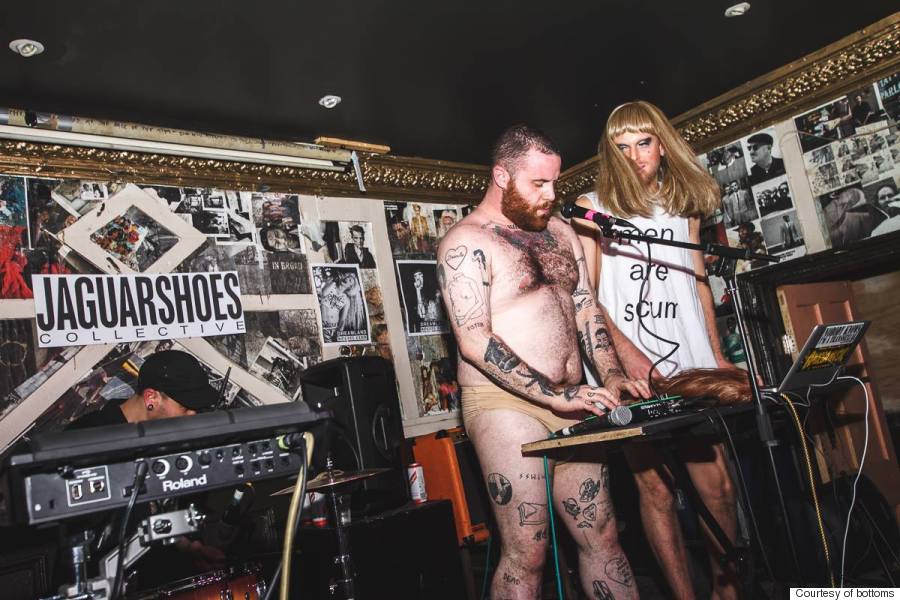
As the nature of what it means to be a queer person shifts and changes with the passing of time, one can only hope that we always have art and performance that accurately reflect the intricate nuances of what these experiences are like — politically, socially, emotionally, physically.
At this strange and complicated period for the queer community, bottoms seems to be accomplishing this in an impressive way that is not only informed by our history with AIDS, persecution and violence but also the current climate of agency and self-identification that parallels mainstream LGBT “acceptance.” We hope to see more work like this from others along the spectrum of queer performance in the future.
bottoms is currently prepping to record the group’s second EP later this summer.. Their first EP, “Goodbye,” can be found here or head here for their Soundcloud.
Missed the previous installments in ASSEMBLAGE? Check out the slideshow below.
— This feed and its contents are the property of The Huffington Post, and use is subject to our terms. It may be used for personal consumption, but may not be distributed on a website.

Thousands of Taiwanese rally for same-sex marriage
Thousands of Taiwanese rally for same-sex marriage
Thousands of gay rights supporters marched between parliament and the headquarters of Taiwan’s two main political parties, months ahead of the elections.
Same-sex marriage is becoming a ‘bigger electoral cause for voters,’ rally organizer Victoria Hsu told Reuters.
‘Young people in particular are fed up with politicians’ silence.’
Led by the Taiwan Alliance to Promote Civil Partnership Rights, the marchers shouted in front of the ruling Kuomintang’s (KMT’s) headquarters, ‘KMT, don’t be the stumbling block in equal marriage rights,’ Focus Taiwan reported.
Hsu, who is a lawyer and head of the alliance, slammed KMT for ‘repeatedly refusing to put the marriage equality bill on the agenda for discussion at the Legislative Yuan’s Judiciary and Organic Laws and Statutes Committee.
‘The final legislative session that begins in September will be the last chance for [the incumbent] lawmakers to review and pass the marriage equality bill,’ she said.
Marchers then headed to the opposition Democratic Progressive Party (DPP) headquarters urging DPP lawmakers, who have proposed the marriage equality bill, to make more effort to push the bill through.
DPP Department of Women’s Development Director Lin Ching-yi, who was there to meet the marchers, said the party has insufficient seats in the committee to do so.

Rally in Taipei for same-sex marriage on 11 July
The rally was scheduled to be held earlier in the month after the US Supreme Court’s decision on 26 June but was postponed out of respect after a devastating explosion the following day at Formosa Coast Fun water park which injured 500 people.
The marriage equality bill, which would legalize same-sex marriage and allow married gay couples to adopt children, was reviewed for the first time at the Judiciary Committee in December last year.
However it has been shelved, largely due to opposition from conservative Christian groups who have formed a network to organize rallies and petition signature collections to lobby against marriage equality.
The post Thousands of Taiwanese rally for same-sex marriage appeared first on Gay Star News.
Sylvia Tan
www.gaystarnews.com/article/thousands-of-taiwanese-rally-for-same-sex-marriage/
Gay couple marries in traditional ceremony in northeastern Thailand
Gay couple marries in traditional ceremony in northeastern Thailand
The northeastern province of Khon Kaen witnessed its first same-sex wedding ceremony on Saturday, reported the English-language Bangkok Post.
The Post reported that Choengchai Plubpiboon, 42, the owner of the stainless steel maker PB Metal Co Ltd, led a traditional ‘khan mak’ engagement procession to the house of his partner Uthane Korasing, 30.
The festivities was attended by family and friends.
Choengchai offered Uthane’s family 1 million baht (US$30,000) and 10 baht-weight of gold ornaments worth 200,000 baht as a dowry, as it is customary for the groom to pay to pay a dowry to the bridge’s family in Thailand, the Post reported.
Thailand does not legally recognize same-sex marriage. The status of the civil union bill, which was reportedly being drafted by Democrat and Pheu Thai parties, is unknown after the May 22, 2014 coup.
Choengchai’s father Thongchai Plubpiboon told the newspaper that his son came out to him 15 years ago.
‘Our family accepts him as he is. He’s hard working and has built a business for the family so that we have everything. What he needed was the right partner,’ the father said.
‘When my son told us he would like to marry Uthane, I was shocked and then I felt happy for him. He finally found a good partner who understands him. I’m very happy for them.’
Two women married in a similar traditional ceremony in the northeastern province of Nakhon Ratchasima last November with the blessings of their families.
A report issued by the US Agency for International Development (USAID) and the United Nations Development Programme (UNDP) last year found that while the tourism authority actively promotes Thailand as a gay-friendly destination, acceptance of LGBTI people in society is still low.
The post Gay couple marries in traditional ceremony in northeastern Thailand appeared first on Gay Star News.
Sylvia Tan
www.gaystarnews.com/article/gay-couple-marries-in-traditional-ceremony-in-northeastern-thailand/
Tribute to Andy Warhol…in my own way!

Roger Rees: 1944-2015
Roger Rees: 1944-2015
Roger Rees, the Tony Award-winning actor with appearances on television programs Cheers and The West Wing, died last night (10 June). His husband, playwright Rick Elice, and family and friends were at his side at his New York City home. The Welsh-born actor was 71. According to a release from O&M Co. the cause was cancer.
Rees’ career started at the Royal Shakespeare Company and he attended the Slade School of Fine Arts. In 1976, he played Malcolm in Trevor Nunn’s stage production of Macbeth. Two years later, he reprised the role for television.
He took the title role in the original production of The Life and Adventures of Nicholas Nickleby, David Edgar’s stage adaptation of the Dickens novel. His performance won him the Olivier and Tony Awards for best actor in 1982.
In 1984, he starred with Sir Laurence Olivier in the television movie The Ebony Tower. From 1988 to 1991 he starred in the sitcom Singles, with co-star Judy Loe. From 1989 to 1991 and in 1993, he appeared on the award winning series Cheers. Later television appearances include substitute teacher Mr. Racine on My So-Called Life, British Ambassador Lord John Marbury on The West Wing, and James MacPherson on Warehouse 13.
Reese was also a presence on the big screen. In 1983 he co-starred with Mariel Hemingway in Star 80. He played the Sheriff of Rottingham in Mel Brooks’ film Robin Hood: Men in Tights (1993). Later film appearances include Frida (2002) and The Prestige (2006).
According to a 2012 profile in The New Yorker, Elice saw Rees in the Broadway production of Nickleby. Describing his future husband as ‘devastatingly beautiful,’ the playwright sent him a letter to invite him to a benefit. Rees did not reply. A year later, after a dress reseal for Cats, the two met again.
‘Standing before me was a six-foot-four, extraordinarily handsome American in a Burberry raincoat,’ Rees recalled to the magazine in 2012. ‘It was the raincoat that did it.’
There was a date, and that led to a long-distance relationship. Rees relocated to New York City in 1995, and the pair lived together. In 2011, two months after same-sex marriage became legal in New York, they married.
Nunn described the actor, in a statement, as ‘inspirational. He had the perpetual boyishness and mischief of a Peter Pan, extraordinary wit combined with a gift for self-satire, and dauntless optimism coupled with deep-rooted belief.’
According to NPR, Sir Patrick Stewart tweeted the following:
Brilliant actor, dear friend and colleague, witty, kind, private man, Roger Rees died this morning. A space is left that cannot be filled.
— Patrick Stewart (@SirPatStew) July 11, 2015
A private funeral service will be held next week; details of a memorial will be forthcoming.
The post Roger Rees: 1944-2015 appeared first on Gay Star News.
James Withers
Budapest Pride 2015

A street artist makes Julius Cesar a queer icon in Rome
A street artist makes Julius Cesar a queer icon in Rome
A rainbow coloured Julius Cesar gazes out atop his famous lines: ‘The die is cast.’
In celebration of LGBTI civil victories across the world, a Roman street artist presented a ‘revised’ portrait of the city’s most famous citizen on Friday.
Mauro Pallotta drew Julius Cesar covered in rainbow colours accompanied by the quote: ‘Alea iacta est’ (the die is cast).
He said: ‘After the historic result of the Supreme Court in the US recently, and the Irish Yes Equality campaign, [I] wanted to reiterate what [Cesar] said first of all: “The die is cast”.’
He was alluding to the momentum the gay rights movement has gained in recent years.
Julius Cesar was born on July 12 100BC. Whether he was a ‘queer icon’ is disputed.
He was not openly homosexual, but suspected to have engaged in affairs with men when young.
During his time as a general, he was teased for a youthful affair he had with a Turkish king: Nicomedes IV.
To taunt him and reduce his credibility, his enemies crafted the phrase: ‘Caesar may have conquered the Gauls, but Nicomedes conquered Caesar.’
Same-sex relationships were tolerated in Cesar’s time and common. However it was considered unmasculine to be the passive partner (‘bottom’), as the chant suggests.
The post A street artist makes Julius Cesar a queer icon in Rome appeared first on Gay Star News.
Jack Flanagan
www.gaystarnews.com/article/a-street-artist-makes-julius-cesar-a-queer-icon-in-rome/
Gay Iconography: Bow Down To Bey
Gay Iconography: Bow Down To Bey

When I started this column in 2013, there was one pop star in particular that inspired my preoccupation with pop stars and the gay men who love them. That star: Beyoncé.
Queen Bey, while widely adored in the gay community, is a divisive figure when it comes to bestowing the title of gay icon. When Beyoncé released her self-titled fifth solo album to widespread critical and commercial success, some members of the LGBTQ community felt a little slighted by the former Destiny’s Child singer. One writer for Slate pointed out that Bey’s failure to acknowledge her gay fans among the album’s strong themes of feminism, empowerment and sexuality. The conversation sparked by the Slate post inspired passionate responses and prompted further examination of how one qualifies as a gay icon. Additionally, as a popular black artist with a large gay fanbase, she was at the center of a debate surrounding gay men misappropriating black female culture.
Throughout her career, however, Bey has shown support for the LGBTQ community. She shared a handwritten message of support for marriage equality to her nearly 40 million Instagram followers. When the Supreme Court decision came down, she shared a special rainbow-themed rendition of her “7/11” video.
In an interview with PrideSource, Beyoncé spoke about her relationship to her gay fans:
“Most of my audience is actually women and my gay fans, and I’ve seen a lot of the younger boys kind of grow up to my music. It’s great when I’m able to do the meet and greets, because I’m able to really connect and have conversations. People look at some of the artists that I admire – like Diana Ross and Cher – and they identity that glamour with Sasha Fierce, and I’ve been really inspired by the language. I have my (gay) stylists and my makeup artist, and all of their stories and the slang words I always put it in my music. We inspire each other.”
Wherever you land on Beyoncé’s place among the pantheon of gay icons like Judy, Barbra and Bette, it’s impossible to deny the impact she’s left in pop culture.
Here are some of our favorite Beyoncé musical moments:
The world first really got to know Her Beyjesty as part of the late-‘90s girl group Destiny’s Child. With hits like “Bills Bills Bills,” “Say My Name,” and “Bootylicious,” Destiny’s Child sold more than 60 million records worldwide. Their track “Independent Women, Pt. 1” (above) was named by Billboard as one of the Top 20 most successful songs of the 2000s.
As a solo artist, Beyoncé has also amassed a massive catalog of hits and awards. She is the second most-honored woman at the Grammys, with 20 statues earned for work with Destiny’s Child and a solo artist. One of her most enduring anthems, “Single Ladies (Put A Ring On It)” inspired countless recreations across YouTube. It was a central performance on Glee, and was even covered by one of the grande dame gay icons Liza Minnelli in the sequel to the Sex And the City movie.
She paired with Mother Monster herself, Lady Gaga, for their duet “Telephone.” The cinematic music video, above, was named the best video of the decade (so far) by Billboard.
If there was ever a reason to tune into the typically tedious Super Bowl halftime show, it would’ve been for Beyoncé. When she took to the field halfway through the game at the Mercedes-Benz Superdome in 2013, she set the stage ablaze with a blistering performance. The incredible medley of hits (including former Destiny’s Child bandmates Michelle Williams and Kelly Rowland shooting up from under the stage) is one of the most tweeted-about moments in history, garnering an astonishing 268,000 tweets per minute.
As she describes on Nicki Minaj’s track “Feeling Myself,” Mrs. Carter “changed the game with that digital drop.” She’s referring to the surprise release of her masterpiece of a fifth album that arrived with no prior promotion, breaking the mold of typical album release strategy. On top of the self-titled disc’s revolutionary arrival, she also released beautifully shot videos for every single track simultaneously.
What do you think? Is Beyoncé a worthy gay icon?
The post Gay Iconography: Bow Down To Bey appeared first on Towleroad.
Bobby Hankinson
bristol pride 2015

