Adam Carolla Says He's 'Done Apologizing' For Jokes About Race And Sexuality

Adam Carolla Says He's 'Done Apologizing' For Jokes About Race And Sexuality
Adam Carolla is not sorry about his jokes that others find offensive.

When he stopped by HuffPost Live on Thursday to chat about the new film “Road Hard,” which Carolla co-wrote, co-directed and stars in, the comic responded to a viewer who asked for his take on Calling Out Carolla, a Tumblr blog that documents “anti-LGBT language” Carolla has used.

“Go find a politician or somebody who’s in charge and poke a popsicle stick up their butt,” Carolla answered. “I’m a comedian. I’m done apologizing, I really am. … And by the way, everyone who apologizes is faking it. They’re only doing it because they’re gonna get canned.”

Carolla added that he doesn’t feel responsible for how anyone interprets the things he says.

“You are in charge of your own feelings. I’m not in charge of your feelings. I’m here to make jokes. I’m here to make commentaries. I’m here to share my opinions,” he said. “Tough shit if you don’t like it.”

When host Josh Zepps suggested that activist groups may find Carolla’s jokes about race or sexuality offensive because he’s a straight white man, Carolla rejected the idea that “white privilege” colors his work.

“I worked cleaning up garbage on construction sites. I got welfare and food stamps. I was as poor as it could be,” Carolla said. “And there’s no, ‘Oh, you don’t have to dig because you’re white.’ … There’s no, ‘You don’t have to pick up garbage because you’re white.’ No, you pick up garbage because you’re poor. You guys focus on color. Focus on poverty.”

Carolla’s problem with the outraged response to jokes made by himself or other comedians is that he feels it distracts from truly harmful comments.

“There’s never been a better time in this country’s history to actually be a racist, because I’m a racist, according to you guys. So if I’m a racist — a guy who’s never done anything bad to any race — and you get to go be a racist too, and I’ll be the racist and I’ll take the heat [in the media],” Carolla said. “If you’re an actual racist, these are your salad days, because you’re busy pointing at comedians, calling them racist.”

The comedian closed out the discussion by saying society should turn its focus from entertainers to people who actively seek to damage minority groups.

“If you want to treat it like a problem — and it is a problem — let’s focus on where the problem is. Who are the actual racists? What is the actual homophobia?” he said. “I’m with you. I’ll grab a pitchfork and be with you.”

Watch Adam Carolla’s full HuffPost Live conversation.

Sign up for Live Today, HuffPost Live’s morning email that will let you know the newsmakers, celebrities and politicians joining us that day and give you the best clips from the day before!

www.huffingtonpost.com/2015/03/06/adam-carolla-done-apologizing_n_6811940.html?utm_hp_ref=gay-voices&ir=Gay+Voices

Meet 'The Check It', America's Only Documented All-Gay Gang: VIDEO

Meet 'The Check It', America's Only Documented All-Gay Gang: VIDEO

Checkit

Filmmakers Toby Oppenheimer and Dana Flor spent the last three years documenting America’s only all-gay or trans gang, a group of approximately 200 African-American teens in Washington D.C. called ‘The Check It’, according to a crowdfunding appeal for their new film.

WarrenThe film follows three bullied teens and tells the story about how they started the gang, VICE reports:

The group formed to provide members safety in numbers and let people know that if you jumped a gay kid in DC, you’d likely get jumped back in retaliation. … Unlike other gangs, the Check It aren’t tied to a specific geographic location. They hang out at each others’ houses, mostly, as well as a local Denny’s and the Chinatown and Gallery Place Metro stations. And they didn’t have to do much to spread their name. A local go-go band called ReAction wrote a song about the gang and name-checked individual members. That meant people like [Trayvon] Warren (pictured) had a certain amount of notoriety, which allowed him to go to pretty much any neighborhood in DC without people giving him much trouble for being, as he and his friends put it, “faggie.”

Write the filmmakers:

At first glance, The Check It, our documentary subjects, seem to be unlikely gang–bangers.  Some of the boys wear lipstick and mascara, some stilettos. They carry Louis Vuitton bags, but they also carry knives, brass knuckles and mace.  As vulnerable gay and transgender youth, they’ve been shot, stabbed and raped.

Once victims, they’ve now turned the tables, beating people into comas and stabbing enemies with ice picks. Started in 2005 by a group of bullied 9th graders, today these 14–22 year old gang members all have rap sheets riddled with assault, armed robbery and drug dealing charges.

Led by an ex-convict named “Mo,” The Check It members are NOW creating their own clothing label, putting on fashion shows and working stints as runway models. But breaking the cycle of poverty and violence they’ve grown up in is a daunting task. So when The Check It are not taking small steps forward on the catwalk, they too often take massive steps backwards. CHECK IT captures the struggles and setbacks, but also the progress and triumphs of these kids.

The doc is produced by RadicalMedia and actor Steve Buscemi.

Watch their trailer, AFTER THE JUMP

2_checkit


Andy Towle

www.towleroad.com/2015/03/thecheckit.html

8 Revelations About 'House Of Cards' From Creator Beau Willimon

8 Revelations About 'House Of Cards' From Creator Beau Willimon
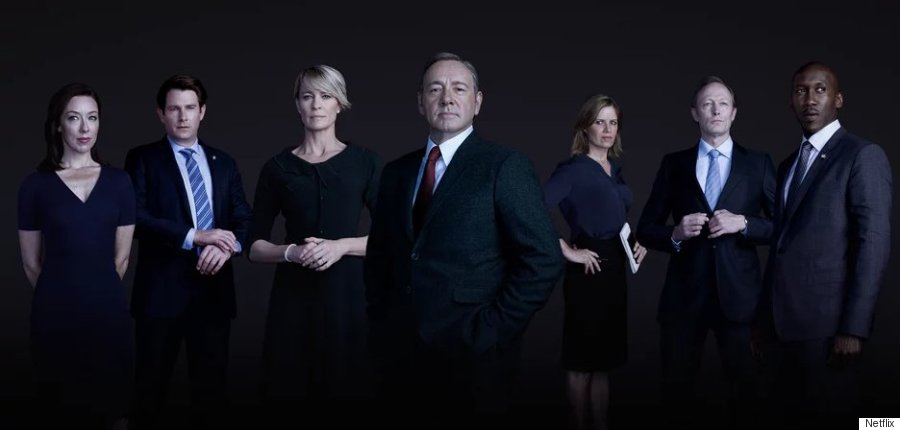
The third season of “House of Cards” premiered on Netflix last week. And while most fans — guilty — have likely binged through all 13 episodes already, the experience was undoubtedly a different one than before: a slower pace and lack of eye-popping moments distinguished Season 3 from its scandalous, murderous predecessors.

To unpack all of the marital drama, sexual intimacy and tonal shifts in the new season, The Huffington Post hopped on the phone with “House of Cards” creator and executive producer Beau Willimon to discuss everything from Frank’s ambiguous sexuality to the Underwood’s first-ever sex scene.

Spoiler alert for all of “House of Cards” Season 3.
hoc cast

1. Making Season 3 different was intentional
“In the first two seasons we devoted a lot of time to Frank and Claire’s political effort. What we really wanted to focus on this season — because now they’re at the top of the mountain and there’s nowhere higher to ascend — is how these characters feel about that. The stress that it puts upon them and their marriage helped us discover new layers that we haven’t had access to before. […] I think that if Frank wasn’t on the ropes in Season 3, that would’ve been false. […] From where we stand, if we didn’t try that then we would be getting comfortable in the groove and not challenging ourselves or the audience.”

2. Frank’s sexuality is supposed to be ambiguous
“People have asked me straight up, ‘Is Frank Underwood bisexual? Is he gay?’ And I don’t think Frank Underwood really puts much stock in those sort of labels. As he says in the Sentinel episode [in Season 1], ‘When I’m attracted to someone, I’m attracted to them. Period.’

“He’s a man with a large appetite, he’s a man who does not allow himself to be placed in any sort of milieu or with one definition. I think he’s incredibly guarded with who he lets get close to him, whether that’s platonic or whether that’s sexual. And when he does, it’s not necessarily a gender or preference, it really has to do with trust. There’s very few people in this world that we’ve created that he can trust. […] We try to approach Frank the way he approaches himself, which is not to sort of pin him down.”
yates

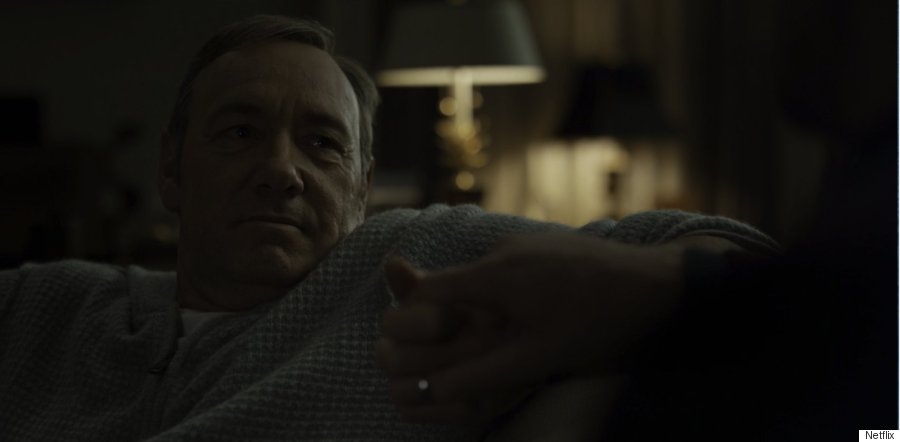
3. What did that intimate moment between Frank and Thomas Yates really mean?
“It’s an emotional connection. Not necessarily a sexual one, but it could be. It depends on how you look at that moment and I think there’s a lot of grey area there. […] At least for that moment, he can trust Thomas Yates, whether it evaporates quickly or not.”

4. We finally saw Frank & Claire have sex … but it wasn’t about sex
“In that scene Frank is perhaps the most vulnerable we’ve ever seen him and Claire recognizes that. Not to sound a little flippant about it, but she’s fucking the hope back into him, and the strength. We see the strength move from her to him. Sex is one way to do that.”
claire bed

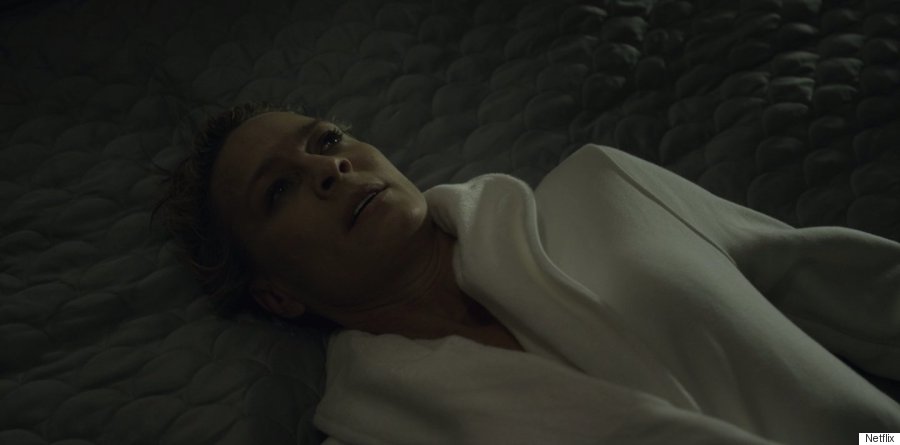
5. But wait, what was that almost-rough-sex scene about?
“Later in the end of the season, we see it reversed. Claire wants Frank to fuck her, to be rough with her and sort of shake her out of this limbo that she’s in. And he doesn’t, in a way, return the favor. There you see the failure to consummate that moment, being one of many things that leads to the end of the season.

I often talk about love as being a transactional thing in the sense that if I give you my love, I expect your love in return. If I give you my vulnerability, my hope is that I will get your strength in return, and vice versa. That’s a good kind of transaction and more often than not, that’s the kind of transaction we see with the Underwoods. The problem is when that transaction breaks down and you’re not getting the love or strength you need in return, you’re vulnerability is simply vulnerability with no return on it. That’s when you see a union start to dissolve.”

6. So why did Frank reject Claire?
“It’s a difficult scene to jump on the phone and analyze without robbing it of its power. But if you put yourself in Frank’s shoes, this is coming out of the blue. This is a violent moment psychologically, emotionally, physically. You can’t necessarily blame him for not wanting to treat his wife the way she’s asking him to be treated.

“David Fincher told me this maxim and it’s so true and one of the best writing lessons I’ve ever learned: In a great scene everyone is right. And I think they’re both right in that scene. She needs something, something that is beyond language, something that is primitive and even violent. What he needs is order, he doesn’t need more chaos. He doesn’t need this violence. He is put off balance by it. You can’t blame him for that. When both people are right, but not right to each other, then you have conflict.”

7. No, Frank isn’t a sociopath. He can feel empathy
“We’ve seen Frank show his human side a lot. We’ve seen how strong of a connection he had with Tim Corbet. We’ve seen the way his friendship developed with Meechum and then in this season with Thomas Yates. Even when Peter Russo met his end, in his own sort of perverse way, Frank would’ve called that a mercy killing. He would’ve felt he was relieving this person of suffering.

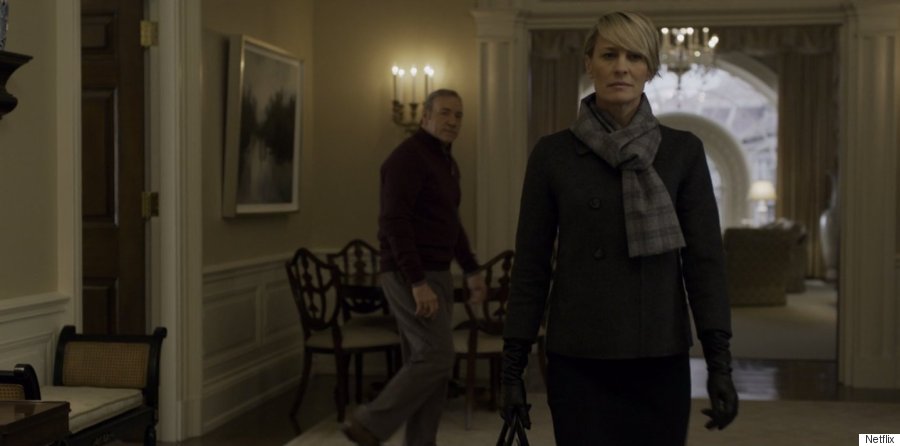
“The big difference [between Frank and Claire] that you see in the sixth episode of Season 3 is that Claire, for the first time allows that side of her to display itself on the world’s stage, literally. Where Frank may have empathy, he also has an incredible ability to compartmentalize it, to compress it, to make sure it doesn’t threaten his goals. The reason he’s so upset with Claire is she allowed her empathy to derail something they’d both been working towards.”
clare leaves

8. If there’s a Season 4, can the Underwoods possibly exist without each other?
“If there is a subsequent season that’s precisely the question one should be asking. […] I think [Claire] is very much in love with her husband when we start this series, and she may still be in love with him when we get to the final episode of Season 3. But this union is not making her the person she wants to be. And maybe this man is no longer the man that she needs in order to fully be her complete realized self. That’s where we leave it.”

“House of Cards” Season 3 is now streaming on Netflix.

www.huffingtonpost.com/2015/03/06/house-of-cards-beau-willimon-frank_n_6810828.html?utm_hp_ref=gay-voices&ir=Gay+Voices

Matt Baume's Field Guide for Spotting Sneaky Homophobic Laws (And How to Stop Them) – VIDEO

Matt Baume's Field Guide for Spotting Sneaky Homophobic Laws (And How to Stop Them) – VIDEO

Baume

In a special two part video, Matt Baume takes viewers on a safari adventure through the country as he points out the four major types of anti-LGBT laws that are stealthily stealing away civil rights for everyone and what we can all do to stand up to this homophobic backlash.

Said Baume:

“Anti-gay discrimination is going extinct. But it’s not going without a fight. A beast is at its most desperate when its facing starvation. So it will do anything to adapt, to survive, and to pass itself on to the next generation.”

Check it out, AFTER THE JUMP

Previously, “Matt Baume Tackles Arkansas’ New Anti-LGBT Law and the Terrifying Roadmap Towards Future Discrimination” [tlrd]


Kyler Geoffroy

www.towleroad.com/2015/03/baumefieldguide.html

WATCH: A Field Guide to Spotting and Stopping the Homophobic Laws Coming to Your Home State

WATCH: A Field Guide to Spotting and Stopping the Homophobic Laws Coming to Your Home State
Don’t look now, but while marriage equality has been spreading across the country, homophobic lawmakers have found a sneaky new way to chip away at civil rights. And not just gay and lesbian civil rights — EVERYONE’S civil rights.

In some cases, they’re passing laws that actually make nondiscrimination against the law. It sounds nuts, but it’s happening right now, and almost nobody’s paying attention.

This is happening because the opponents of marriage equality have finally realized that they’re going to lose. Their backup plan? Pass laws that quietly revoke civil rights across the board, hitting gays and lesbians and everyone else along the way.

In Alabama, for example, Republican State Rep. Mike Ball just proposed HB56, a new law that would allow religious groups to disregard the marriage of any couple they don’t approve of.

He says it’s “not a major change in the law.” But the truth is that it creates a special new license to discriminate. It could be used by hospitals to stop couples from making medical decisions for each other. Or it could force married couples apart at homeless shelters. Mike Ball’s target is probably gay couples, but his law could also be used against interracial couples, or interfaith couples, or anyone with a previous marriage.

Different states are considering over two dozen laws like these around the country. And they’re hard to spot, since they’re usually cloaked in feel-good terms like “religious liberty” or mundane language like “commerce improvement.”

But like the telltale droppings of a rodent infestation, once you know what to look for, you can spot them with ease.

I made this video to explain exactly what these laws do, and how to identify them:

But if you’re in a hurry, here’s what you need to be on the lookout for:

  • Government-Required Discrimination: Laws that require government employees to turn away gay and lesbian couples. Any county clerk who does the right thing and helps an LGBT couple wed will lose their salary and pension.
  • Random Public Discrimination: Imagine if any time you needed a public service, you could be randomly turned away — whether it was riding the bus, asking police for help, or getting a tax refund. These laws let any public employee decide whether or not to help you.
  • Religious Lawbreaking: Some politicians have latched onto a few bakers and florists and photographers who don’t approve of gay and lesbian weddings, and created laws that give those businesses permission to discriminate against LGBTs. But the new exemptions actually go much further, letting any person or business break all kinds of laws, as long as they can claim they’re doing it for religious purposes.
  • Banning Nondiscrimination: This is the most jaw-dropping of all. When these laws pass at the state level, they prohibit towns from providing any new nondiscrimination protection. Once again, LGBTs are the target, but other groups — such as the elderly or veterans — are affected too.

So, obviously, this is a huge looming catastrophe that could do a ton of damage — it’s like the global warming of civil rights.

The good news is that because these laws rely on secrecy, they can be defeated, in part, by exposing their true purpose. I made a second video explaining five simple steps you can take to stop the homophobic backlash:

To sum it up:

  1. Be out. If it’s safe for you to be openly LGBT, do it. And if you’re a straight ally, be out about that too.
  2. Listen to Opponents. When people who oppose nondiscrimination laws talk about things that are important to them (like their job, their home, their marriage, their education, or their family), listen and ask questions.
  3. Tell Your Story. Once you’ve listened to someone talk about the things that matter to them, tell them how you could lose all of those things if these anti-civil-rights laws pass.
  4. Be Vigilant. Watch out for these dangerous laws popping up in your home state. In fact, they may already have been proposed — check the first video above to see if yours is on the map.
  5. Make a Fuss. If a dastardly lawmaker in your state proposes a law like these, don’t let them get away with it. Sound the alarm on social media, make a video about the freedoms you stand to lose, or start a petition.

These tactics were proven to be super-effective with marriage equality, which is why national public opinion has flipped in the span of about a decade.

Homophobic lawmakers know that the tide is turning against them, and these laws are disguised for precisely that reason: their authors know that if people found out what they REALLY do, they’d be a lot less popular.

And that means that discriminatory laws can be defeated, in the same way that marriage bans were defeated. The first step is simply shining a light on them.

www.huffingtonpost.com/matt-baume/watch-a-field-guide-to-sp_b_6814564.html?utm_hp_ref=gay-voices&ir=Gay+Voices